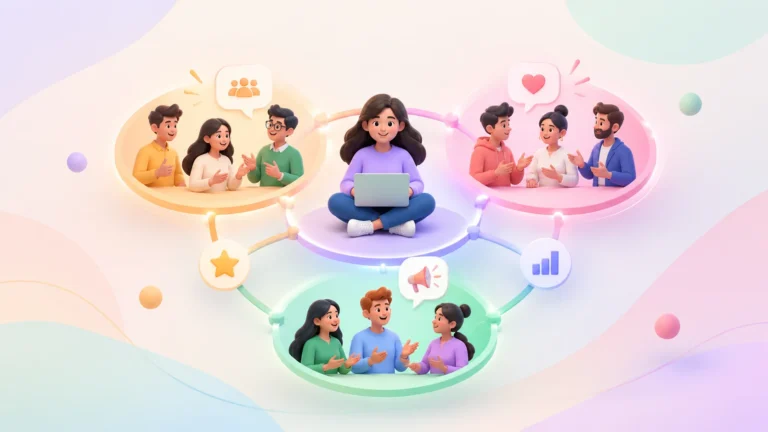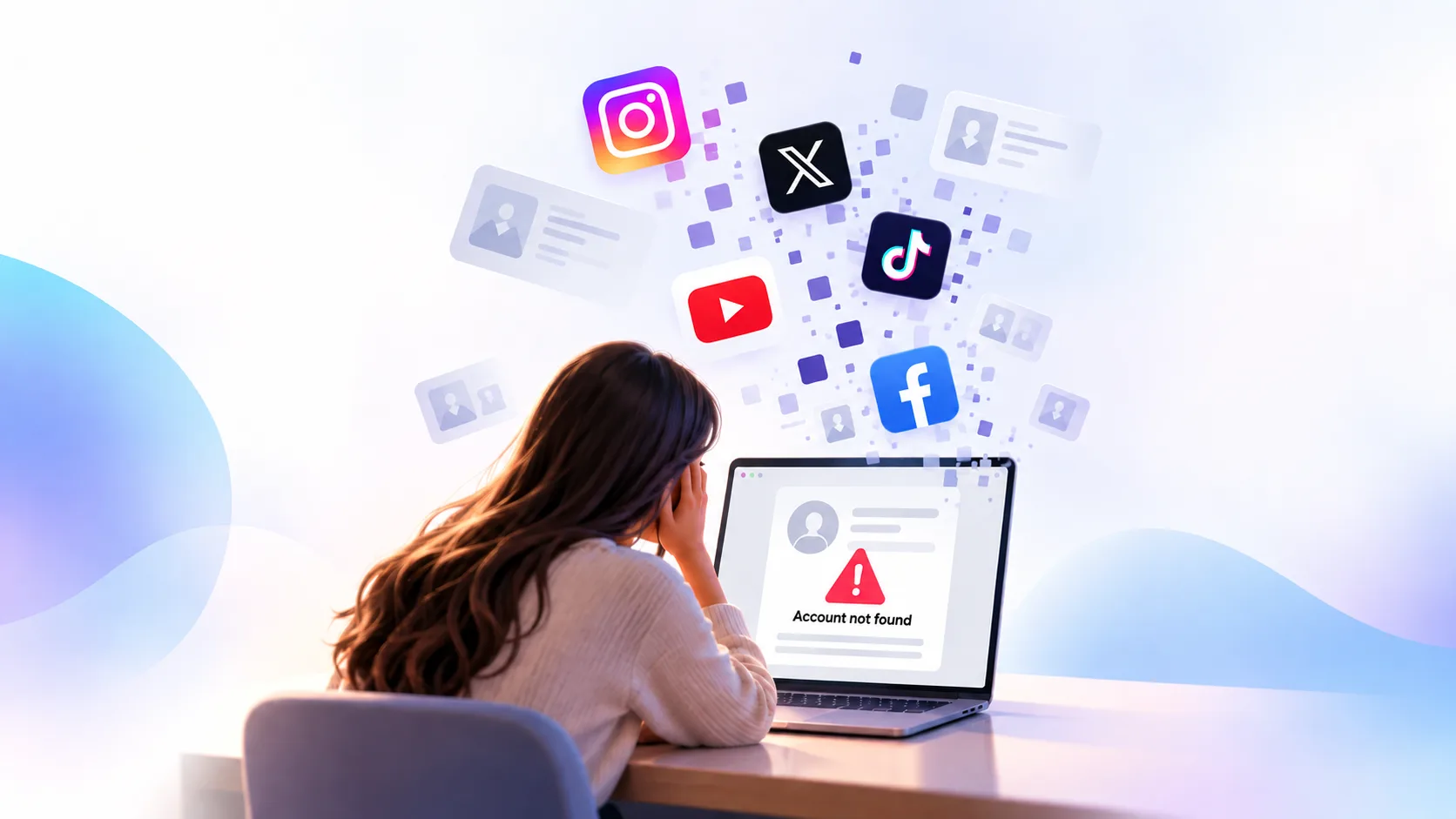
Imagine spending years building followers, publishing content, and creating engagement—then one day your social media account disappears.
Losing a social media account is not simply about losing access to a profile. It can affect your audience reach, published content, communication, community interactions, brand visibility, and the relationships you have built with your audience.
The bigger question is not only, “What happens if my account disappears?” It is also, “What happens to the audience relationship if the platform becomes unavailable?”
For brands and creators that depend heavily on third-party platforms, understanding social media platform risk and building additional ways to connect with an audience can help reduce dependency on a single platform.
What Happens When Your Social Media Account Disappears?
When a social media account disappears, you may lose access to your profile, published content, followers, messages, engagement history, and the ability to communicate with your audience through that account. The exact impact depends on whether the account was suspended, deleted, hacked, restricted, or permanently removed by the platform.
The larger concern for brands and creators is platform dependency. Your audience may interact with you through a social platform, but the platform controls the infrastructure, account access, policies, and many aspects of the user experience.
Why Can a Social Media Account Disappear?
A social media account can become unavailable for several different reasons. Not every disappearance means the account has been permanently deleted.
Account Suspension
Platforms may suspend accounts temporarily or permanently when their systems or moderation processes identify potential violations of platform rules.
Account Deletion
An account may be voluntarily deleted by its owner or removed by the platform. Deletion can affect access to the profile, content, followers, and previous interactions.
Hacking or Account Takeover
If someone gains unauthorized access to an account, the original owner may temporarily lose control of the profile. The attacker may also change account details, publish unauthorized content, or restrict the owner’s access.
Policy or Terms Violations
Social platforms operate under their own terms, policies, and enforcement systems. Violations can result in restrictions, suspension, or removal depending on the platform and circumstances.
Technical or Platform Issues
Temporary technical problems, outages, authentication errors, or account-related issues can sometimes prevent users from accessing their accounts.
Platform Changes
Social platforms can change their features, policies, algorithms, access conditions, or account requirements. These changes can affect how brands and creators communicate with their audiences.
What Happens to Your Followers When Your Account Disappears?
When an account becomes unavailable, followers may no longer be able to access the profile, view its content, or interact with it.
Communication can also be interrupted. A follower count may represent a large audience, but it does not necessarily mean that a brand or creator has a direct, independent relationship with every person who follows the account.
Access to audience insights and historical engagement information may also be affected depending on the platform and the status of the account.
This is why owning your community data and building relationships beyond a single social platform can be an important consideration for organisations developing long-term community strategies.
Do You Own Your Social Media Followers?
Not in the same way that you control the environment of an independently managed community.
Social media followers are people using a third-party platform. Following a brand or creator does not give that organisation unrestricted ownership of those individuals or their personal information.
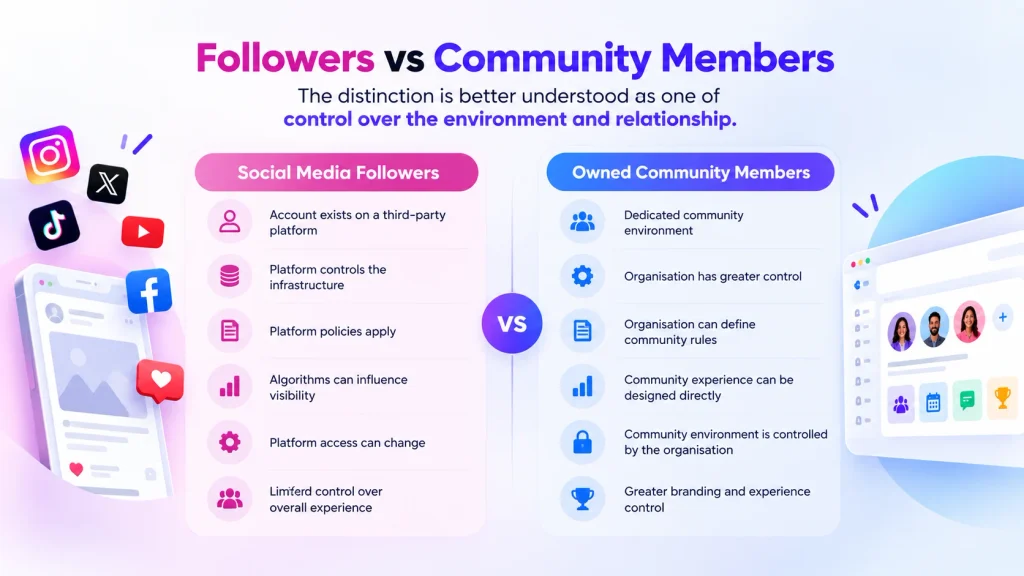
| Social Media Followers | Owned Community Members |
|---|---|
| Relationship exists on a third-party platform | Members participate in a dedicated community environment |
| Platform controls the infrastructure | Organisation has greater control over the community environment |
| Platform policies apply | Organisation establishes community rules |
| Algorithms can influence visibility | Organisation can design the community experience |
| Platform access can change | Community environment is managed by the organisation |
| Overall experience is influenced by the platform | Branding and experience can be more directly controlled |
An owned community does not mean an organisation automatically owns members’ personal information. It means the organisation can have greater control over the community environment and can build responsibly managed, consent-based first-party relationships and insights.
What Happens to Your Social Media Content?
The impact on content depends on why and how the account becomes unavailable.
Posts
Previously published posts may become inaccessible if the account is suspended, deleted, or permanently removed.
Videos and Images
Videos, images, and other media hosted on the platform may no longer be accessible through the account.
Comments and Conversations
Comments, replies, and previous conversations can become difficult or impossible to access when the account is unavailable.
Messages
Direct messages and other platform-based communication can be interrupted when account access is lost.
Analytics and Insights
Historical audience information, engagement data, and analytics may also become unavailable depending on the platform, account status, and available recovery options.
For this reason, organisations should consider maintaining appropriate backups of important content and records rather than relying entirely on one platform.
The Bigger Problem: Social Media Platform Dependency
Social media can be an effective channel for reaching audiences, distributing content, and creating awareness. The challenge arises when an organisation depends entirely on social media as its community infrastructure.
Platform dependency can involve:
- Algorithm changes
- Platform policy changes
- Account restrictions
- Changes in organic reach
- Fragmented communication
- Limited control over the user experience
- Dependence on third-party infrastructure
The goal does not have to be abandoning social media. Instead, organisations can use social platforms as one part of a broader audience and community strategy.
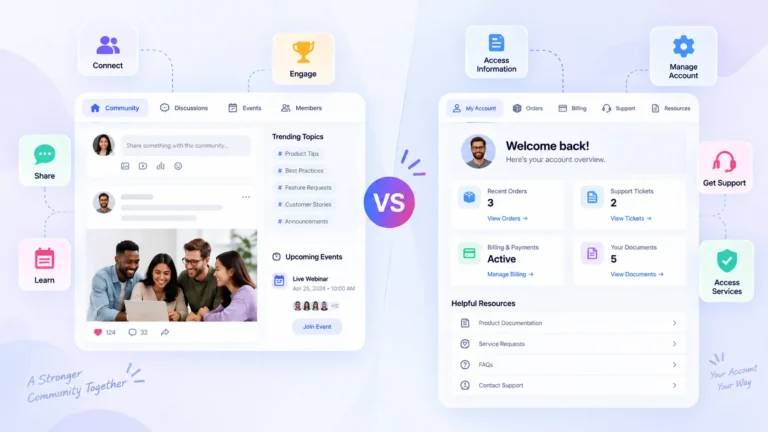
Followers vs Community Members: What’s the Difference?
Followers and community members can both be valuable, but they represent different types of audience relationships.
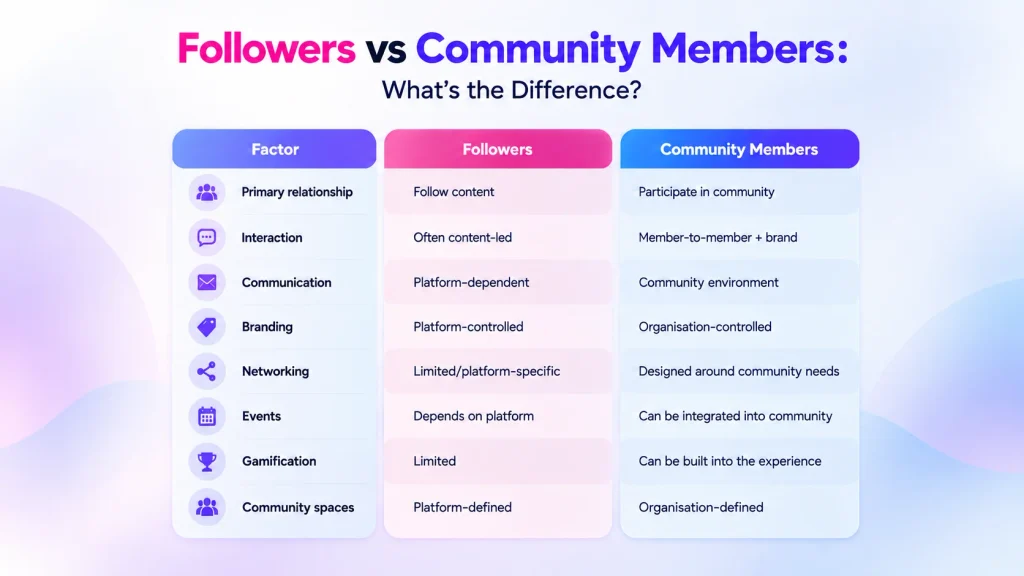
| Factor | Followers | Community Members |
|---|---|---|
| Primary relationship | Follow content | Participate in a community |
| Interaction | Often content-led | Member-to-member and brand interaction |
| Communication | Platform-dependent | Takes place within a community environment |
| Branding | Influenced by platform design | Organisation has greater branding control |
| Networking | Platform-specific | Can be designed around community needs |
| Events | Depends on platform capabilities | Can be integrated into the community |
| Gamification | Depends on platform | Can be designed into the experience |
| Community spaces | Platform-defined | Organisation-defined |
This does not mean one approach has to replace the other. Social media and dedicated communities can serve different stages of the audience journey.
What Is an Owned Community?
An owned community is a dedicated digital environment where an organisation creates and manages a community experience around its brand, members, content, and objectives.
Depending on the platform, an owned community can include:
- Branded environments
- Member profiles
- Discussions
- Networking
- Events
- Content
- Community management
- Engagement features
- Analytics
- Moderation
Organisations looking to create a branded environment can explore branded community strategies to create a structured space where members can interact beyond the limitations of a traditional social media feed.
Should You Stop Using Social Media?
No. Social media can still play an important role in audience discovery, awareness, content distribution, and brand visibility.
A more balanced approach is to use different channels for different purposes:
Social Media → Discovery
Owned Community → Deeper Participation
Community → Relationships
Social media can introduce people to a brand or creator, while a dedicated community can provide additional opportunities for conversations, networking, events, participation, and long-term engagement.
What Should Creators Do If Their Social Account Disappears?
Creators who depend heavily on one social platform can take several practical steps to reduce platform dependency.
1. Maintain Owned Communication Channels
Develop communication channels that are not dependent on one social account.
2. Build an Independent Community
Create a dedicated environment where interested followers can participate beyond the social platform.
3. Encourage Followers to Join the Community
Give highly engaged followers clear reasons to participate in a community, such as discussions, networking, events, exclusive content, or recognition.
4. Maintain Content Backups
Keep appropriate backups of important videos, images, articles, and other content assets.
5. Maintain Consent-Based Audience Information
Where appropriate, maintain relevant audience or member information through systems that follow applicable privacy and consent requirements.
6. Build Relationships Beyond One Platform
Avoid making one social network the only place where audience relationships exist.
7. Use Social Media as a Discovery Channel
Social media can continue to play an important role in attracting new people while the community provides another environment for deeper participation.
For creators looking to develop this model, a dedicated creator community can provide a structured environment for moving beyond a follower-only relationship.
What Should Businesses Do If Their Social Account Disappears?
For businesses, losing access to a social account can affect customer communication, campaigns, content access, social proof, announcements, and audience reach.
Potential consequences include:
- Interrupted customer communication
- Reduced audience reach
- Loss of access to published content
- Disruption to social campaigns
- Difficulty communicating announcements
- Potential loss of historical engagement information
A dedicated customer or community environment can provide an additional channel for communication and participation alongside social media.
The purpose is not necessarily to replace every social interaction. Instead, businesses can create another environment where customers, members, advocates, or other stakeholders can participate directly.
How Can You Reduce Your Dependence on Social Media?
1. Build an Owned Community
Create a dedicated environment where members can communicate, participate, and interact around a shared purpose.
2. Keep Social Media Active
Continue using social channels for discovery, awareness, content distribution, and audience acquisition.
3. Diversify Communication
Avoid depending on a single platform for every audience interaction.
4. Back Up Important Content
Maintain appropriate copies of important content and digital assets.
5. Develop Direct Member Relationships
Create opportunities for meaningful participation beyond likes, follows, and comments.
6. Create Community Spaces
Give members dedicated spaces for discussions, networking, events, and collaboration.
7. Track Community Engagement
Use appropriate analytics and first-party insights responsibly to understand participation and community activity.
Social Media vs Owned Community
Social media and owned communities can work together while serving different purposes.
| Area | Social Media | Owned Community |
|---|---|---|
| Discovery | Strong | Can support referrals and discovery |
| Audience relationship | Platform-mediated | More direct |
| Branding | Platform constraints | Greater control |
| Algorithm dependency | Higher | Lower |
| Community structure | Platform-defined | Organisation-defined |
| Member interaction | Available | Community-focused |
| Events | Platform-dependent | Can be integrated |
| Gamification | Platform-dependent | Can be designed into the experience |
| Analytics | Platform-specific | Community-specific |
| Governance | Platform rules | Organisation-defined rules |
The practical approach for many organisations is not an either/or decision. Social media can support discovery while a dedicated community provides additional space for participation and relationship building.
How Can an Organisation Move From Followers to Community Members?
A simple audience journey can look like this:
Social Content
↓
Interested Follower
↓
Community Invitation
↓
Member Registration
↓
Community Participation
↓
Contribution
↓
Recognition
↓
Long-Term Community Relationship
Social media can remain the top-of-funnel discovery channel. People who want deeper interaction can then be introduced to a dedicated community where they can participate in discussions, events, networking, content, and other community activities.
How Thrico Helps Organisations Build Their Own Community
Thrico is a community platform designed to help organisations create branded environments where members can connect, participate, communicate, and engage.
Instead of treating social media as the only destination for audience interaction, organisations can use a dedicated community environment to bring together capabilities such as:
- Communities
- Member profiles
- Connections
- Content
- Conversations
- Events
- Gamification
- Rewards
- Networking
- Analytics
- Community management
The Thrico community platform approach allows organisations to create a dedicated digital environment around their community goals while continuing to use external channels such as social media for discovery and awareness.
What Features Should an Owned Community Have?
The right feature set depends on the organisation’s goals, audience, and community model. Common capabilities include:
Member Profiles
Profiles allow members to represent themselves and discover relevant people within the community.
Communities and Groups
Groups and community spaces can organise members around interests, locations, departments, topics, or objectives.
Feed and Content
A community feed can provide a central place for updates, articles, announcements, media, and other content.
Discussions and Chat
Communication features can support conversations between members and organisations.
Events
Event functionality can help organisations manage community activities, meetings, webinars, and other experiences.
Networking
Networking features can help members discover and connect with relevant people.
Gamification
Gamification can introduce participation mechanisms such as points, achievements, badges, or recognition.
Rewards
Reward systems can be used to recognise meaningful participation and encourage continued engagement.
Analytics
Analytics can help community managers understand participation and engagement patterns.
Moderation
Moderation tools help organisations maintain community standards and manage interactions.
Branding
Branding capabilities allow organisations to create an environment aligned with their identity.
Roles and Permissions
Roles and permissions can help define what different members, administrators, moderators, and other users can access.
Integrations
Integrations can connect the community environment with other systems and workflows where required.
Community Platform Features That Help Reduce Social Media Dependency
A community platform can provide capabilities that are difficult to structure around a traditional social media profile alone.
These can include dedicated member spaces, discussions, networking, events, gamification, content management, moderation, branding, analytics, and role-based access.
When evaluating these capabilities, organisations should consider the community platform features that align with their specific audience and objectives rather than choosing a platform based only on the number of available features.
Should You Move All Your Social Media Followers to a Community?
No. The objective does not necessarily need to be moving every follower from social media into a community.
A more practical approach can be:
- Use social media for reach.
- Identify highly engaged followers.
- Invite interested people into the community.
- Provide meaningful community value.
- Encourage participation.
- Recognise contributions.
- Develop ongoing member relationships.
This creates a complementary model in which social media continues to support discovery while the community provides another environment for deeper participation.
What Happens If Your Social Media Account Disappears? — Key Takeaways
- You may lose access to your profile and published content.
- Communication with followers can be interrupted.
- Followers may no longer be reachable through the account.
- Historical engagement and insights may be affected.
- Platform policies and access conditions can change.
- Social media does not necessarily need to be abandoned.
- Businesses and creators can reduce dependency by developing additional communication and community channels.
- An owned community can provide greater control over branding, member experience, and community operations.
Frequently Asked Questions
A disappearing account can result in loss of access to the profile, content, followers, messages, and platform-based audience engagement. The exact impact depends on why the account became unavailable and the platform’s recovery or appeal processes.
Followers may no longer be able to access the account or interact with it, and the account owner may lose the ability to communicate with them through that platform.
Yes. If an account is deleted, suspended, or permanently inaccessible, the account owner may lose practical access to its follower base through that platform.
Followers are people using the social platform. Having a follower relationship does not give an organisation unrestricted ownership of those individuals or their personal information.
An owned community is a dedicated environment managed by an organisation where members can interact, participate, communicate, and build relationships around a shared purpose.
Businesses can use social media for discovery and awareness while developing additional channels for deeper customer and community relationships.
Creators can diversify their communication channels, back up important content, and build a dedicated community where they can develop more direct relationships with members.
Followers primarily follow content on a platform, while community members can participate in a dedicated environment through discussions, events, networking, content, and other activities.