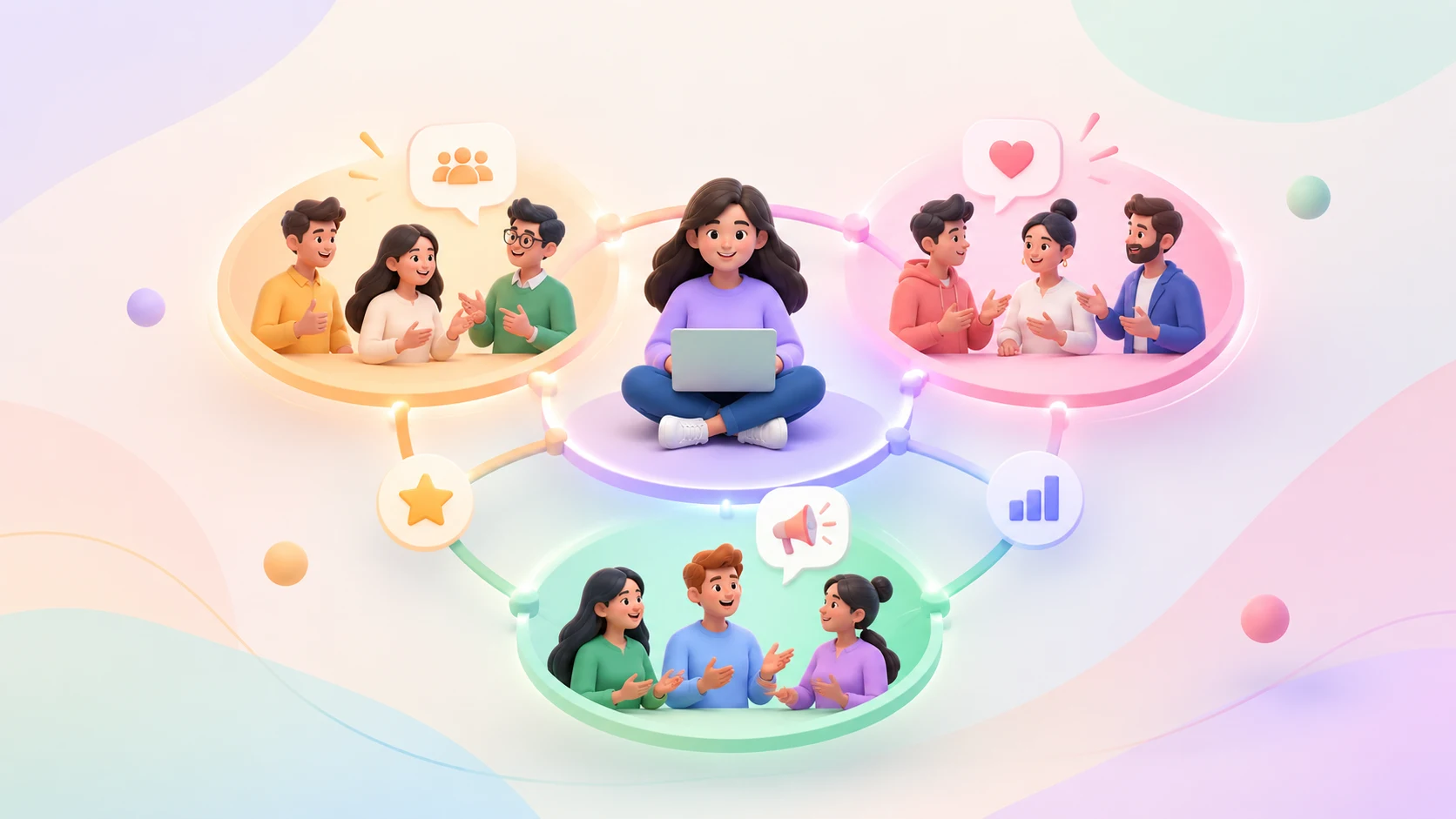
Modern organisations rarely interact with just one type of audience. Employees, customers, partners, advocates, members and brand audiences all play different roles in the growth of an organisation.
The challenge is that these relationships are often managed through separate platforms. Employee communication may happen through an internal system, customer conversations through another platform, social engagement somewhere else, and advocacy through individual campaigns.
This can create fragmented experiences and make it difficult to understand how different audiences interact with the organisation.
A connected approach asks a different question:
What if employee engagement, customer engagement and brand advocacy could operate as connected community experiences within one ecosystem?
A modern community platform can provide the infrastructure needed to bring these experiences closer together while still allowing organisations to create different journeys, permissions, content and engagement programmes for different audiences.
Thrico follows this approach by providing community infrastructure that can support employees, customers, advocates, partners, members and other stakeholder groups within a broader community ecosystem.
Why Employee, Customer and Brand Communities Are Becoming Connected
Employees and customers may have different objectives, but their relationship with an organisation is not always completely separate.
Employees can become advocates. Customers can become contributors. Community members can create content, provide feedback, participate in events and recommend a brand to others.
When these relationships are viewed as connected parts of a broader ecosystem, organisations can create more opportunities for participation and advocacy.
Employees Build the Internal Community
Employee communities can support more than internal communication.
They can provide spaces for:
- Employee communication
- Collaboration
- Knowledge sharing
- Recognition
- Employee-generated content
- Internal discussions
- Challenges and activities
- Employee advocacy
The goal is to move from one-way communication towards active participation.
Instead of simply receiving company updates, employees can contribute knowledge, recognise colleagues, participate in discussions and become active participants in the organisation’s community.
Customers Build the External Community
Customer communities can extend the relationship beyond a purchase or support interaction.
Customers can participate through:
- Product discussions
- Questions and answers
- Product feedback
- Peer-to-peer interaction
- User-generated content
- Events
- Reviews and recommendations
- Referrals
- Advocacy programmes
This creates opportunities for customers to contribute value to other customers while also sharing experiences with the brand.
Brand Communities Connect the Relationship
A brand community can provide the broader environment where different stakeholder relationships become connected.
The objective is not necessarily to place every person into the same space.
Instead, organisations can create relevant community experiences for different audiences while connecting them through a common infrastructure, brand identity and engagement strategy.
This can help turn separate interactions into a more connected relationship between the organisation and its wider ecosystem.
The Problem With Managing Communities in Silos
Managing employee, customer and brand communities separately can create fragmented communication, disconnected engagement data and inconsistent community experiences.
When every audience operates in a different system, organisations may face several challenges:
- Separate communication channels
- Disconnected engagement data
- Duplicated community management
- Limited cross-community advocacy
- Fragmented member journeys
- Difficulty identifying highly engaged members
- Dependence on multiple platforms
The problem becomes more visible as the organisation grows.
Fragmented Data
An organisation may know that an employee attended an event, that a customer contributed to a discussion, or that an advocate shared content.
But when these interactions exist across disconnected platforms, understanding broader engagement patterns becomes more difficult.
A connected ecosystem can provide a more structured way to understand participation across different community experiences.
Fragmented Engagement
People can have multiple relationships with the same organisation.
An employee may also be a brand advocate. A customer may create valuable content. A community member may participate in events, discussions and referral programmes.
Treating every relationship as completely separate can make these journeys harder to manage.
A connected community model allows organisations to design different experiences while maintaining a broader view of participation.
How Thrico Creates a Unified Community Ecosystem
A unified community ecosystem does not mean every audience needs the same experience.
Instead, it means the organisation can use a common community infrastructure while creating relevant experiences for different groups.
Thrico’s community solutions are designed to support different audiences, including employees, customers, members, students, alumni, fans and other communities.
This approach can bring together:
- Community
- Content
- Conversations
- Engagement
- Gamification
- Events
- Networking
- Advocacy
- Insights
One Community Infrastructure, Multiple Audiences
An organisation may need different community experiences for:
- Employees
- Customers
- Brand advocates
- Partners
- Members
- Alumni
- Students
- Fans
- Other stakeholder groups
The underlying infrastructure can remain connected while the experience is adapted to each audience.
For example, an employee community may focus on recognition and internal collaboration, while a customer community may focus on product discussions, peer support and feedback.
Thrico’s community solutions are designed around these different community objectives rather than forcing every organisation or audience into the same model.
Connecting Employee Engagement With Brand Advocacy
Employee engagement can develop into employee advocacy when employees are given meaningful opportunities to participate, contribute and represent the organisation.
A simplified journey can look like this:
Employee → Participant → Contributor → Advocate → Brand Ambassador
The journey does not happen automatically. Organisations need to create opportunities that encourage participation.
These can include:
- Recognition
- Challenges
- Rewards
- Content sharing
- Employee-generated content
- Peer recognition
- Advocacy campaigns
- Community activities
From Employee Participation to Advocacy
An employee who regularly participates in internal discussions may eventually contribute expertise, share company content or participate in an advocacy programme.
The important factor is creating a progression from simple participation to meaningful contribution.
Community engagement can therefore become a foundation for advocacy rather than treating advocacy as an isolated campaign.
Recognition as an Engagement Mechanism
Recognition can make participation visible.
Points, badges, levels, challenges and rewards can give employees clear ways to understand their contribution and progress.
Thrico’s approach to gamification includes mechanisms such as points, badges, levels and engagement loops. These can help turn individual actions into visible participation journeys.
Organisations can explore points, badges, levels and engagement loops to understand how these mechanisms can be used to encourage meaningful community participation.
Connecting Customer Engagement With Brand Advocacy
The customer journey can follow a similar progression:
Customer → Community Member → Contributor → Advocate → Brand Champion
A customer may initially join a community to ask a question or find information.
Over time, that customer may start answering questions, sharing experiences, participating in events, creating content or referring other people.
Turning Customer Participation Into Advocacy
Customer advocacy becomes more meaningful when it grows from genuine participation.
For example, customers can contribute through:
- Product discussions
- Feedback
- User-generated content
- Events
- Peer support
- Reviews
- Referrals
- Community challenges
- Knowledge sharing
This creates a path where customers can move from passive consumers to active contributors.
Creating Feedback Loops
A customer community can also create an ongoing feedback cycle:
Customer Feedback → Community Insight → Brand Action → Community Update → Further Participation
The organisation receives feedback, identifies useful insights, takes action where appropriate and communicates updates back to the community.
This can encourage members to continue participating because they can see that community contributions are part of an ongoing conversation.
This model also connects naturally with community-led growth, where customers, users and advocates contribute through discussions, feedback, referrals, user-generated content, events and peer-to-peer interactions.
How Gamification Connects Different Community Experiences
Gamification can provide a common engagement layer across different community experiences.
However, this does not mean employees, customers and advocates need to follow identical rules.
The mechanics can be adapted around the behaviour an organisation wants to encourage.
Employee Gamification
Employee communities can use gamification for:
- Recognition
- Challenges
- Contribution points
- Leaderboards
- Rewards
- Participation milestones
- Knowledge-sharing activities
For example, an organisation could recognise employees who contribute useful knowledge, participate in community activities or complete specific challenges.
Customer Gamification
Customer communities can use gamification to encourage:
- Helpful contributions
- Product knowledge
- Community participation
- Event attendance
- Feedback
- Referrals
- Content creation
- Recognition
The goal should be to reward behaviours that create value for the community rather than simply encouraging a high volume of low-value activity.
Brand Advocacy Gamification
Advocacy programmes can use gamification around:
- Content sharing
- Referrals
- User-generated content
- Campaign participation
- Community contributions
- Ambassador programmes
Different audiences can therefore have different reward structures while operating within the same broader community infrastructure.
One Ecosystem, Different Experiences
One of the most important principles of a unified community ecosystem is that connected does not mean identical.
Can Employees and Customers Have Different Community Experiences?
Yes.
A unified community ecosystem can provide different content, permissions, groups, campaigns and engagement journeys for different audiences.
For example:
Employees may receive:
- Internal content
- Employee groups
- Recognition programmes
- Internal challenges
- Advocacy campaigns
Customers may receive:
- Product discussions
- Customer groups
- Educational content
- Feedback opportunities
- Customer events
- Referral programmes
Brand advocates may receive:
- Advocacy campaigns
- Exclusive content
- Referral opportunities
- Recognition
- Ambassador activities
The infrastructure can remain connected without requiring everyone to experience the community in exactly the same way.
From Separate Communities to One Community Flywheel
A connected ecosystem can be represented as a community flywheel:
Employees
↓
Engagement + Recognition
↓
Employee Advocacy
↓
Brand Reach
↓
Customers
↓
Content + Feedback + Participation
↓
Customer Advocacy
↓
Referrals + UGC + Growth
↓
Stronger Brand Community
The objective is not to create one giant community where every person sees everything.
The objective is to connect community experiences while maintaining relevant journeys for each audience.
This distinction is important because different groups have different expectations, motivations and reasons for participating.
The Role of Content, Conversations and Community Data
A connected community ecosystem needs more than member profiles.
Three layers are particularly important:
Content
Content keeps the community active and gives members reasons to return.
This can include:
- User-generated content
- Brand updates
- Educational resources
- Employee stories
- Customer stories
- Community announcements
- Event content
Content can also become a starting point for discussions and participation.
Conversations
Conversations turn content consumption into interaction.
These can include:
- Discussions
- Q&A
- Feedback
- Networking
- Peer interaction
- Forums
- Polls
- Surveys
The more opportunities members have to contribute, the more the community can move beyond one-way communication.
Insights
Community data can help organisations understand participation patterns.
Depending on the community model, organisations may want to monitor:
- Participation
- Content interactions
- Engagement
- Member activity
- Retention
- Community growth
- Event participation
- Advocacy activity
Organisations looking at the broader capabilities of a community platform can explore these community platform features when evaluating what their community infrastructure needs.
Why an Owned Community Ecosystem Matters
Organisations increasingly want to build direct relationships with their audiences rather than depending entirely on third-party social platforms.
An owned or branded community can provide greater control over:
- Community experience
- Branding
- Member relationships
- Content
- Engagement programmes
- Community data
- Audience journeys
A branded environment also gives members a dedicated place to interact with the organisation and with one another.
This is different from simply creating another social media account.
A branded community can provide an organisation-specific environment where community identity, engagement and member relationships are brought together.
What a Unified Employee and Customer Community Ecosystem Can Enable
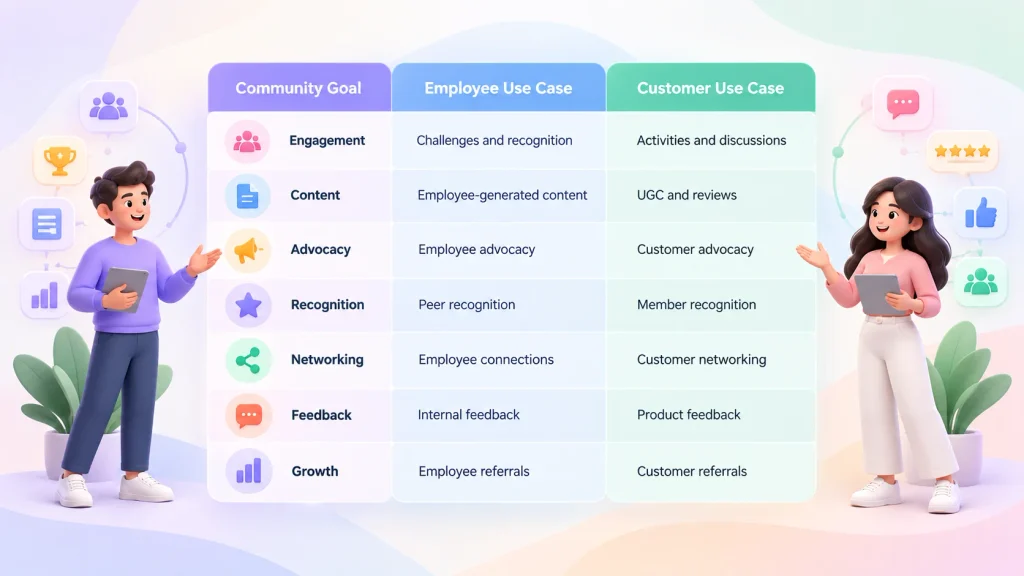
| Community Goal | Employee Use Case | Customer Use Case |
|---|---|---|
| Engagement | Challenges and recognition | Activities and discussions |
| Content | Employee-generated content | UGC and reviews |
| Advocacy | Employee advocacy | Customer advocacy |
| Recognition | Peer recognition | Member recognition |
| Networking | Employee connections | Customer networking |
| Feedback | Internal feedback | Product feedback |
| Growth | Employee referrals | Customer referrals |
The infrastructure can support these different objectives without requiring identical experiences for employees and customers.
How Thrico Supports the Unified Community Model
A unified community model can be understood through six connected components:
1. Community
Groups, feeds, profiles, connections and conversations provide the foundation for member interaction.
2. Content
Organisations and members can create and share content that keeps the community active and encourages participation.
3. Gamification
Points, coins, badges, levels, challenges, leaderboards and rewards can provide additional mechanisms for recognising participation.
4. Insights
Community insights can help organisations understand engagement, participation, retention and growth patterns.
5. Advocacy
Employee and customer participation can support advocacy activities, referrals, content sharing and community-led growth.
6. Branded Experience
A branded community can create an organisation-specific experience across web and mobile environments while maintaining a consistent community identity.
Together, these components provide a foundation for building community experiences around different audiences and objectives.
Conclusion: One Ecosystem, Multiple Community Journeys
Employee, customer and brand communities do not have to operate as completely disconnected experiences.
A unified community ecosystem can provide the infrastructure needed to manage different audiences while connecting engagement, content, conversations, recognition, advocacy and insights.
The key is not to make every audience experience the same community.
Instead, organisations can create multiple community journeys on connected infrastructure.
Employees can have experiences designed around collaboration, recognition and advocacy. Customers can have experiences focused on product discussions, feedback, education and participation. Advocates can have dedicated campaigns, recognition and referral opportunities.
Thrico brings these capabilities together through a unified community infrastructure designed to help organisations build, engage and grow communities across employees, customers and other stakeholder groups.
Frequently Asked Questions
Yes. Thrico can support employee and customer community experiences within a broader community ecosystem. Organisations can create relevant content, access levels, engagement journeys and programmes for different audiences while using connected community infrastructure.
A unified community platform brings community engagement, content, conversations, networking, gamification, insights and community management into a connected environment. Instead of relying entirely on disconnected tools, organisations can manage different community experiences through a broader infrastructure.
Yes. A unified ecosystem does not require every member to see the same content or have identical permissions. Organisations can create different groups, content, access levels, campaigns, rewards and engagement journeys for employees, customers, partners, advocates and other audiences.
Gamification can encourage participation through mechanisms such as points, badges, levels, challenges, leaderboards, recognition and rewards. The behaviours being rewarded can differ by audience. Employee programmes may focus on recognition and participation, while customer programmes may focus on contributions, feedback, referrals or advocacy.
Thrico can support employee advocacy by providing community engagement, recognition, rewards, content participation and advocacy activities. Employees can move from participating in internal community experiences to contributing content, sharing knowledge and taking part in programmes designed around brand advocacy.
Customer communities can use discussions, content, feedback, events, recognition, gamification and referrals to encourage customers to become active contributors. Over time, participation can create opportunities for customers to share experiences, create content, recommend the brand and support other community members.