The Real Risk of Building Your Audience on a Platform You Do Not Own
Your community has forty thousand members and you cannot email a single one of them.
That sentence describes most brand communities on social platforms, and it usually goes unnoticed until the moment it matters. A reach drop, a takedown, a policy change, or simply the quarter someone asks what the audience is actually worth. At that point the follower count stops being an asset and starts being a rental agreement you never read.
This is what platform risk means in practice. Not a catastrophe, usually, but a slow discovery that the relationship you built belongs to somebody else, and that you have no way to take it with you.
The Illusion of Owning Your Audience on Social Media
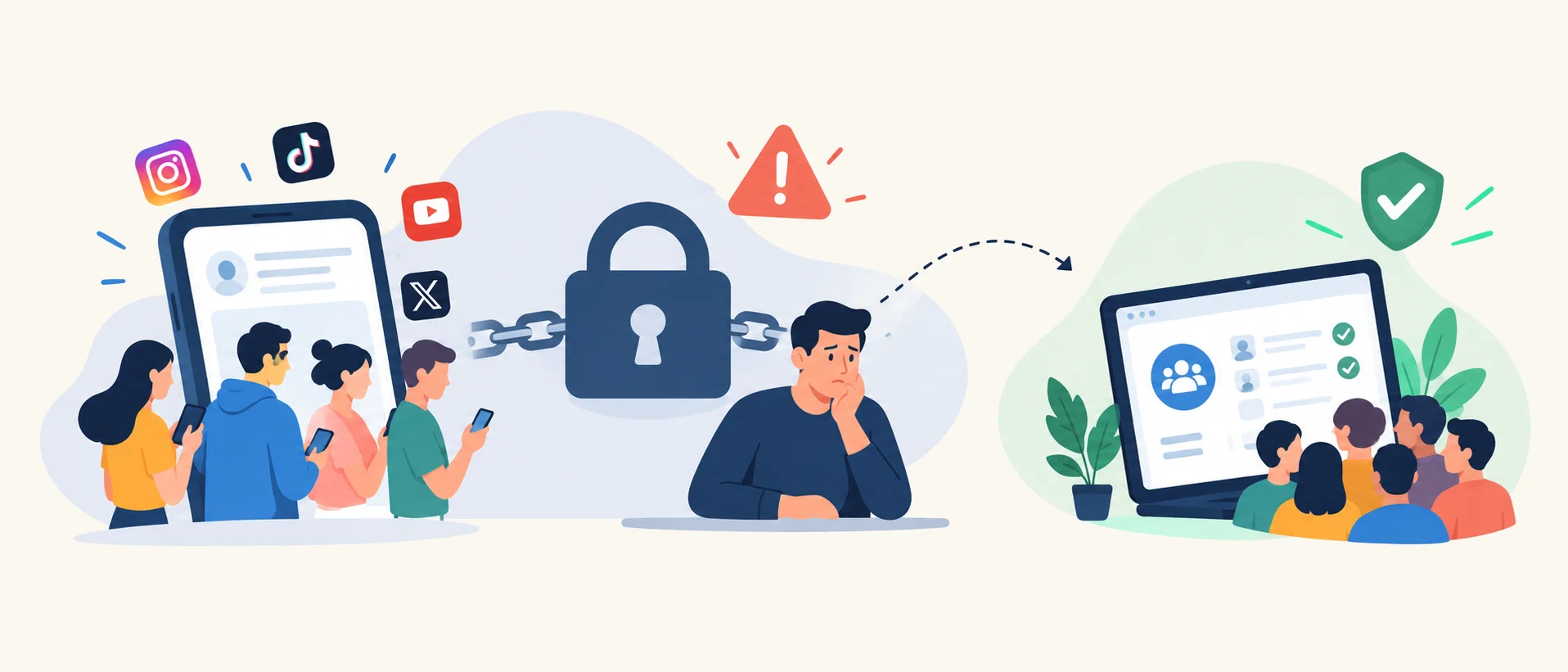
You do not own your audience on social media. You own the content you posted and a licence to reach people through a channel that sets the terms, decides who sees what, and can change either without telling you. The follower count sits in the platform’s database, not yours.
That distinction is invisible while things work. A brand posting three times a week to a healthy Instagram audience is having exactly the experience of ownership: people see the posts, people reply, sales follow. Nothing in the day-to-day tells you the arrangement is conditional.
It becomes visible in one of two ways. Either reach falls and the audience stops arriving, or access is interrupted and the audience becomes unreachable.
Did you know The categories most marketers still use here were defined in one Forrester report by Sean Corcoran, published 16 December 2009, separating owned, earned and paid media. The framework is now old enough to drive, and it remains the clearest way to see what a social following actually is.
What Rented Media vs Owned Media Really Means
- Owned media: A channel your organisation controls. Your website, your email list, your app, your own community platform. You hold the records and you decide who receives what. A white-label community platform sits in this column for the same reason your website does, which is that the records and the distribution are both yours.
- Rented media: A channel you occupy on someone else’s terms. An intermediary controls distribution and access, and can end the arrangement. A Facebook Group is rented. A newsletter is owned.
- Earned media: Coverage and word of mouth you did not pay for and cannot control at all. Included here only because it is routinely confused with the other two.
The word rented is doing precise work. You are not being cheated. You are getting real value at a real price, and the price is that the landlord sets the rules.
The test: if the platform disappeared tomorrow, could you still reach these people? If the answer needs a workaround, the channel is rented.
Who Actually Owns Your Followers on Instagram, Facebook and TikTok?
- Who holds the member records? The platform. Your access is an interface for viewing aggregate numbers, not a database you control or can copy.
- Who decides how many followers see a post? The platform’s ranking system, optimising for its objectives rather than yours. Neither you nor the follower who chose to follow you sets this.
- Who decides whether the account continues to exist? The platform, under terms you accepted, enforced largely by automated systems at a scale that makes individual review impractical.
None of this is hidden. It is written into the terms of service of every major network and it is the basis of the business model. The service is free to you because the audience relationship is the product.
Real Platform Risks Every Brand Should Know in 2026
Platform risk is the exposure a brand carries when its audience relationship depends on an intermediary. It takes six forms, ordered here by how likely you are to meet them, which is not the order they are usually presented in.
| Risk | Likelihood | What it actually costs |
| Algorithm change | Near-certain, repeatedly | Reach, gradually and without notice |
| Revenue volatility | High wherever social drives sales | Income tied to a decision you were not part of |
| Data lockout | Certain, discovered late | The ability to rebuild anywhere else |
| Brand vulnerability | Continuous | Context around your brand that you did not choose |
| Suspension or deletion | Occasional | All access, with no service level on appeal |
| Platform shutdown | Rare | Everything at once |
The dramatic ones get written about most. The certain ones cost more.
Algorithm Changes That Cut Organic Reach Overnight
Take a group of twelve thousand members. In its first year a post reaches a healthy share of them and conversation follows easily. By year three the membership has doubled, the posting rate has doubled with it, and the same post reaches fewer people than it did when the group was half the size.
Nothing was done wrong. The mechanism is arithmetic. A feed ranks a finite amount of attention against a growing amount of content, so as more accounts post more often, the share available to any one of them falls. Reach decay is structural rather than a policy someone could reverse.
The planning consequence: reach is not a number you can budget against next year, because it is set by a system optimising for something other than your budget.
Revenue Volatility
Reach decay becomes a revenue problem the moment any measurable share of sales runs through the channel.
Suppose a fifth of orders originate from social discovery and reach halves over eighteen months, which is unremarkable. A tenth of revenue has gone without a single decision being made inside your company. Most brands find that correlation after the fact, because social is measured as an audience channel rather than a revenue one.
What this costs you: Run four numbers on your own community. Admin hours per week times loaded hourly cost. Members reached per post as a share of members joined. Number of separate tools bolted alongside the group. Contact records you could export today. The fourth is usually zero, and it decides what the other three were worth.
Data Lockout: Why You Cannot Export Your Audience
What you can usually take with you: Your own posts and files. Aggregate analytics. Screenshots. A hand-compiled note of who was active and what they asked about.
What you generally cannot take: Member contact records. Email addresses. Phone numbers. Anything that would let you rebuild the audience somewhere else without asking each person individually.
Check the current export documentation for every platform you use before assuming either column, because the details differ by product and change over time. The shape of the split is the whole of the risk, and it is what makes the other five permanent. A reach drop you can work around. A lockout with no export leaves nothing to work around with.
A Facebook Group is the clearest case, because three years of moderation, posting and member approvals produce no exportable record of who any of those members were. That is what makes the true cost of running a group so hard to calculate: the spend is real and the asset it was supposed to build did not accumulate anywhere retrievable.
Brand Vulnerability
Your community sits inside an environment you do not control, next to content you did not choose, under a moderation system that is not yours. Members experience all of it as context for your brand.
The exposures are ordinary rather than dramatic. Competitor advertising served alongside your posts, unrelated content in the same feed, and moderation decisions made at platform scale that will occasionally be wrong about your members.
Account Suspensions and Group Deletions Without Warning
Enforcement at platform scale usually runs in this order:
- Automated flag: Triggered by your content, by a member’s, or by a pattern a classifier misread.
- Restriction or removal: Often immediate, often with a notice that does not name the specific rule.
- Appeal: Available, slow, largely automated at first stage, with no service level attached.
- Silence: You cannot tell members what happened, because the channel you would use to tell them is the one that went away.
Common mistake: Treating a second social account as a backup. A mirror on another network is another rented channel with the same failure modes and a separate algorithm. Redundancy means different ownership, not a second landlord.
Platform Shutdowns and Forced Migrations
The rarest and the most cinematic. Platforms close, get acquired, or restructure so heavily that the product you built on stops existing in a usable form.
It is listed last because planning for it specifically is a poor use of attention. A brand that has handled reach decay and data lockout has already handled this one, and a brand that has not will find a shutdown merely accelerates a loss that was accumulating anyway.
What It Means to Truly Own Your Audience Data
Owning audience data means holding the member records yourself, reaching members without an intermediary deciding how many receive the message, and being able to export what you hold whenever you choose. Ownership is a set of capabilities, not a badge a vendor puts on a page.
That definition matters because ownership is sold loosely. Almost every community platform claims it, and very few will describe on a public page what a customer can actually retrieve, in what format, and under what terms.
So treat it as something to verify rather than believe.
Checklist: five questions to ask any community vendor
- Can I export member records, including contact details, in a machine-readable format, on demand?
- Is there a documented API, and is it on the tier I would actually buy?
- Where is the data hosted, and can I choose the region?
- What happens to my data if I stop paying, and for how long can I retrieve it?
- Is any of the above in the contract, or only on the marketing page?
Most vendors fail at least two. That is the useful finding, and it tells you ownership is a spectrum rather than a category.
How Thrico Approaches Ownership of Your Community Data
Thrico, the community management platform built by PulsePlay Digital, is designed around a different structural arrangement rather than a better version of the same one. The community runs as a private branded space your organisation operates, on web and a branded mobile app, with an admin dashboard covering members, content and analytics.
What changes is who sits between you and your members. No ranking system decides which members see an announcement, and no external moderation policy applies to your space, because the space is not a feed inside a public network. Distribution follows the modules you switch on rather than an intermediary’s priorities.
Being straightforward about the current limits: Thrico has not published an export specification, a hosting region statement or a security page. Questions one to four above are the right ones to put to the team directly, and anyone claiming otherwise about any vendor, including this one, is describing marketing rather than a contract.
Steps to Start Moving Your Audience to an Owned Platform
Start with the members you can already reach directly, not with the whole audience.
- List what you already hold. Newsletter subscribers, customers, past event registrations. The overlap with your community is the portion you can reach without anyone’s permission.
- Check what exports platform by platform, from current documentation. Usually less than expected.
- Stand up the owned space and give the first cohort a reason to be there that does not exist on the old one.
- Run both in parallel while the new space develops enough activity to be worth visiting.
- Keep posting where the audience already is. Reach on a rented channel is still reach.
The goal is not to leave social media. It is to stop being unable to survive it.
Decision cue: The moment to start is the quarter someone asks what the community returns. That question is unanswerable without first-party data, and becoming able to answer it takes longer than the meeting allows.
FAQs
The group and its content become inaccessible, and so does your route to the members, because member contact details are not something group admins hold. Appeals are possible but slow and offer no guaranteed outcome. Without a second channel established beforehand, there is no way to reach anyone.
Owned media is a channel your organisation controls, such as your website, email list or own community platform. Rented media is a channel you occupy on another company’s terms, where they control distribution and access. The test is whether you could still reach the audience if the platform vanished.
Because it converts an audience into an asset you can measure, reach and carry. Without member records you cannot attribute revenue, segment communication, or continue the relationship if reach falls or access is interrupted. Ownership is what makes community performance forecastable rather than dependent on decisions made elsewhere.
You can generally export your own content and view aggregate insights, and generally cannot export member or follower contact records. Export options differ by platform and product and change over time, so check each platform’s current help documentation directly before building a plan around what it allows.
First-party data is information your organisation collects directly from people who chose to give it to you, such as an email address, a profile or a purchase history. It matters because you hold it, can act on it without an intermediary, and can keep using it if any external channel becomes unavailable.
Thrico runs your community as a private branded space your organisation operates, with member management and analytics in your own admin dashboard rather than inside a public network. Export terms, hosting region and security documentation have not yet been published, so ask about those directly.
It is the exposure created when audience relationships, and any revenue they produce, rely on an intermediary that controls distribution and access. It shows up as reach decay, revenue volatility, data lockout, brand adjacency issues, enforcement actions and, occasionally, platform closure.