Community management is the process of building, managing, engaging, and growing a community around a shared interest, purpose, brand, product, organisation, or experience. It involves managing conversations, supporting members, encouraging participation, moderating content, creating valuable experiences, and measuring community engagement.
Community management is more than simply replying to comments or posting content. It combines people, communication, content, engagement, moderation, and operations to create a healthy and active community.
It can be used for customer communities, employee communities, associations, academic institutions, creator communities, D2C brands, and other member-based organisations. Modern community management can also be managed through a unified community management platform that brings members, conversations, content, engagement, and insights together.
What Does Community Management Mean?
Community Management Definition
In simple terms, community management means creating an environment where members can connect, participate, contribute, and build relationships around a shared purpose.
A simple way to understand it is:
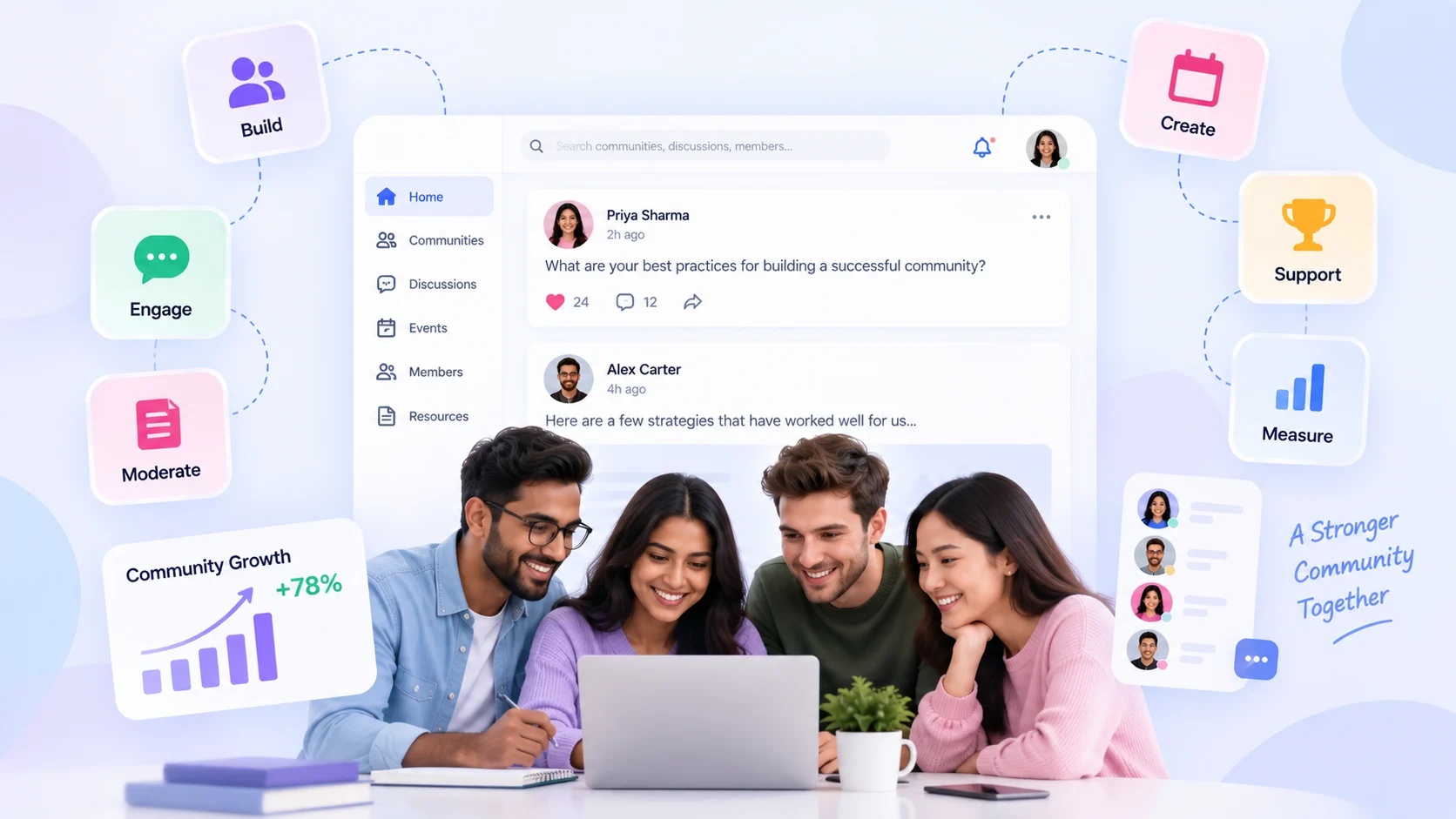
Community Management = Build + Engage + Support + Moderate + Measure + Grow
- Build: Create a relevant community and bring the right members together.
- Engage: Start conversations and encourage members to participate.
- Support: Help members find information, answers, and resources.
- Moderate: Maintain community guidelines and manage inappropriate content.
- Measure: Track engagement, participation, retention, and growth.
- Grow: Improve the overall community experience and attract or retain more members.
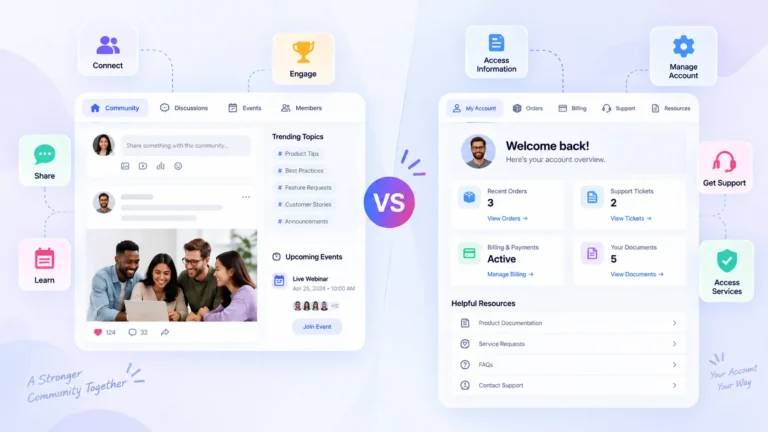
Community Management vs Managing a Social Media Audience
Social media audiences and communities can both involve content and engagement, but their purpose and relationship model are different.
| Social Media Audience | Community Management |
|---|---|
| Primarily reach-focused | Relationship-focused |
| Content distribution | Participation and interaction |
| Brand-to-audience | Member-to-member and brand-to-member |
| Often dependent on third-party platforms | Can be hosted in an owned or branded environment |
| Often campaign-driven | Long-term relationship-driven |
For a more detailed comparison, see our guide on community management vs social media marketing.
Why Is Community Management Important?
Community management helps organisations create stronger relationships with the people who matter to their business, organisation, or purpose.
Builds Stronger Member Relationships
Consistent interaction helps members feel recognised and connected. Community managers can welcome members, respond to questions, highlight contributions, and create opportunities for meaningful interaction.
Increases Community Engagement
Discussions, events, polls, educational content, challenges, and member contributions give people different ways to participate.
The goal is not simply to increase activity but to encourage meaningful participation that provides value to members.
Improves Retention
An active community can give members reasons to return regularly. Useful conversations, exclusive content, networking opportunities, recognition, and events can strengthen the overall member experience.
Creates Feedback Loops
Communities provide direct opportunities for members to share:
- Feedback
- Questions
- Ideas
- Product experiences
- Suggestions
- Challenges
This information can help organisations understand what members need and where the community experience can improve.
Encourages Advocacy
Highly engaged members can become contributors, advocates, referrers, and brand champions. For businesses, community participation can connect with customer relationships, retention, advocacy, and long-term engagement.
What Does a Community Manager Do?
A community manager is responsible for creating and maintaining a positive, useful, and engaging community experience.
Create and Curate Community Content
Community managers may create:
- Questions
- Discussions
- Announcements
- Educational content
- Polls
- Events
- Member stories
The content should encourage participation rather than simply promote the organisation.
Engage With Members
Community managers may:
- Respond to questions
- Start conversations
- Welcome new members
- Recognise contributors
- Connect members with relevant people or resources
Moderate the Community
Moderation helps maintain a safe and useful environment. Responsibilities can include enforcing guidelines, managing inappropriate content, resolving conflicts, and maintaining community standards.
Encourage Participation
Community managers can use challenges, events, recognition, rewards, member spotlights, and gamification to encourage participation.
Monitor Community Health
Important indicators can include:
- Active members
- Engagement
- Content interactions
- Participation
- Retention
- Community growth
Collect Member Feedback
Community conversations can reveal recurring questions, member concerns, product feedback, and new opportunities. Community managers can organise this feedback and use it to improve the overall experience.
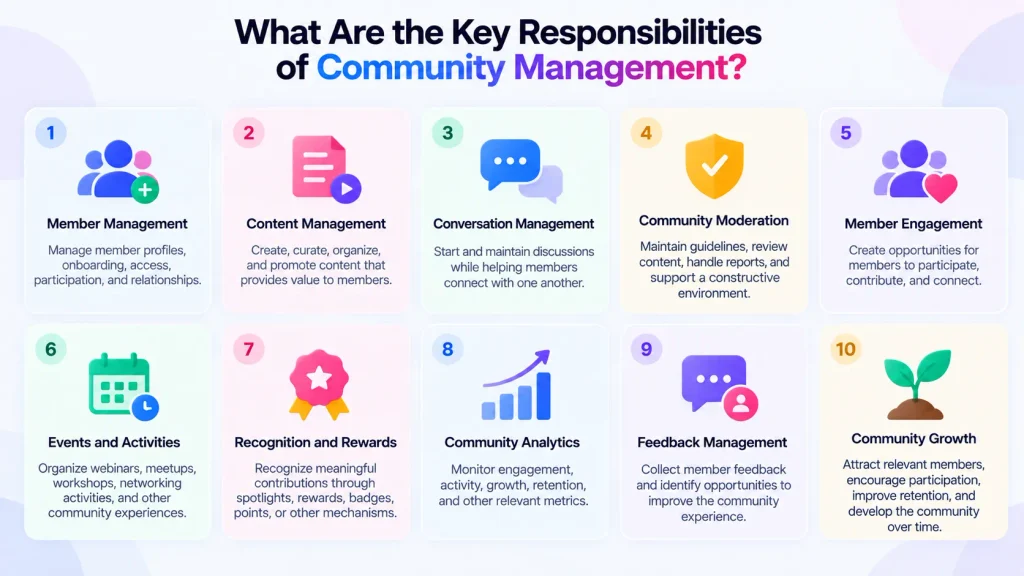
What Are the Key Responsibilities of Community Management?
The main responsibilities of community management include:
1. Member Management
Managing member profiles, onboarding, access, participation, and member relationships.
2. Content Management
Creating, publishing, organising, and maintaining useful community content.
3. Conversation Management
Starting discussions, responding to questions, and encouraging member-to-member interaction.
4. Community Moderation
Applying community guidelines and maintaining a safe and relevant environment.
5. Member Engagement
Creating activities and experiences that encourage members to participate.
6. Events and Activities
Planning online or offline events, challenges, discussions, networking activities, and other community experiences.
7. Recognition and Rewards
Recognising valuable contributions through member spotlights, badges, points, rewards, or other forms of recognition.
8. Community Analytics
Tracking engagement, participation, retention, growth, and other community KPIs.
9. Feedback Management
Collecting and organising member feedback to identify needs and improvement opportunities.
10. Community Growth
Improving the member experience, attracting relevant members, and increasing long-term participation.
How Does Community Management Work?
Community management generally follows a continuous process:
Define the community → Understand members → Create the community experience → Publish valuable content → Start conversations → Encourage participation → Moderate → Measure → Improve
Step 1 — Define the Community Purpose
First, establish why the community exists.
Examples include:
- Customer community
- Employee community
- Association community
- Student or alumni community
- Creator or fan community
A clear purpose helps determine what content, activities, and experiences the community should provide.
Step 2 — Understand Your Members
Identify member:
- Goals
- Interests
- Problems
- Motivations
- Preferred interactions
Understanding members helps community managers create experiences that are relevant rather than generic.
Step 3 — Create Valuable Experiences
A community can include:
- Communities and groups
- Feed
- Discussions
- Events
- Networking
- Opportunities
- Educational resources
The exact combination depends on the community’s purpose.
Step 4 — Encourage Participation
Participation can be encouraged through:
- Questions
- Polls
- Events
- Challenges
- Recognition
- Rewards
The objective should be meaningful participation rather than activity for its own sake.
Step 5 — Moderate and Maintain Community Health
Community guidelines, moderation, roles, permissions, and content review help maintain a positive environment.
Step 6 — Measure and Improve
Community managers should regularly review engagement, participation, retention, content activity, member growth, and other relevant KPIs.
The insights can then be used to improve content, activities, onboarding, and member experiences.
What Are the Different Types of Community Management?
Community management can take different forms depending on the audience and objective.
Customer Community Management
Customer communities can support:
- Customer support
- Product education
- Feedback
- Advocacy
- Retention
They provide customers with a place to interact with the brand and with other customers.
Employee Community Management
Employee communities can support:
- Internal communication
- Employee engagement
- Recognition
- Collaboration
- Advocacy
An employee community platform can bring employees together through conversations, groups, content, activities, recognition, and engagement experiences.
Association Community Management
Association communities focus on:
- Member engagement
- Networking
- Events
- Renewals
- Recognition
A community platform for associations can connect members, chapters, events, communication, networking, and advocacy within one environment.
Academic Community Management
Academic communities can support:
- Students
- Alumni
- Faculty
- Mentorship
- Career opportunities
A community platform for academia can help institutions maintain connections across the student-to-alumni journey.
Creator Community Management
Creator communities can bring together:
- Fans
- Followers
- Content
- Engagement
- Monetization opportunities
A creator community platform can help creators build a direct relationship with their audience rather than relying entirely on social media algorithms.
D2C Community Management
D2C communities can support:
- Customer loyalty
- User-generated content
- Referrals
- Reviews
- Repeat engagement
A D2C community platform can connect customers with content, conversations, rewards, referrals, and brand experiences.
What Are the Best Community Management Strategies?
Create a Clear Community Purpose
Members should understand why the community exists and what value they can receive from participating.
Make Onboarding Simple
A simple onboarding experience helps new members understand the community, complete their profiles, discover relevant spaces, and participate quickly.
Publish Consistently
Regularly publishing useful content gives members reasons to return and participate.
Start Meaningful Conversations
Ask relevant questions, create discussions, and encourage members to share experiences and knowledge.
Recognize Member Contributions
Recognition can include member spotlights, badges, rankings, rewards, or public appreciation.
Organize Community Events
Events can create structured opportunities for members to learn, network, participate, and connect.
Use Gamification Carefully
Points, badges, ranks, leaderboards, challenges, and rewards can encourage participation when they are connected to meaningful community behaviours.
Learn more about gamification for community engagement and how structured recognition and rewards can be incorporated into a community experience.
Build Strong Community Guidelines
Clear guidelines help members understand acceptable behaviour and give moderators a framework for handling issues.
Personalize Member Experiences
Relevant content, groups, activities, and communication can make the community more useful for different member segments.
Measure Community Performance
Track the metrics that align with the community’s actual purpose rather than focusing only on member count.
What Tools Are Used for Community Management?
Community management can involve several categories of tools.
Community Platform
Used for:
- Members
- Groups
- Feed
- Discussions
- Networking
Content Management Tools
Used for:
- Posts
- Stories
- Resources
- User-generated content
Engagement Tools
Used for:
- Polls
- Events
- Challenges
- Rewards
Moderation Tools
Used for:
- Content moderation
- Member management
- Roles
- Permissions
Analytics Tools
Used for:
- Active members
- Engagement
- Retention
- Growth
Community Management Platform
A unified community management platform can bring many of these functions into one environment. This can reduce fragmented workflows and give community teams a central place to manage members, content, conversations, engagement, moderation, and insights.
How to Measure Community Management Success
Community management success should be measured using KPIs that match the purpose of the community.
Community Engagement Rate
Measures how actively members interact with community content and experiences.
Monthly/Daily Active Members
Shows how many members are regularly returning and participating.
Member Retention
Measures how effectively the community keeps members engaged over time.
Content Participation
Tracks posts, comments, reactions, contributions, and other content interactions.
Discussion Activity
Measures the volume and quality of conversations taking place.
Event Participation
Tracks registrations, attendance, and engagement around community events.
Member Growth
Measures how the community member base changes over time.
Referral Activity
Tracks invitations and referrals generated by community members.
Contribution Rate
Measures how many members actively contribute rather than simply joining or viewing content.
Advocacy and UGC
Tracks member-generated content, recommendations, referrals, reviews, and other advocacy activity.
Community managers should not measure success using member count alone. A large community with very little participation may provide less value than a smaller community with active, meaningful interactions.
For organisations that need a central place to monitor community activity, community management and analytics can bring together member management, moderation, engagement, and community insights.
What Are the Common Community Management Challenges?
Low Member Engagement
Solution:
- Better onboarding
- Questions
- Events
- Recognition
- Relevant content
Inactive Members
Solution:
- Personalized communication
- Member interests
- Targeted activities
- Re-engagement campaigns
Too Much Promotional Content
Solution:
- Balance brand and member value
- Encourage user-generated content
- Create useful discussions
- Prioritize member needs
Spam and Inappropriate Content
Solution:
- Community guidelines
- Moderation
- Roles
- Permissions
- Content review
Fragmented Community Management
When member management, content, conversations, moderation, engagement, and analytics are handled across disconnected tools, community teams may have difficulty maintaining a consistent member experience.
A unified community management environment can help bring these activities together.
Community Management Best Practices
Use this checklist when developing a community management strategy:
- Define a clear community purpose.
- Know your members.
- Create useful content.
- Encourage member-to-member interaction.
- Welcome new members.
- Recognize meaningful contributions.
- Moderate consistently.
- Organize recurring activities.
- Track engagement metrics.
- Continuously improve the community experience.
How Can a Community Management Platform Help?
A dedicated community management platform can bring different parts of the community experience into one environment.
Depending on the platform and configuration, this can include:
- Member profiles
- Communities
- Groups
- Feed
- Conversations
- Events
- Networking
- Moderation
- Gamification
- Rewards
- Analytics
- Roles and permissions
Instead of managing each activity separately, organisations can create a connected environment where members can participate, communicate, contribute, and access relevant experiences.
This is particularly useful for organisations managing multiple audiences or large communities where engagement, moderation, member management, and analytics need to work together.
Organisations looking for a unified community management platform can use these capabilities to create a more connected approach to member engagement and community operations.
How Thrico Supports Community Management
Thrico is designed as a unified community management platform that brings together community, content, conversations, engagement, gamification, and insights.
Manage Members
Community teams can manage member information and create structured member experiences from a central environment.
Manage Content
Feeds, stories, user-generated content, campaigns, and other community content can support ongoing member engagement.
Manage Conversations
Discussions, forums, chats, polls, feedback, and other interaction formats can help members communicate with each other and the organisation.
Manage Community Engagement
Events, activities, networking, recognition, challenges, and other participation experiences can give members more ways to engage.
Moderate the Community
Community moderation tools can help teams review content, manage inappropriate activity, maintain community standards, and manage member-related actions.
Measure Community Performance
Community insights can help teams understand member activity, engagement, content performance, participation, and other community-level signals.
Gamify Participation
The Thrico gamification platform can support points, badges, ranks, challenges, leaderboards, recognition, and rewards to encourage meaningful participation.
The role of community management is ultimately to create an environment where people have reasons to join, participate, contribute, connect, and return. A unified platform can help community teams manage these experiences more consistently as the community grows.
Frequently Asked Questions
Community management is the process of building, engaging, supporting, moderating, measuring, and growing a community. It involves managing conversations, helping members, creating valuable content and experiences, encouraging participation, maintaining community standards, and using engagement insights to improve the overall community experience.
Community management helps organisations build stronger member relationships, increase engagement, collect feedback, improve retention, encourage advocacy, and create a sense of belonging. For businesses, it can also support customer relationships, product feedback, user-generated content, referrals, and long-term community-led growth.
A community manager creates and manages community content, starts conversations, responds to members, welcomes new users, moderates discussions, encourages participation, organises activities, recognises contributors, collects feedback, and tracks community health and engagement metrics.
The main responsibilities include member management, content management, conversation management, moderation, engagement, events and activities, recognition and rewards, analytics, feedback management, and community growth. The exact responsibilities depend on the type and purpose of the community.
An example is a customer community where a company welcomes customers, publishes educational content, answers questions, hosts events, collects product feedback, recognises active members, and encourages customers to share experiences and help other members.
Online community management is the process of managing digital communities through platforms, websites, applications, forums, or other online environments. It includes member engagement, content, conversations, moderation, events, recognition, analytics, and other activities that support digital community participation.
Benefits can include stronger member relationships, higher engagement, improved retention, better feedback collection, increased advocacy, more user-generated content, stronger networking, and a more connected member experience. The specific benefits depend on the community’s audience, objectives, and engagement strategy.
Community management can use community platforms, content management tools, engagement tools, moderation systems, analytics tools, event tools, and gamification systems. A unified community management platform can bring many of these capabilities together instead of requiring teams to manage separate tools.
Community management can be measured using active members, engagement rate, retention, content participation, discussion activity, event participation, member growth, referral activity, contribution rate, advocacy, and user-generated content. The most relevant KPIs should be connected to the community’s specific objectives.
Social media management generally focuses on publishing content, building reach, engaging audiences, and supporting marketing goals on social platforms. Community management focuses more on ongoing relationships, member participation, conversations, retention, feedback, and creating a connected community experience.
Yes. Businesses can use community management platforms to create customer or employee communities, manage members, publish content, facilitate discussions, organise events, encourage participation, collect feedback, recognise members, and measure engagement.
Thrico provides a unified environment for building, engaging, managing, and growing communities. Its capabilities cover areas such as members, communities, content, conversations, engagement, moderation, gamification, rewards, and insights, allowing organisations to manage community experiences from a connected platform.