Businesses are moving beyond social media groups because they want greater control over their brand experience, member relationships, community engagement, and first-party insights. While social media groups remain useful for audience discovery and informal conversations, a branded community offers a dedicated environment designed around the organization and its members.
This shift does not mean abandoning social media. Businesses can continue using social channels to attract audiences while building a branded community for deeper, ongoing engagement. Platforms such as Thrico bring together member connections, discussions, content, events, and community management to support this approach.
For organizations ready to take the next step, learning how to launch your own branded community is a practical starting point.
What Is the Difference Between Social Media Groups and Branded Communities?
Social media groups and branded communities both help people connect and share information. However, they differ in how much control organizations have over the experience, how interactions are managed, and how community activities support long-term business goals.
What Is a Social Media Group?
A social media group is a space within an existing social networking platform where people gather around a shared interest, organization, brand, or topic.
Businesses commonly use Facebook Groups, LinkedIn Groups, and other social or messaging communities to share updates, start discussions, answer questions, and interact with their audiences.
Social media groups offer several advantages:
- Easy to get started: Businesses can often create a group without building a separate digital environment.
- Access to existing audiences: Social platforms provide opportunities to reach people who already use those networks.
- Familiar interaction features: Members can participate using tools they already understand.
- Audience discovery: Public posts, recommendations, and social sharing may help new people discover a group.
- Informal conversations: Groups can make it easy to discuss topics and exchange information.
However, social media groups also have limitations. Businesses depend on the host platform’s policies, available features, interface, and distribution mechanisms. Changes to algorithms or product features can affect how content reaches members.
Branding and customization may also be restricted, and access to analytics and member information depends on the platform’s available tools and policies.
Social media groups remain useful for many purposes, but they may not provide every capability a business needs as its community grows.
What Is a Branded Community?
A branded community is a dedicated digital environment where an organization brings members together under its own identity and community structure.
Instead of relying entirely on a third-party social platform, a business can use a community platform designed to support member profiles, discussions, networking, content sharing, events, and ongoing engagement.
Depending on the platform, a branded community may offer:
- Custom branding and a consistent member experience.
- Member profiles and connections.
- Dedicated discussion spaces and groups.
- Content publishing and knowledge sharing.
- Events and community activities.
- Engagement and recognition features.
- Member management and moderation.
- Community analytics and engagement insights.
A branded community gives businesses more flexibility to organize interactions around their objectives. The actual level of customization, data access, and control depends on the selected platform and its capabilities.
Learn more about what a branded community platform is and why your business needs one.
Social Media Groups vs Branded Communities: Key Differences
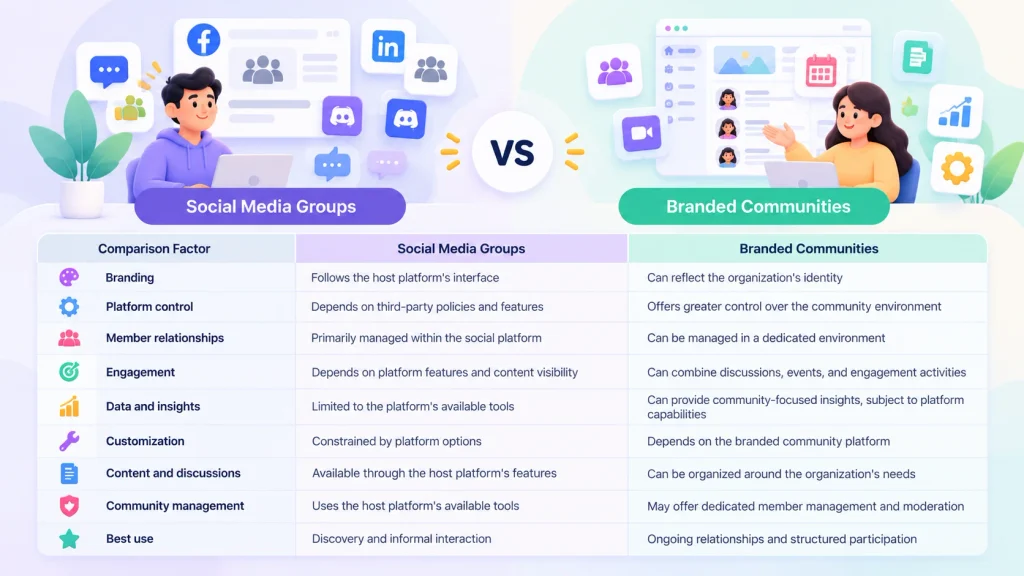
The following table highlights the main differences between the two approaches.
| Comparison Factor | Social Media Groups | Branded Communities |
| Branding | Follows the host platform’s interface | Can reflect the organization’s identity |
| Platform control | Depends on third-party policies and features | Offers greater control over the community environment |
| Member relationships | Primarily managed within the social platform | Can be managed in a dedicated environment |
| Engagement | Depends on platform features and content visibility | Can combine discussions, events, and engagement activities |
| Data and insights | Limited to the platform’s available tools | Can provide community-focused insights, subject to platform capabilities |
| Customization | Constrained by platform options | Depends on the branded community platform |
| Content and discussions | Available through the host platform’s features | Can be organized around the organization’s needs |
| Community management | Uses the host platform’s available tools | May offer dedicated member management and moderation |
| Best use | Discovery and informal interaction | Ongoing relationships and structured participation |
Neither option is automatically better in every situation. Social media groups can provide useful engagement and analytics, while branded communities vary in the level of control and functionality they offer.
The right choice depends on the organization’s objectives, audience, resources, and long-term community strategy.
Why Are Businesses Moving From Social Media Groups to Branded Communities?
As businesses invest more in customer relationships and audience engagement, many begin looking for ways to build communities that extend beyond individual social media interactions.
Here are six reasons a branded community may become a valuable addition to a business’s digital strategy.
1. Greater Control Over the Brand Experience
A business’s brand extends beyond its logo and website. It also includes how customers interact with the organization, discover information, participate in conversations, and connect with other members.
Social media groups operate within the host platform’s design and functionality. Businesses generally have limited control over how the group looks and how the overall experience is organized.
A branded community can provide greater flexibility to create an experience that reflects the organization’s identity and audience.
Businesses may be able to customize branding, organize community spaces, structure discussions, and create a more consistent journey for members, depending on the platform.
For example, a software company could organize its community around product education, customer support, feature discussions, and events. Members would have a dedicated environment for finding information and interacting with other users.
This structure can make the community feel like a more integrated part of the organization’s customer experience.
2. Less Dependence on Social Media Algorithms
Social media platforms determine how content is distributed and displayed through their own systems, policies, and product features.
Changes to those systems can influence content visibility, notifications, and the ways businesses interact with their audiences.
A business that relies entirely on a social media group has limited control over these external factors.
A branded community provides another channel for maintaining member relationships and organizing conversations. Depending on its capabilities, the organization may have additional options for member notifications, direct communication, content organization, and event participation.
This does not guarantee that every community post will reach every member. Participation still depends on member interest, content relevance, communication preferences, and the community’s engagement strategy.
The advantage is having another environment for building relationships rather than relying exclusively on a third-party social platform.
3. Better Access to First-Party Community Insights
Understanding members is essential for building a useful community.
Businesses need to know which topics matter to their audience, what questions members ask, which resources they use, and what encourages them to participate.
Social media groups provide some useful insights, but the available information depends on the platform.
A dedicated community platform may offer additional ways to understand member activity through discussions, profiles, event participation, surveys, feedback, and engagement analytics.
These insights can help businesses:
- Identify frequently discussed topics.
- Understand common customer questions.
- Discover gaps in existing content.
- Evaluate participation in community events.
- Improve onboarding and member experiences.
- Identify opportunities for more relevant engagement.
Access to community information should always be handled responsibly. Businesses must follow applicable privacy laws, respect member consent, and apply appropriate data security practices.
They should also understand why owning your community data matters when evaluating how a community platform supports data access, portability, and long-term community management.
Greater control over community data does not mean unlimited ownership of every piece of information. Actual rights and responsibilities depend on platform terms, data protection requirements, and the circumstances in which information is collected.
4. More Meaningful Member Engagement
A social media group can generate likes, comments, shares, and discussions. However, businesses interested in long-term relationships often need to look beyond activity on individual posts.
A branded community can organize recurring conversations, networking opportunities, events, shared resources, and member contributions within one environment.
This creates opportunities for members to return for reasons beyond seeing a new update.
For example, members of a professional community may participate in industry discussions, attend events, exchange advice, and connect with people who share their interests.
A customer community may help users ask questions, share product experiences, and learn from other customers.
Businesses should measure meaningful engagement through indicators such as:
- Active members over a defined period.
- Repeat participation.
- Quality of member contributions.
- Discussion responses and useful answers.
- Event attendance.
- Member feedback and retention.
A large follower count does not necessarily indicate a healthy community. The more important question is whether members receive value and have reasons to participate consistently.
5. Multiple Community Activities in One Environment
As a community grows, businesses may find themselves using several tools to manage discussions, publish content, organize events, collect feedback, and recognize contributions.
When these activities are spread across disconnected systems, members may find it harder to discover information and participate consistently.
A community platform may bring several activities together, depending on its features.
These can include:
Content feeds and discussions: Give members a place to share updates, ask questions, and exchange ideas.
Member connections and networking: Help members discover people with relevant interests or expertise.
Events and activities: Support webinars, workshops, meetings, and community gatherings.
Polls, surveys, and feedback: Help organizations collect member opinions and understand their needs.
Gamification and recognition: Offer ways to acknowledge contributions and encourage specific participation activities.
Moderation and member management: Help administrators organize the community and maintain appropriate participation standards.
Bringing these capabilities together can make community management more organized and provide a more consistent member experience.
However, businesses should compare the actual functionality of each platform rather than assuming every provider offers the same features.
Before choosing a solution, review the community platform features every business should look for.
6. Stronger Long-Term Customer Relationships
Customer relationships do not end when a purchase is complete.
Customers may need help understanding a product, discovering new features, solving problems, or learning from other users. A community can provide an ongoing environment for these interactions.
A branded customer community may support:
- Customer education and product adoption.
- Peer-to-peer knowledge sharing.
- Product feedback and feature discussions.
- Customer events and learning opportunities.
- Connections between customers with similar needs.
- Continued interaction after a purchase.
For example, customers using a business software product could exchange practical advice, share workflows, and discuss common challenges. The company could also use relevant feedback to identify areas where documentation or product education needs improvement.
These activities may contribute to stronger customer relationships, but results depend on the quality of the community experience, the relevance of its resources, and how consistently the organization supports its members.
A branded community is not a guaranteed way to increase retention or revenue. It is an environment businesses can use to support those objectives through useful interactions and ongoing engagement.
What Challenges Do Businesses Face When Relying Only on Social Media Groups?
Social media groups can work well for small communities and informal discussions. As organizational needs become more complex, however, some limitations may become more noticeable.
Fragmented Conversations Across Multiple Platforms
Businesses often communicate with their audiences through several channels, including social media, email, messaging applications, websites, and event tools.
When community discussions are spread across these channels, it can become harder for members to find previous conversations, discover useful resources, and continue discussions.
Administrators may also need to manage different moderation processes, communication workflows, and activity reports.
A dedicated community environment can help organize these interactions, provided the selected platform supports the required activities.
Limited Branding and Customization
Social media groups typically follow the design and functionality of their host platform.
Businesses may have limited options for organizing the experience, presenting their identity, or adapting the environment to their specific community goals.
A branded community may offer greater flexibility, depending on the provider’s customization options.
This can be particularly relevant for organizations that want the community to form part of a broader customer, employee, or member experience.
Difficulty Measuring Community Health
A large group may appear successful because it has many members or frequent posts. However, these numbers do not necessarily show whether members find the community useful.
Businesses need to understand participation quality, repeat activity, contribution levels, and member retention.
Useful indicators include:
- Monthly or weekly active members.
- New-member activation.
- Repeat participation.
- Questions answered and resources shared.
- Event registration and attendance.
- Member feedback.
- Retention over a defined period.
The right metrics depend on the community’s purpose. A customer support community, for example, may prioritize useful answers and resolution activity, while a professional community may focus on networking and event participation.
Limited Control Over the Member Journey
A community member may discover a business through social media, sign up for an event through another tool, join a mailing list, and participate in a discussion elsewhere.
When these interactions are disconnected, creating a consistent member journey can be challenging.
A branded community may provide a more structured environment for onboarding, content discovery, discussions, events, and ongoing participation.
Businesses should consider how the platform fits with their existing tools and whether its integrations support the experience they want to create.
For more ideas, explore how to improve user interaction and retention in community platforms.
How Can Businesses Transition From Social Media Groups to Branded Communities?
Moving from a social media group to a branded community requires more than creating a new account and inviting members.
The transition should give people a clear reason to join and make the new environment useful from the beginning.
Step 1: Define the Purpose of the Community
Start by identifying what the community should accomplish.
Possible objectives include customer engagement, customer education, employee communication, professional networking, advocacy, learning, and peer support.
Choose a primary purpose and identify the activities that will help achieve it.
For example, a customer community may focus on product education and peer support, while an association community may prioritize member networking, events, and ongoing participation.
A clear purpose helps guide platform selection, content planning, and success measurement.
Step 2: Identify What Members Need
Review the existing group’s discussions, common questions, feedback, and participation patterns.
Look for topics members regularly discuss and problems they want help solving.
Ask questions such as:
- What information do members frequently request?
- Which discussions attract meaningful participation?
- What prevents members from participating?
- Would members benefit from events or networking?
- What resources would make the community more useful?
These findings can help shape the new environment around real member needs rather than assumptions.
Step 3: Choose a Suitable Branded Community Platform
Compare potential platforms based on your requirements.
Consider:
- Branding and customization.
- Member profiles and connections.
- Discussions and content publishing.
- Events and community activities.
- Member management and moderation.
- Privacy and access controls.
- Analytics and reporting.
- Mobile accessibility.
- Integration with existing systems.
- Pricing and ongoing operating costs.
Not every organization needs every feature. Prioritize capabilities that support your community’s purpose and avoid paying for unnecessary complexity.
Step 4: Plan Member Onboarding
Explain the transition clearly before inviting members to join the new community.
Tell them why the organization is creating a dedicated environment, what benefits it offers, and how they can participate.
A practical onboarding plan should include:
- Clear joining instructions.
- A simple registration process.
- A welcome message explaining the community’s purpose.
- Guidance on finding discussions and resources.
- Community guidelines.
- Relevant conversations and activities for new members.
Do not assume that every social media group member will automatically migrate. Some members may prefer the existing platform, while others may need time to understand the benefits of joining a new environment.
Make participation easy and give members a meaningful reason to take the next step.
Step 5: Give Members Reasons to Participate
A community becomes useful when members find relevant information and opportunities to interact.
Prepare activities before inviting people to join.
These may include:
- Discussions around common questions.
- Useful guides and educational resources.
- Member introductions.
- Expert sessions and events.
- Polls and feedback activities.
- Networking opportunities.
- Challenges and recognition, where appropriate.
Encourage participation by responding to questions, highlighting useful contributions, and creating opportunities for members to help one another.
Avoid focusing entirely on posting frequency. The goal is to create valuable interactions that members want to return to.
Step 6: Measure and Improve
Track the community’s performance against the objectives established at the beginning.
Useful metrics may include:
- Number of members who join.
- Percentage of new members who become active.
- Repeat participation.
- Discussion and content contributions.
- Event attendance.
- Member feedback.
- Retention over time.
Review these indicators regularly and use the findings to improve onboarding, content, activities, and community management.
For a practical starting point, learn how to launch your own branded community.
How Does Thrico Support Branded Community Building?
Thrico is a community platform that brings together capabilities designed to support member connections, discussions, content, engagement, and community management.
For organizations evaluating a move beyond social media groups, a dedicated platform can provide an environment structured around the needs of the business and its members.
The appropriate setup depends on the organization’s goals and the features available in the selected plan.
Branded Community Experiences
A branded community gives an organization an opportunity to create a member environment aligned with its identity and audience.
Branding and customization options can help establish a consistent experience and make the community feel connected to the wider organization.
Businesses should review the available customization options to determine whether they meet their requirements.
Member Connections and Discussions
Member profiles, conversations, content, and community spaces can help people connect and exchange information.
For example, customer communities can support product-related discussions, while professional communities can help members discover people with relevant experience or interests.
These interactions can create opportunities for knowledge sharing and ongoing participation.
Engagement Through Events and Gamification
Events and other community activities give members different ways to participate.
Depending on the platform’s available features, businesses may also use challenges, points, rewards, and recognition to encourage specific contributions.
For instance, an organization might recognize helpful answers, encourage participation in a learning event, or create activities around a shared community objective.
The most effective approach is to choose activities that provide value to members rather than adding engagement mechanics without a clear purpose.
Community Management and Insights
Community management involves organizing member spaces, supporting discussions, maintaining guidelines, and monitoring participation.
Relevant analytics can help administrators understand activity and identify opportunities to improve the experience.
Businesses should evaluate the platform’s moderation tools, reporting capabilities, data access, and integrations before making a decision.
To learn more, explore what Thrico brings together as a community platform or discover how to launch a branded community.
Thrico can be considered as part of a broader community strategy in which the organization defines its objectives, chooses relevant features, and measures performance over time.
Should Every Business Move Away From Social Media Groups?
No. Social media groups remain useful for many businesses, and moving to a branded community is not always necessary.
The right approach depends on the organization’s objectives, community size, available resources, and member expectations.
When Social Media Groups May Be Enough
A social media group may be sufficient when:
- The community is small and informal.
- The main goal is audience discovery or public discussion.
- Existing platform features meet members’ needs.
- Branding and customization requirements are limited.
- The organization does not need a separate community environment.
- Available analytics are sufficient for measuring progress.
For example, a small business testing interest in a new product may find that an existing social media group provides everything it needs.
In this situation, introducing another platform could add unnecessary work and cost.
When a Branded Community Makes More Sense
A dedicated community platform may be worth considering when:
- The business needs a branded member experience.
- Members require ongoing interaction beyond social media posts.
- Community activities need better organization.
- The organization wants relevant first-party insights and more control over community operations.
- Discussions, events, networking, and content need to work together.
- The community has become an important part of the customer or member experience.
For example, a professional association with recurring events, member directories, educational resources, and networking activities may benefit from a dedicated environment that brings these experiences together.
A Simple Decision Checklist
Before choosing between social media groups and a branded community, ask:
- Do we need more control over the community experience?
- Are our current tools making member management difficult?
- Do members need activities beyond posts and comments?
- Do we need more detailed insights into community participation?
- Would a dedicated environment improve how members find information and connect?
- Do we have the resources to manage and maintain another platform?
If the answer to several questions is yes, it may be time to evaluate a branded community platform.
Businesses do not necessarily need to abandon social media. They can continue using social channels for discovery while using a branded community to support deeper, ongoing relationships.
Conclusion
Social media groups remain useful for audience discovery, informal conversations, and community participation. However, as businesses develop more structured community strategies, they may need greater control over branding, member experiences, activities, and access to relevant community insights.
Branded communities provide an alternative environment for organizing discussions, networking, events, content, and ongoing interactions around an organization’s objectives.
Moving beyond social media does not mean abandoning it. Businesses can continue using social channels to reach new audiences while developing a dedicated community for deeper engagement and long-term relationships.
The right decision depends on the needs of the business and its members. By defining clear objectives, selecting suitable tools, planning onboarding, and measuring meaningful participation, organizations can build communities that provide value over time.
For businesses exploring this approach, Thrico offers a community platform to consider when evaluating how to bring member connections, discussions, content, and engagement activities together in a dedicated environment.
Frequently Asked Questions
Businesses are moving toward branded communities because they want greater control over the brand experience, member relationships, engagement, and community insights. A dedicated community can organize discussions, events, content, and networking in one environment. Social media remains useful for discovery, while branded communities can support deeper, ongoing participation.
A social media group operates within an existing third-party platform and follows its available features and policies. A branded community provides a dedicated environment organized around an organization’s identity and goals. Depending on the platform, it may offer greater customization, member management, community analytics, and ways to organize ongoing interactions.
Neither option is universally better. Social media groups can be effective for discovery, informal conversations, and smaller communities. Branded communities may be more suitable when organizations need a dedicated member environment, more structured activities, or additional control over branding and community operations. The right choice depends on business objectives and member needs.
Yes. Businesses can use social media to attract audiences, share public updates, and introduce people to their community. A branded community can then provide a dedicated space for discussions, events, knowledge sharing, and ongoing member relationships. Using both channels allows organizations to support discovery and deeper participation without relying entirely on one platform.
Branded communities can support customer engagement through recurring discussions, peer-to-peer interaction, events, educational resources, networking, and recognition. These activities give customers additional ways to participate and find value after a purchase. Results depend on the relevance of the content, the quality of community management, and how well activities address customer needs.
Branded communities may provide businesses with greater control over community data and access to relevant engagement insights. However, actual data rights depend on the platform’s terms, technical capabilities, member consent, and applicable privacy regulations. Businesses should review data access, portability, security, and compliance requirements before choosing a platform.
A business should consider moving when its community requires more customization, structured activities, member management, or integrated experiences than its current tools provide. Fragmented discussions, limited reporting, and growing administrative complexity may also indicate that a dedicated community platform is worth evaluating.
Businesses can encourage participation by explaining the benefits clearly, making registration straightforward, and providing useful content and activities from the beginning. Member introductions, relevant discussions, events, educational resources, and opportunities to connect can help people understand the community’s value. A gradual transition and clear communication can also reduce confusion.
Important features may include branding and customization, member profiles, discussions, content publishing, groups, events, networking, moderation, member management, analytics, and appropriate privacy controls. Depending on the community’s goals, businesses may also need gamification, integrations, mobile access, and reporting tools. The best feature set depends on the organization’s requirements.
Thrico provides a community platform designed to bring together community-related capabilities such as member connections, discussions, content, engagement, and community management. Businesses can evaluate its available features against their requirements for branding, participation, and ongoing member relationships. The results depend on the chosen configuration, implementation, and community strategy.