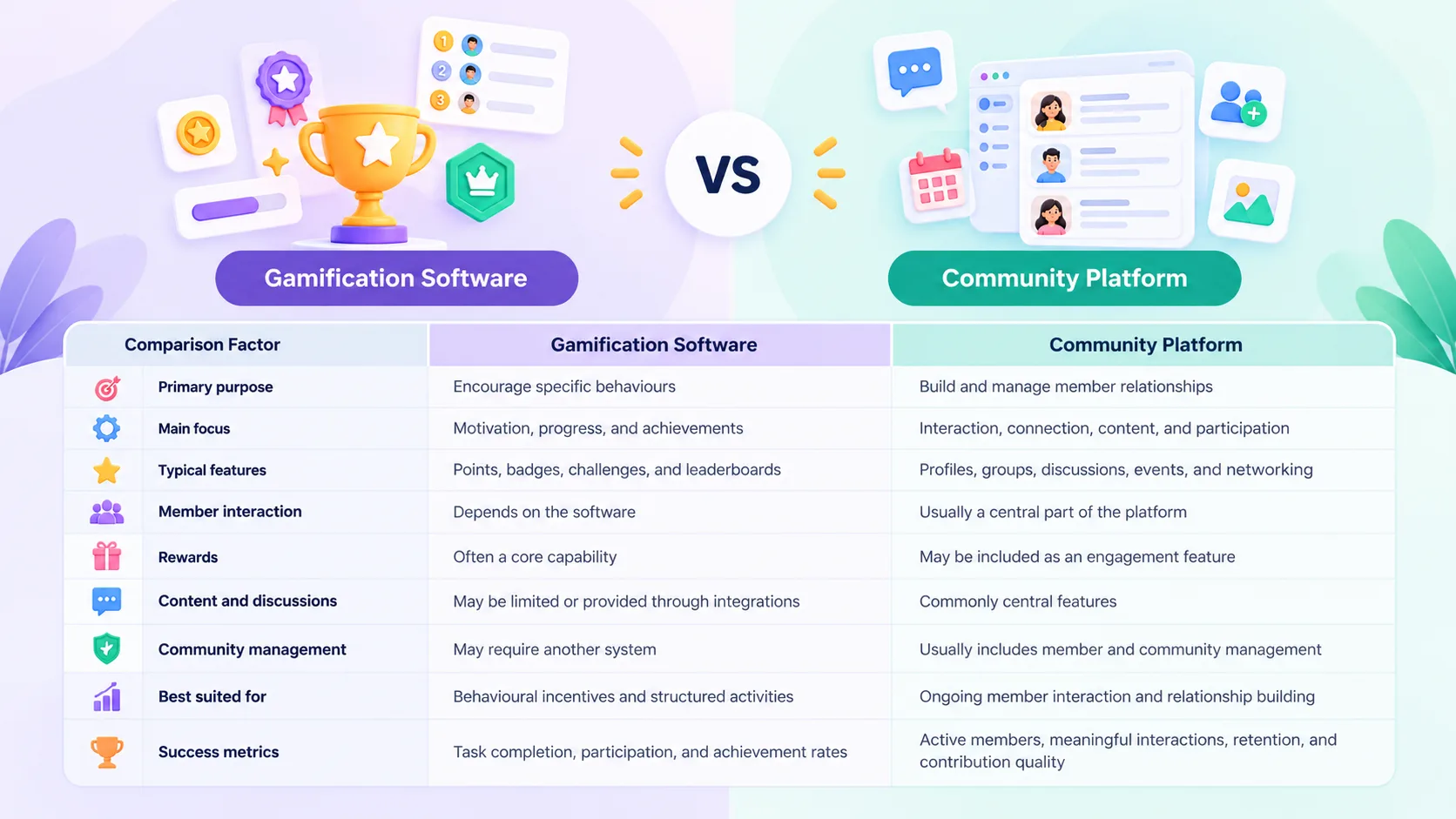
Gamification software helps businesses encourage specific behaviours through points, badges, challenges, and rewards. A community platform provides a broader environment for member profiles, discussions, content sharing, networking, and ongoing interactions. The right choice depends on your goals. Businesses looking to combine community building with structured participation incentives may benefit from using both.
Before choosing a solution, explore the community platform features every business should look for to understand which capabilities align with your business objectives.
What Is Gamification Software?
Gamification software uses game-inspired mechanics in non-game activities to encourage participation, motivate users, track progress, and reinforce desired behaviours.
Instead of relying only on traditional engagement methods, businesses can introduce points, achievements, challenges, and rewards to make specific activities more interactive.
For example, a company may reward employees for completing training modules, encourage customers to participate in a loyalty programme, or recognize community members who regularly contribute helpful answers.
Gamification software is useful when an organization wants to motivate people to take specific actions and measure their progress toward defined goals.
Common Features of Gamification Software
Although features vary by provider, most gamification solutions focus on motivating participation and recognizing achievements.
1. Points and Scores
Points allow businesses to assign value to specific actions. Users might earn points for completing tasks, participating in activities, or achieving defined milestones.
2. Badges and Achievements
Badges recognize accomplishments and provide visible markers of progress. They can reward activities such as completing a course, contributing useful information, or reaching a participation milestone.
3. Leaderboards and Rankings
Leaderboards display performance or participation rankings. They can encourage friendly competition when users understand the criteria and consider the competition fair.
4. Challenges and Missions
Challenges give users specific objectives to complete. Businesses can use them to encourage learning, product adoption, customer participation, or employee development.
5. Progress Tracking
Progress indicators help users understand how far they have progressed toward a goal. They can make larger tasks easier to manage by breaking them into smaller milestones.
6. Rewards and Incentives
Rewards recognize participation or achievement. Depending on the programme, they may include digital recognition, privileges, discounts, or other incentives.
7. Streaks and Milestones
Streaks recognize consistent participation, while milestones celebrate progress over time. These mechanics can encourage users to return regularly, provided the expectations remain reasonable.
8. Performance Dashboards
Where available, dashboards help administrators review participation, task completion, achievement rates, and other relevant metrics.
The value of these features depends on how well they support the intended behaviour. Adding points or badges without a clear objective does not automatically produce meaningful engagement.
What Is Gamification Software Used For?
Gamification software can support several business activities.
Employee training: Organizations can use challenges, progress tracking, and achievements to encourage employees to complete learning programmes.
Customer loyalty: Businesses can recognize repeat purchases, referrals, and other activities that align with their loyalty programme.
Learning programmes: Educational organizations can use points, milestones, and achievements to make learning progress more visible.
Sales enablement: Sales teams can use challenges and performance tracking to encourage completion of training activities or progress toward defined objectives.
Product adoption: Businesses can encourage users to explore important product features and complete onboarding activities.
Community participation: Organizations can use rewards and recognition to encourage members to contribute content, answer questions, attend events, and participate in discussions.
For communities specifically, understanding the gamification features that support community engagement can help businesses choose participation mechanics that match their members’ needs.
What Is a Community Platform?
A community platform is a digital environment where people connect, communicate, share information, participate in discussions, attend events, and build ongoing relationships around a shared interest, organization, brand, or professional goal.
Unlike a standalone gamification tool, which primarily focuses on encouraging specific behaviours, a community platform provides the infrastructure for continuous interaction between members.
For example, a business may create a customer community where users exchange product knowledge, ask questions, share experiences, and participate in events. An organization may also use a community platform to connect employees, alumni, association members, or professional networks.
The primary purpose is to create a space where members can interact and continue finding value over time.
Common Features of a Community Platform
Community platforms bring together different tools that support member interaction and community management.
1. Member Profiles and Directories
Profiles help members introduce themselves, share relevant information, and discover other people with similar interests or professional backgrounds.
2. Communities and Groups
Groups allow members to organize conversations around specific topics, teams, interests, or objectives.
3. Content Feeds and Publishing
Content features allow members and administrators to share updates, articles, announcements, questions, and other useful information.
4. Discussions, Forums, and Chat
Discussion tools enable members to ask questions, exchange ideas, share experiences, and communicate with one another.
5. Networking and Member Connections
Networking features help members discover relevant contacts and develop relationships within the community.
6. Events and Activities
Event capabilities support the organization of webinars, workshops, meetings, networking sessions, and other community activities.
7. Moderation and Member Management
Administrative tools help organizations manage membership, oversee discussions, establish community guidelines, and maintain a suitable environment.
8. Analytics and Engagement Insights
Available analytics can help administrators understand member activity, participation patterns, content performance, and community growth.
9. Branding and Customization
Customization capabilities allow organizations to create a community experience that reflects their brand, audience, and objectives.
10. Gamification and Rewards
Some community platforms include built-in gamification features such as points, badges, leaderboards, challenges, and recognition.
The availability and depth of these capabilities vary by provider, so businesses should evaluate features against their actual requirements.
What Is a Community Platform Used For?
Community platforms support different types of organizations and audiences.
- Customer communities: Help customers exchange knowledge, find answers, and share product experiences.
- Employee communities: Support internal communication, knowledge sharing, and collaboration.
- Professional networks: Connect people within an industry, profession, or area of expertise.
- Educational communities: Bring together students, educators, researchers, and alumni.
- Association communities: Help associations maintain member relationships and encourage participation.
- Brand communities: Give customers and supporters a place to interact around a shared brand or interest.
Understanding what a community platform brings together can help businesses assess how member profiles, connections, discussions, content, events, and engagement features work together to support long-term relationships.
Gamification Software vs Community Platform: What Is the Difference?
The primary difference between gamification software and a community platform is their purpose.
Gamification software focuses on motivating specific behaviours through game-inspired mechanics. A community platform focuses on creating an environment where members can interact, share information, and build relationships.
The following comparison highlights their main differences.
| Comparison Factor | Gamification Software | Community Platform |
| Primary purpose | Encourage specific behaviours | Build and manage member relationships |
| Main focus | Motivation, progress, and achievements | Interaction, connection, content, and participation |
| Typical features | Points, badges, challenges, and leaderboards | Profiles, groups, discussions, events, and networking |
| Member interaction | Depends on the software | Usually a central part of the platform |
| Rewards | Often a core capability | May be included as an engagement feature |
| Content and discussions | May be limited or provided through integrations | Commonly central features |
| Community management | May require another system | Usually includes member and community management |
| Success metrics | Task completion, participation, and achievement rates | Active members, meaningful interactions, retention, and contribution quality |
Actual features vary by provider. Some gamification products include community functionality, while modern community platforms may offer built-in gamification tools.
This distinction matters because businesses should choose based on the problem they need to solve, not simply the number of features a product advertises.
A company that already has an active application and wants to encourage users to complete specific tasks may need gamification software. An organization that wants to build a branded environment for discussions, networking, and ongoing member relationships may need a community platform.
Businesses that want both capabilities should evaluate whether one solution can meet their requirements before purchasing separate tools.
What Are the Key Benefits of Gamification Software?
Gamification software can help organizations structure participation and make progress more visible. Its effectiveness depends on the relevance of the activities, the design of the incentives, and the needs of the people using it.
Encourages Specific Actions
Gamification allows businesses to identify desired behaviours and create incentives around them.
For example, a training programme may reward employees for completing modules, while a customer programme may recognize users who complete onboarding activities.
Clear objectives help participants understand what is expected and why an activity matters.
Makes Progress Visible
Progress bars, milestones, scores, and levels show users how far they have progressed.
This can make larger objectives easier to approach by breaking them into manageable steps. Participants can see what they have completed and what remains.
Supports Training and Learning
Training programmes can use challenges, achievements, and progress indicators to encourage learners to complete activities.
For instance, an organization might divide a training course into stages and recognize learners as they complete each stage.
These features support participation, but they should complement useful learning content rather than replace it.
Recognizes Performance and Contributions
Badges, scores, and rewards provide ways to recognize specific accomplishments.
In a community setting, recognition might be given to members who answer questions, share useful resources, or contribute to discussions.
Recognition works best when the criteria are clear and the activities being rewarded are genuinely valuable.
Helps Track Participation
Gamification tools may provide reports on task completion, activity levels, achievement rates, and participation patterns.
These insights help administrators identify which activities attract participation and where users may need additional support.
However, increased activity does not automatically translate into better business outcomes. Organizations should connect participation data with the goals they want to achieve.
For more context, explore the role of gamification in community engagement.
What Are the Key Benefits of a Community Platform?
A community platform provides a shared environment for people to connect, communicate, and contribute over time.
Builds Long-Term Member Relationships
Community platforms give members opportunities to interact beyond individual transactions or isolated activities.
Through ongoing conversations, networking, and shared experiences, members can develop relationships with other people and with the organization supporting the community.
For businesses, these relationships may support customer education, knowledge sharing, and continued participation.
Brings Communication Into One Environment
Without a dedicated community space, conversations may be scattered across email, messaging applications, social networks, and separate event tools.
A community platform can bring discussions, content, events, and member interactions into a more organized environment.
This makes it easier for members to find relevant information and continue conversations over time.
Encourages Peer-to-Peer Knowledge Sharing
Members often have experiences and knowledge that can help others.
A community platform provides a place for members to ask questions, share advice, exchange solutions, and discuss common challenges.
Over time, useful discussions can become a knowledge resource for the wider community.
Supports Events and Networking
Events, group activities, and member discovery tools create opportunities for people to connect.
Organizations can use these capabilities to host discussions, organize educational sessions, and bring members together around shared interests.
The value comes from creating opportunities for meaningful interaction, not simply increasing the number of events.
Provides Community-Level Insights
Community analytics can help administrators understand participation, identify active members, evaluate content performance, and monitor growth.
These insights support decisions about content, onboarding, event planning, and engagement strategies.
Organizations should focus on metrics that reflect their objectives rather than treating every activity measure as a sign of success.
Businesses looking to improve results can also explore how to improve user interaction and retention in community platforms.
Gamification Software vs Community Platform: Which Do You Need?
The right choice depends on whether your primary goal is to motivate specific actions, build ongoing relationships, or achieve both.
Choose Gamification Software If…
A standalone gamification solution may be appropriate when:
- You already have a website, application, learning system, or platform where users interact.
- You want to introduce points, badges, challenges, or achievements.
- Your main objective is to encourage specific actions.
- You need progress tracking for learning or training.
- Your existing system already handles communication and community interactions adequately.
- You want to recognize task completion or participation without creating a separate community environment.
Example: A company has an employee training portal and wants to encourage employees to complete learning modules. It introduces progress indicators, achievement badges, and structured challenges within the existing system.
In this case, gamification software may address the primary need without requiring a separate community platform.
Choose a Community Platform If…
A community platform may be the better fit when:
- You need a dedicated place for members to connect.
- Discussions, networking, content, and events are important.
- You need tools to manage members, groups, and community spaces.
- Your audience needs ongoing peer-to-peer interaction.
- You want to build a branded community around a business, organization, or shared interest.
- You want members to exchange knowledge and develop relationships over time.
Example: A business wants to create a customer community where users can discuss products, ask questions, share experiences, attend events, and connect with other customers.
In this case, a community platform provides the environment needed for continuous interaction and relationship building.
If you are unsure whether this is the right investment, review the signs your business needs a dedicated community platform.
Choose Both If…
Businesses may benefit from combining a community platform with gamification when they need an environment for ongoing interaction and structured incentives that encourage participation.
For example, a customer community may provide member profiles, discussions, events, and shared resources. Gamification can complement these features by recognizing members who answer questions, attend events, or contribute useful content.
Similarly, an employee community may use challenges and recognition to encourage knowledge sharing and participation in internal activities.
The two approaches serve different purposes:
- The community platform provides the environment for members to interact.
- Gamification provides mechanics that encourage specific actions within that environment.
However, a separate gamification product may not be necessary if the selected community platform already includes the required points, badges, rewards, or challenges.
The decision should be based on feature requirements, integration needs, user experience, and total cost.
Can a Community Platform Replace Gamification Software?
A community platform can replace standalone gamification software in some situations, but not all.
If a community platform includes the gamification features a business needs, it may be sufficient to manage member interactions and encourage participation in one environment.
For example, an organization that needs member discussions, profiles, events, badges, and basic participation challenges may not need a separate gamification tool.
However, specialized gamification software may be more suitable when the organization requires advanced game mechanics, complex scoring rules, highly customized reward systems, or integrations with existing applications.
Before deciding, evaluate the following factors.
Required gamification mechanics: Determine whether built-in features support the points, challenges, scoring rules, achievements, and rewards you need.
Integration requirements: Check whether the solution works with your existing website, application, CRM, learning management system, or other business tools.
Reporting and analytics: Assess whether the available reporting capabilities provide the information required to evaluate participation and performance.
Customization: Determine whether you can configure the experience to match your business rules and programme objectives.
Member experience: Consider whether the solution makes it easy for users to participate without introducing unnecessary complexity.
Total implementation and operating costs: Include subscriptions, setup, integrations, administration, maintenance, and staff time.
The goal is to select a solution that meets your actual requirements without paying for unnecessary functionality or creating avoidable operational complexity.
How Does Thrico Combine Community Building and Gamification?
Thrico brings community-building capabilities and engagement mechanisms together within a community platform.
This approach can be relevant to organizations that want to create a dedicated environment for member interaction while also encouraging participation through recognition and incentives.
The suitability of the platform depends on the specific features required and how they align with the organization’s goals.
Community Spaces and Member Connections
Community spaces, member profiles, connections, and conversations provide the foundation for interaction.
These capabilities can help organizations create places where members discover relevant people, exchange information, participate in discussions, and build ongoing relationships.
For example, a customer community can give users a place to share experiences and discuss common questions. A professional community can help members connect with others in their industry.
Gamification and Recognition
Gamification mechanisms can complement community interactions by recognizing specific activities and achievements.
Depending on the available capabilities, these mechanisms may include points, badges, leaderboards, rewards, and challenges.
Organizations can use such features to recognize helpful contributions, encourage participation in events, or structure activities around community objectives.
The important consideration is whether the incentives encourage behaviours that genuinely benefit members and the community.
A Connected Member Experience
Combining community interactions with participation incentives can help organizations manage relationships and encourage contributions within the same environment.
Rather than treating member interaction and gamification as completely separate activities, businesses can evaluate how the two work together to support their goals.
For example, a community may offer discussions and knowledge-sharing resources while recognizing members who contribute useful answers.
Explore the Thrico community platform to learn more about its community infrastructure and engagement capabilities.
As with any platform, businesses should evaluate the actual features, analytics, integrations, and operating requirements before making a decision. Results depend on how the solution is implemented and used.
How to Choose the Right Solution for Your Business
Choosing between gamification software and a community platform becomes easier when you evaluate your requirements systematically.
1. Define Your Primary Objective
Start by identifying the problem you want to solve.
Do you want users to complete specific activities, participate in training, or achieve defined milestones? Gamification may be the primary requirement.
Do you want members to connect, share knowledge, participate in discussions, and build ongoing relationships? A community platform may be more appropriate.
If both goals are important, consider a solution that combines the required capabilities.
2. Evaluate Existing Tools
Review your current technology stack before purchasing anything new.
You may already have a platform that supports communication, user accounts, and content sharing. In that case, adding gamification functionality could be sufficient.
Alternatively, if interactions are scattered across different tools and there is no dedicated member environment, a community platform may address a more fundamental need.
3. Compare Required Features
Create a list of essential and optional features.
For gamification, essential requirements might include points, badges, challenges, scoring rules, and progress tracking.
For a community platform, they might include member profiles, discussions, groups, events, moderation, analytics, and branding.
If you need both, identify whether one platform can meet the requirements or whether integrations are necessary.
4. Check Integrations and Scalability
Consider how the solution will work with your existing systems and future plans.
Evaluate integration requirements, data access, administrative workflows, customization, and the ability to support your expected community size.
A solution that meets your immediate needs should also fit your likely operational requirements as the programme develops.
5. Calculate Total Cost
Compare the full cost of ownership rather than looking only at subscription prices.
Include implementation, integrations, maintenance, administration, training, content, and staff time.
A standalone gamification tool may be economical when added to an existing platform. However, purchasing multiple tools can introduce additional costs and complexity.
A community platform with suitable built-in gamification may reduce the need for separate systems, depending on the features required.
6. Define Success Metrics
Choose metrics that reflect the solution’s purpose.
For gamification, relevant measures may include task completion, participation, achievement rates, and progress through learning activities.
For a community platform, relevant measures may include active members, meaningful interactions, retention, knowledge contributions, and event participation.
If you use both, evaluate whether the combined approach supports the outcomes you intended to achieve.
Defining success metrics before implementation makes it easier to assess performance and identify areas for improvement.
Conclusion
Gamification software and community platforms address different but complementary business needs.
Gamification software helps organizations encourage specific behaviours through points, badges, challenges, rewards, and progress tracking. Community platforms provide the environment for members to connect, share knowledge, participate in discussions, attend events, and build lasting relationships.
If your primary objective is to motivate users within an existing application, gamification software may be sufficient. If you need a dedicated environment for member interaction and relationship building, a community platform is likely to be the better fit.
Businesses that want to combine ongoing community interaction with structured participation incentives should evaluate whether a platform with built-in gamification can meet both requirements.
Thrico brings community-building capabilities and engagement mechanisms together, giving organizations an option to consider when evaluating their community needs.
Ultimately, the right solution is the one that supports your business objectives, fits your existing systems, delivers the required member experience, and provides a practical way to measure success.
Frequently Asked Questions
Gamification software uses game-inspired mechanics such as points, badges, challenges, and rewards to encourage specific behaviours. A community platform provides an environment for members to connect, share content, participate in discussions, attend events, and build relationships. Businesses should choose based on their objectives and may use both when they need community interaction and structured participation incentives.
Yes. Some community platforms include gamification features such as points, badges, leaderboards, challenges, and rewards alongside member interaction and community management tools. However, the available features vary by provider, so businesses should verify that a platform meets their requirements.
Not necessarily. Gamification software can encourage participation, but it may not provide the member profiles, discussions, groups, content publishing, events, and community management tools needed to build an ongoing community. If these capabilities are important, a dedicated community platform may be more suitable.
A business should consider both when it needs a dedicated environment for member interaction and specialized gamification capabilities to encourage specific behaviours. For example, a customer community may need discussions and networking alongside challenges and recognition for helpful contributions. However, a separate gamification tool may be unnecessary if the community platform already provides the required features.
Gamification can encourage participation by recognizing achievements, setting clear goals, and making progress visible. Its effectiveness depends on the relevance of the incentives, the needs of the members, and the quality of the overall community experience. Businesses should measure whether gamification contributes to meaningful participation rather than assuming that more points or badges automatically improve engagement.
Neither solution is universally better. A community platform is generally more suitable for ongoing member interaction and relationship building, while gamification software focuses on encouraging specific actions. The right choice depends on your objectives, existing tools, required features, and budget.
Thrico’s community platform positioning combines community interactions with engagement mechanisms. Businesses interested in gamification should review the current platform capabilities and confirm that the available features meet their specific requirements for points, badges, rewards, challenges, and recognition before making a purchasing decision.