Gamification in communities has bloomed as an effective way to increase user engagement and motivation. By using game design elements like points, badges, leaderboards, and quests in contexts other than games, community platforms have an opportunity to make interactions more fun and rewarding. Gamification capitalises on our human faculties for achievement and recognition to encourage active participation. Community managers are constantly searching for new ways to encourage more interaction and loyalty among members, and gamification has become an increasingly appealing approach.
At Thrico, we help organisations use gamification to unlock the potential of their communities and transform passive audiences into engaged members. In this blog, we will highlight the benefits of gamification on community platforms with examples of how it can drive engagement, loyalty, collaboration, learning, positive behaviors, and brand equity.
What is gamification in community platforms?
Points:
Gamification is the purposeful use of game design elements in non-game settings to improve engagement levels. In community platforms, these typically consist of:
Points are earned by taking part in activities such as posting, commenting, or completing tasks.
Badges:
Badges represent levels of achievement, serving as visual tokens for milestone accomplishments or specific actions.
Leaderboards:
Leaderboard ranks drive healthy competition among users.
Challenges:
Challenges are fun, time-bound activities that engage users to try different activities.
Rewards:
Rewards are tangible or digital rewards that reinforce participation.
Thrico implements these elements into our platform to build active, value-led ecosystems.
How Gamification Enhances Engagement
Gamification turns typical community engagement into fun and rewarding:
Encouraging Engagement:
Points and badges incentivise users to post regularly.
Keeping Users Engaged:
Leaderboards and streaks help bring users back.
Driving Engagement:
Contributing or working together on a challenge can facilitate greater conversation.
Thrico’s gamification module for community engagement helps brands and associations create spaces where members are genuinely excited to engage with each other and share and move forward together.
Boosts User Retention and Loyalty
Gamification builds the “stickiness” of platforms by
Using Achievements:
Rewards and recognitions keep users coming back over time.
Creating Connections:
Shared milestones and friendly competition encourage a mutually beneficial relationship.
Personal Engagement:
Custom reward systems recognise individual journeys.
At Thrico, you will not only attract users, but you will also keep them coming back. Through gamification, we assist communities in retaining their top contributors by obtaining long-term loyalty.
Fosters Healthy Competition and Collaboration
Gamification rewards both individual performance and group collaboration.
Leaderboards:
Users receive motivation to increase their contributions.
Peer Recognition:
Badges and mentions enable members to express acknowledgement to each other.
Group Challenges:
Users engage in team-based activities together with other functions.
Thrico’s platform engages clients enjoyably, incorporating competition with collaboration to foster community positively and productively.
Promotes Learning and Skill Development
Gamified communities cultivate peer learning.
Knowledge sharing:
Users earn rewards based on the helpfulness of answers and insights.
Level-up paths:
Visual progress systems provide a look at growth and expertise.
Mentorship support:
Acknowledge and reward users who mentor other users.
Thrico supports communities that foster learning by embedding gamification tools that recognise expertise and allow users to continually grow.
Encourages Positive Behavior and Community Guidelines
Gamification is the systematic process of building incentives into an online community to support super-nice behavior
Reputation Scores:
Recognition of civility and helpfulness.
Description:
An aggregate of civic behaviors and positive interactions around the site.
Behavioral Rewards:
Recognition of respectful constructive interaction.
Spam Control:
A disincentive for trolls via automated moderation.
Thrico’s gamified reputation systems contribute to the creation of safe and inclusive high-value online environments.
Business and Brand Benefits
Beyond engagement, gamification delivers major value to brands:
Brand Advocacy:
Engaged users frequently become organic advocates.
Monetization Opportunities:
Increased time on the platform drives revenue.
Customer Support:
Self-service help forums can reduce operational costs.
Thrico turns organizations’ community platforms into brand amplifiers and revenue drivers through gamification.
Conclusion
The advantages of gamification in community platforms range from increasing user engagement and loyalty to fostering collaboration and enhancing learning. How we can help you at Thrico is to turn community participation into a fun experience for users and a real growth opportunity for your brand.
Community engagement is the heartbeat of thriving online spaces. Whether you run a brand community, a creator hub, a customer support forum, or a private membership network, the metric that silently predicts your long‑term success is engagement — not just headcount. Members who consistently show up, contribute, and connect with others generate the content, feedback, and relationships that keep your community alive. The problem? Attention is scarce, distractions are everywhere, and even valuable communities can feel like a chore without the right motivation loops.
That’s where gamification steps in. By weaving game‑like elements — points, badges, leaderboards, streaks, missions, and more — into your community experience, you make participation feel fun, meaningful, and rewarding. Done right, gamification can lift participation rates, boost retention, and turn lurkers into loyal contributors who actively share insights, content, and enthusiasm.
In this in‑depth guide, we’ll break down the psychology of gamification in online communities, show you practical gamification ideas you can deploy today, and walk you through implementing them step‑by‑step. You’ll also gain best practices, insights into common pitfalls to avoid, and a look at what’s next as AI and digital collectibles continue to evolve the space.
If you’re ready to increase user participation with proven engagement strategies, let’s dive in.
What is gamification in online communities?
At its simplest, gamification applies game design mechanics to non‑game contexts to motivate behavior. In communities, this means utilizing elements such as points, badges, leaderboards, challenges, and quests to encourage members to post, comment, share, attend, and assist others.
Why obsess over engagement? Because engagement compounds. A highly engaged member contributes content that attracts others, sparks discussion, and creates value that keeps people coming back. Engagement also predicts member retention, conversion to paid tiers or purchases, and content sharing beyond the platform. It’s the closest thing to a universal health score for communities.
When you add the right gamified incentives, you create reward loops that reinforce positive behaviors — posting, answering questions, welcoming newcomers, and sharing helpful resources. Over time, these loops drive participation, loyalty, and a vibrant culture.
What is Gamification in Community Engagement?
Definition:Gamification is the use of game‑like elements — points, badges, leaderboards, and challenges — to make community participation fun and rewarding.
1. The psychology behind gamification
Reward loop: When an action produces a visible reward (points, recognition, progress), we’re more likely to repeat it. Consistency turns actions into habits.
Intrinsic vs. extrinsic motivation: Badges and points are extrinsic, but they can amplify intrinsic drivers such as mastery, purpose, and belonging. The best systems support both.
Progress and competence: Humans love to see progress. Levels, streaks, and skill paths signal mastery and keep members moving forward.
Social recognition: Public shoutouts, leaderboards, and peer nominations tap into our desire for status and appreciation — powerful motivators when used respectfully.
Loss aversion: Streaks make people reluctant to miss a day and “lose” progress, encouraging consistent micro‑actions.
2. Familiar examples you already know
Reddit Karma: Rewards contributions that the community upvotes, surfacing reputable voices.
Stack Overflow Badges: Structured achievements for helpful answers and sustained contributions.
Fitness Apps (e.g., Apple Watch): Rings, milestones, and monthly challenges that push daily consistency.
These models translate cleanly to community spaces, regardless of your niche.
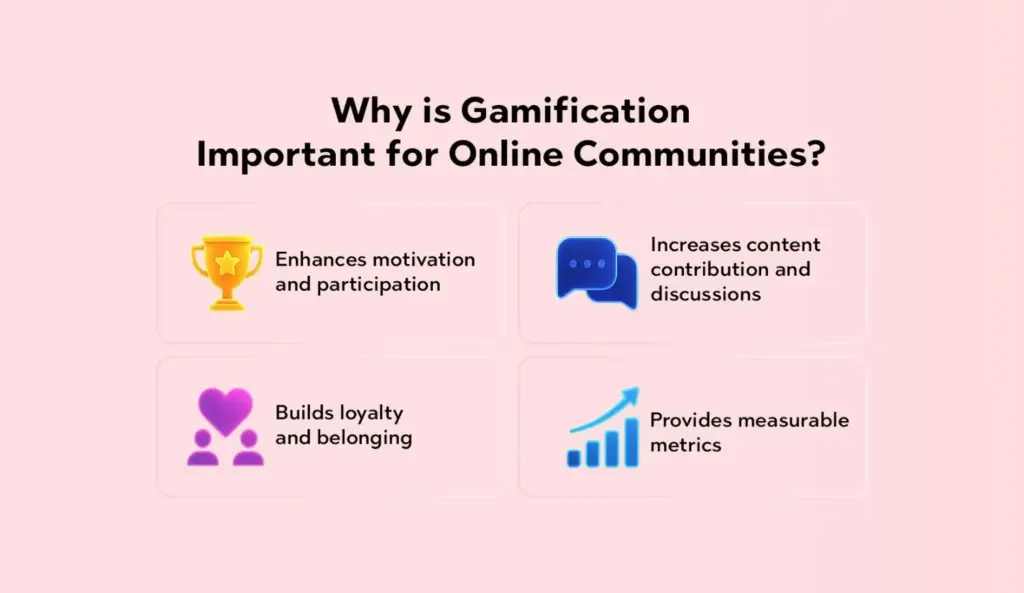
Why is Gamification Important for Online Communities?
Enhances motivation and participation: Members see immediate feedback for helpful actions, which creates momentum.
Increases content contribution and discussions: When posts, answers, and shares earn rewards, members create more value.
Builds loyalty and belonging: Recognition (badges, spotlights, titles) strengthens identity within the group.
Provides measurable metrics: Points, levels, streaks, and challenge completions provide admins with clear data to track.
A directional stat: Communities that thoughtfully implement gamification frequently report materially higher activity; many cite up to ~48% higher active participation after rollout. Your mileage will vary, but the lift can be significant when aligned with meaningful actions.
Top Gamification Ideas to Increase Community Engagement
Below are ten practical gamification ideas you can launch in any modern community platform. Mix and match based on your goals, member personas, and content format.
1) Points and Rewards System
What it is: Members earn points for actions like creating posts, commenting, answering questions, attending events, inviting friends, or completing onboarding.
How to set it up:
Map points to your north‑star behaviors. For example: 10 points for a thoughtful post, 5 for a helpful comment, 3 for upvoting, 20 for verified solutions.
Provide redeemable rewards: role titles, special badges, early access to content, discount codes, event tickets, or credits for community merch.
Add anti‑spam safeguards: rate limits, minimum character counts, and moderator review for low‑effort activity.
Example:Members earn 10 points for every new post they share and 20 points when their answer is marked as a solution.
Pro tip: Pair points with seasonal resets (e.g., quarterly) so new members can catch up while lifetime totals still track long‑term contribution.
2) Challenges and Missions
What it is: Time‑boxed quests that encourage specific behaviors. Weekly “Share your best tip,” monthly “Resource Roundup,” or themed learning sprints.
How to set it up:
Publish a calendar of challenges with clear success criteria.
Offer completion badges and bonus points for streaking across multiple challenges.
Spotlight standout entries in a monthly recap post or live session.
Why it works: Challenges add urgency and give members a reason to participate now, boosting consistency without heavy moderation.
3) Leaderboards
What it is: Public rankings that celebrate top contributors by points, accepted answers, challenge wins, or badges.
How to set it up:
Show weekly and monthly boards (not just all‑time) to lower the barrier for newer members.
Display avatars and short titles (“Top Helper,” “Insight Machine”) for personality.
Consider opt‑out and anonymized aliases for privacy‑conscious members.
Pro tip: Reset leaderboards monthly or seasonally to keep the race fresh while preserving lifetime stats on member profiles.
4) Badges and Achievements
What it is: Visual markers awarded for milestones: First Post, Top Contributor, 5 Helpful Answers, Event Regular, Welcome Wagon.
How to set it up:
Bundle badges into tracks (Learning, Helping, Leadership, Creativity) so members can pursue identities that match their strengths.
Use tiered badges (Bronze → Silver → Gold) to signal progression.
Make criteria transparent and visible on badge hover or in a badge directory.
Why it works: Badges turn invisible good deeds into visible micro‑status, which motivates both the earner and others.
5) Streaks and Progress Tracking
What it is: Daily or weekly counters that reward consistent participation — think Duolingo, but for your community.
How to set it up:
Let members set personal cadence goals (e.g., “2 helpful contributions per week”).
Offer streak protection tokens for vacations or emergencies.
Show gentle reminders when streaks are about to break.
Pro tip: Pair streak milestones with small perks: custom profile frames at 7, 30, 100 days; access to exclusive threads at 12 weeks.
6) Polls and Interactive Quizzes
What it is: Lightweight, low‑friction activities that invite everyone to click, vote, or learn.
How to set it up:
Run weekly polls about topics, product ideas, or upcoming events.
Host short quizzes with leaderboards for bragging rights.
Offer participation points for voting and bonus points for thoughtful comments.
Why it works: Polls and quizzes lower the activation energy. Even lurkers will often click a button — and that small action can lead to bigger ones.
7) Peer Recognition and Shoutouts
What it is: Members can nominate others for titles like Member of the Month, Rising Star, or Helpful Contributor.
How to set it up:
Provide a simple nomination form and rotating judges (staff + respected members).
Announce winners publicly and add a permanent badge to their profiles.
Encourage nominees with honorable mentions — recognition scales well.
Why it works: Recognition from peers carries emotional weight, building trust and reinforcing a pro‑social culture.
8) Virtual Coins or Tokens
What it is: In‑platform currency that members earn and spend. Coins can tip great posts, unlock premium content, or redeem perks.
How to set it up:
Award coins for behaviors with real community value (solutions, tutorials, event hosting).
Create a store: shoutout credits, coaching sessions, merch, partner discounts, or gated channel access.
Allow micro‑tipping so appreciation becomes a habit.
Pro tip: Separate points (reputation) from coins (utility). One signals status; the other fuels an economy.
9) Learning Levels or Skill Progression
What it is: Structured learning paths with levels (Beginner → Intermediate → Advanced → Expert). Members unlock badges and privileges as they level up.
How to set it up:
Define level criteria: complete 3 tutorials, publish 1 how‑to post, answer 2 questions with accepted solutions, and pass a short quiz.
Offer level‑specific perks: access to mentor channels, event discounts, or the right to host community sessions.
Visualize progress on member profiles so advancement is tangible.
Why it works: Progression taps into mastery and purpose — intrinsic drivers that sustain engagement far beyond novelty.
10) Team Competitions and Group Goals
What it is: Collaborative contests where members rally around shared objectives: ship a community resource library in a month, co‑create a zine, or raise funds for a cause.
How to set it up:
Form balanced teams (mix veterans and newcomers) and assign captains.
Score both output (deliverables) and behavior (helpfulness, documentation).
Celebrate team retrospectives so learning outlives the competition.
Pro tip: Alternate competitive sprints with cooperative quests where the entire community works toward a single progress bar and unlocks a collective reward when it fills.
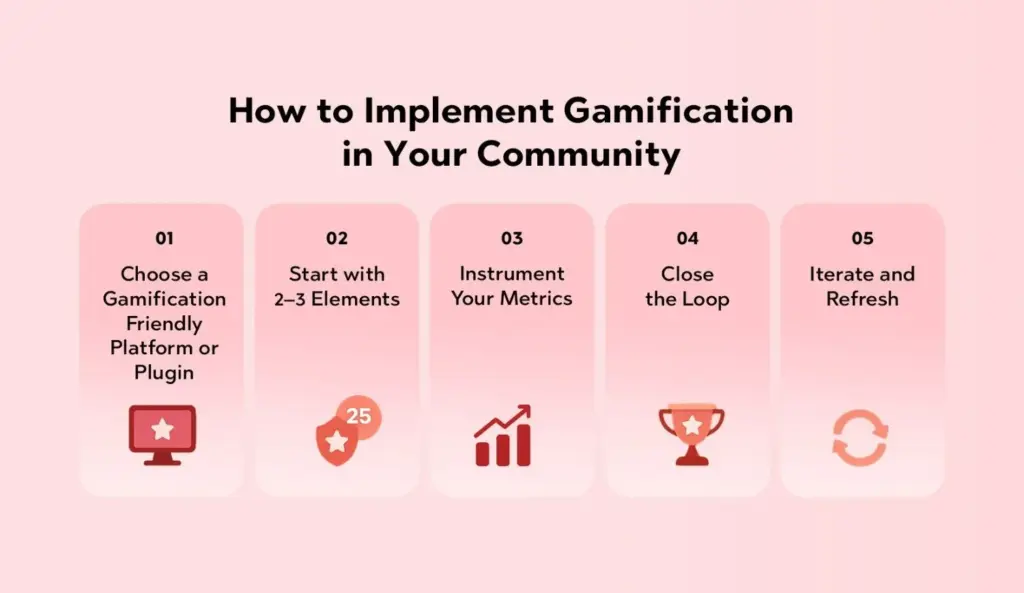
How to Implement Gamification in Your Community
You don’t need to overhaul your platform overnight. Start small, learn, and iterate.
Choose a Gamification‑Friendly Platform or Plugin
Many modern community platforms (e.g., Circle, Discourse, Tribe/Insided) provide native or add‑on mechanics. Choose tools that make it easy to assign points, issue badges, run challenges, and display leaderboards.
Start with 2–3 Elements
Launch with badges + points + a monthly challenge. Keep the system understandable and ensure every reward maps to valuable behaviors.
Instrument Your Metrics
Track weekly active members, post frequency, comment/answer ratio, challenge participation, streak counts, and cohort retention.
Close the Loop
Showcase winners, publish monthly recaps, and offer tangible (not just symbolic) perks so rewards feel meaningful.
Iterate and Refresh
Retire stale badges, rotate challenge themes, and introduce seasons so your system never feels dusty. Watch for unintended gaming and adjust point weights accordingly.
Looking for a platform that makes this easy? Explore Thrico’scommunity building tools to design points, badges, leaderboards, and more — without wrestling with plugins.
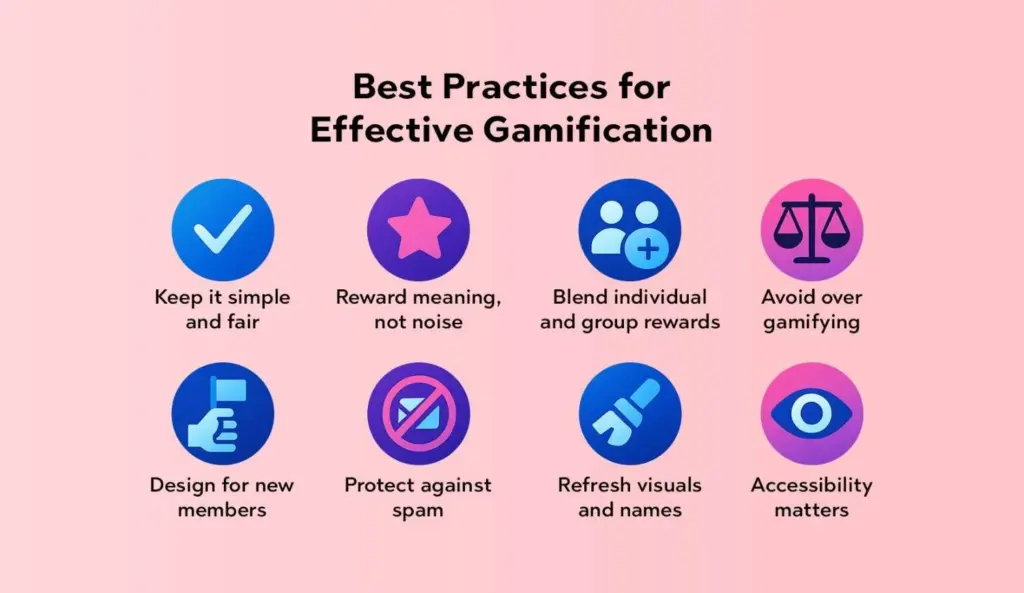
Best Practices for Effective Gamification
Keep it simple and fair. Members should instantly understand how to earn points and what rewards mean.
Reward means, not noise. Prioritize accepted answers, tutorials, peer recognition, and collaborations over raw post volume.
Blend individual and group rewards. Celebrate personal milestones and team wins to balance competition with camaraderie.
Avoid over‑gamifying. Not everything needs points. Leave space for organic connection and deep work.
Design for new members. Use onboarding quests and easy first wins (e.g., Introduce Yourself badge) to reduce the intimidation curve.
Protect against spam. Add friction where needed: character minimums, cooldowns, moderator flags, and quality thresholds.
Refresh visuals and names. Rotating badge art, seasonal titles, and fresh challenge themes keep excitement high.
Accessibility matters. Ensure badges, colors, and progress visuals work for all members (alt text, contrast, screen reader labels).
Common Mistakes to Avoid
Over‑indexing on points. Points alone can create noisy, low‑quality activity. Tie points to outcomes that help members.
Ignoring intrinsic motivation. Give members a purpose: learning, mastery, impact, belonging. The best systems elevate these, not overshadow them.
Pure competition, no collaboration. Leaderboards without peer recognition or team goals can demotivate non‑winners.
One‑size‑fits‑all rewards. Different personas crave different rewards. Offer a menu: recognition, access, learning, perks.
No feedback loop. Don’t set‑and‑forget. Ask members what feels meaningful and what feels like busywork, then iterate quickly.
Benefits of Gamification for Community Growth
Higher retention and loyalty: Members with clear progress paths and recognition stick around longer.
More and better content: Structured rewards encourage tutorials, case studies, and thoughtful answers, not just chatter.
Richer discussions: Polls, quizzes, and challenges spark ongoing debates and knowledge‑sharing.
Stronger brand–community connection: Visible appreciation and perks deepen the relationship between your organization and its members.
Operational clarity: Admins gain granular metrics to forecast growth, identify champions, and reward impact.
AI‑based personalization: Adaptive rewards that tailor challenges, content recommendations, and next best actions to each member’s behavior and goals.
Digital collectibles and credentials: NFT‑style badges or verifiable credentials that members can showcase across platforms and even on professional profiles.
Learning x Gaming convergence: Skill trees, boss battles (capstone projects), and cooperative quests that blur the line between course and community.
If you run an online community, you already know the golden rule: activity begets activity. The more members post, reply, and return, the healthier your community becomes. But sparking that virtuous cycle isn’t always easy—especially once the novelty fades. That’s where gamification in member engagement shines.
What is gamification? Gamification is the practice of applying game-like elements—such as points, badges, levels, streaks, and leaderboards—to non-game environments. In community platforms, it’s used to increase member activity by encouraging people to complete micro-actions (like reacting to posts), return consistently (via streaks), and level up (through progression systems).
Why is gamification effective for community/member engagement? Humans are wired to respond to progress, status, and rewards. When your platform surfaces these motivators as visible signals—progress bars, badges, rankings—members feel an ongoing nudge to participate. The result is a system that transforms passive readers into active contributors.
Quick benefits at a glance:
Motivation: Clear goals and instant feedback keep members engaged.
Habit-building: Streaks, routines, and micro-rewards build daily momentum.
Retention: Members who feel progress (and recognition) return more often.
Community health: Gamification boosts posts, replies, and overall interaction quality.
In this guide, we’ll share gamification tips and tricks, concrete community gamification strategies, examples from well-known platforms, and practical steps to track what’s working. Whether you’re launching a new space or refreshing a mature community, this playbook will help you implement gamification thoughtfully—and sustainably.
What Is Gamification in Member Communities?
1. Definition in simple terms:
Community gamification means turning everyday member actions into a rewarding, trackable, and sometimes competitive experience. It gives members a reason to take action now, and a reason to return later.
2. How it works:
You connect member actions to rewards. When someone posts, comments, reacts, shares, or attends an event, the system grants points, progress, or status. Over time, members unlock levels, badges, or perks that recognize their contributions.
3. Common gamification elements:
Points: Earned for micro-actions (posting, commenting, reacting).
Badges: Milestones for meaningful achievements (100 posts, first helpful answer, event organizer).
Levels: Tiered progression that unlocks privileges (e.g., access to advanced groups or tools).
Leaderboards: Friendly competition across weekly/monthly periods to keep the race fresh.
Streaks: Daily or weekly activity chains that encourage consistency.
Challenges/Missions: Time-bound or themed tasks (e.g., “Welcome Week,” “Help a New Member,” “Share 3 resources this month”).
Reward Store: Redeemable points for digital goodies, profile highlights, or partner perks.
This blend of visible progress, status, and rewards nudges people to become the community’s heartbeat.
Why Gamification Boosts Member Activity
1. Psychological drivers:
Dopamine & Feedback Loops: Immediate feedback (a pop-up, sound, or animation) when someone earns a badge or completes a challenge provides a mini dopamine hit, reinforcing the action.
Competition & Social Proof: Leaderboards and public badges spark friendly competition and show what “good” participation looks like.
Mastery & Achievement: Levels and progress bars make improvement visible, satisfying the human desire to advance.
2. Builds consistency and engagement:
Streaks and time-boxed challenges encourage members to return frequently. When missing a day breaks a streak, people feel a small loss—so they log back in to maintain momentum.
3. Increases platform stickiness:
Members who invest time and effort into achieving status, earning badges, or maintaining streaks become emotionally committed. That personal investment turns your platform into a daily habit.
4. Encourages contribution and participation:
Gamification rewards the helpful behaviors you want to scale: thoughtful posts, insightful comments, event participation, and mentorship. Over time, your content quality rises in tandem with participation.
Best Gamification Strategies to Increase Member Activity
1. Add Points & Badges for Micro-Actions
What to reward:
Liking/reacting to posts
Commenting or replying
Posting helpful content (guides, tutorials, case studies)
Sharing resources or events
Marking answers as “accepted” or “helpful.”
Welcoming newcomers
Why micro-rewards matter: Micro-rewards provide instant confirmation that actions are valuable. They also lower the barrier to entry for new members. Not everyone will publish a detailed case study on day one—but most will like, react, or leave a short reply. Small wins compound into bigger contributions.
Pro tip: Assign slightly higher points to behaviors you want to drive most (e.g., helpful answers over generic reactions). This avoids gaming the system with low-effort interactions.
2. Use Levels & Progress Bars
Why levels matter: Levels quantify status. Seeing “Level 3 Contributor” or a progress bar at 75% gives members a clear, motivating goal. It also creates aspirational role models in the community whose behavior others follow.
Unlockable features or perks:
Access to specialized channels or topic Hubs
Ability to host events or AMAs
Profile flair and highlighted posts
Early access to new features, courses, or templates
Pro tip: Tie levels to trust and responsibility—not just vanity. As people level up, extend moderation capabilities, mentorship roles, or beta access. That deepens their connection to the community’s success.
3. Leaderboards to Encourage Friendly Competition
Implement weekly/monthly leaderboards: Short time frames keep the race fair and winnable for newcomers. Seasonal or campaign-based boards also add variety.
Community recognition:
Spotlight top contributors in a monthly roundup.
Give “Rising Star,” “Helper of the Month,” or “Knowledge Sharer” awards.
Feature winners on the homepage or newsletter.
Pro tip: Maintain multiple leaderboard categories (e.g., most helpful answers, most welcomes, most shared resources) so different member strengths can shine.
4. Challenges & Activity Missions
Daily/weekly challenges:
“Reply to 3 posts today.”
“Share one resource this week.”
“Attend one live session this month.”
Task-based rewards: Bundle actions into missions (e.g., “Onboard Hero: complete your profile, introduce yourself, and post your first question”). Completing a mission yields a badge, bonus points, or profile flair.
Event-based missions: Tie challenges to webinars, product launches, or community festivals. Offer event-limited badges to create urgency and FOMO.
Pro tip: Rotate themes (learning, networking, building, mentoring) so challenges feel fresh and inclusive for different member types.
6. Streaks to Build Daily Habits
Streak types to try:
Posting streak: Post once per day for N days.
Learning streak: Complete a lesson, quiz, or resource daily.
Loyalty streak: Log in or engage (react/comment) daily.
Pro tip: Offer grace periods or “streak freezes” to avoid burnout. Life happens; letting a member preserve a rare 60-day streak with a one-time freeze makes your system feel humane.
Perks and coupons: Redeem points for community swag, partner discounts, or event tickets. A transparent reward store makes the value of participation concrete.
Pro tip: Keep the economy balanced. If rewards are too cheap, you’ll see inflation (and lower perceived value). If they’re too pricey, members give up.
7. Personalized Rewards
AI-based recommendations: Surface challenges and content that match each member’s interests and skill level. A design learner sees design tasks; a marketer sees campaign-based missions.
Custom badges by interest: Offer “Topic Specialist” badges (e.g., “No-Code Pro,” “Kubernetes Helper,” “Email Strategy Mentor”) based on consistent contributions in specific tags.
Pro tip: Personalization increases the signal-to-noise ratio. Members engage more when the experience feels tailor-made.
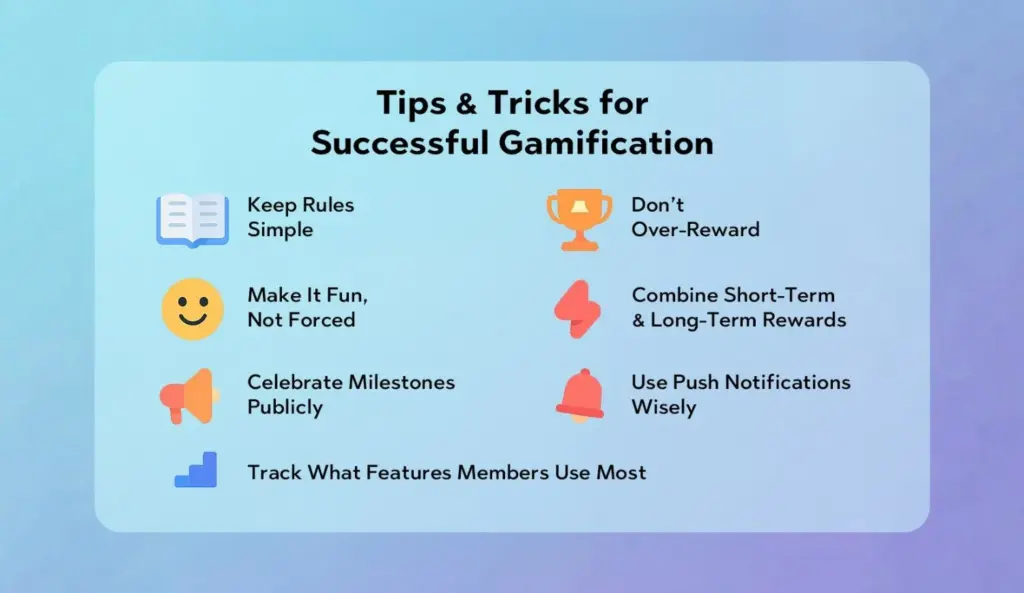
Tips & Tricks for Successful Gamification
Keep Rules Simple: If members can’t understand how to earn points or why their level changed, motivation drops. One clear rules page beats three complex ones.
Don’t Over-Reward: If everything earns points, nothing feels meaningful. Put a spotlight on high-value behaviors (helpful answers, tutorials, peer support).
Make It Fun, Not Forced: Gamification should feel like a bonus layer, not homework. Avoid nagging. Let members opt into challenges they care about.
Combine Short-Term & Long-Term Rewards: Pair quick hits (daily challenges) with deeper arcs (leveling, reputation). The mix keeps both new and veteran members engaged.
Celebrate Milestones Publicly: Announce new badge earners, leveling milestones, or challenge winners in a dedicated “Hall of Fame” thread.
Use Push Notifications Wisely: Nudge members to complete a streak or continue a challenge—but cap frequency to avoid fatigue.
Track What Features Members Use Most: Use analytics to see which badges or missions correlate with higher session duration or repeat logins, then double down on those.
Tools & Platforms That Support Gamification
1. Community platforms with built-in gamification: Many modern community platforms now include points, badges, leaderboards, and streaks out of the box, alongside analytics. When evaluating platforms, look for customizable rules, granular permissions, and automation (e.g., “grant badge when X occurs”).
2. Custom gamification systems: If you need special mechanics—like domain-specific challenges, complex reward stores, or AI-driven personalization—consider layering a custom rules engine on top of your existing stack via APIs.
3. Mobile-first gamification features: Push notifications, streak saves, and on-the-go challenges perform especially well on mobile, where members naturally check in multiple times per day.
4. Want to see community-building features in action? Explore Thrico’s community building tools to see how points, badges, leaderboards, and workflows can slot into your engagement strategy.
Common Mistakes to Avoid
Overcomplicated Game Mechanics: If members need a tutorial to understand your system, it’s too complex. Trim rules until they’re intuitive.
Reward Fatigue: Endless badges reduce meaning. Use tiers (Bronze/Silver/Gold) or seasonal badges instead of dozens of similar ones.
Ignoring User Feedback: Members will tell you which rewards feel valuable and which don’t. Run periodic surveys and adjust.
One-Size-Fits-All Rewards: Not everyone cares about swag or discounts. Offer experience-based rewards (mentorship sessions, early access) alongside tangible perks.
Lack of Moderation or Transparency: Ensure leaderboards can’t be exploited by spam. Publish anti-cheat rules and consequences.
How to Measure the Success of Gamification
Don’t fly blind. Tie your gamification plan to measurable outcomes and review them monthly.
1. Core metrics to track:
Daily Active Members (DAU): Are more members returning each day?
Post Frequency: Are posts, replies, and reactions trending upward?
Session Duration: Are members staying longer per visit after you introduced gamification?
Repeat Logins: What % of users return at least 2–3 times per week?
Challenge Participation Rate: How many members start and complete challenges? Which challenge types convert best?
Community Growth & Retention: Are new signups activating (e.g., first post within 7 days)? What’s 30/60/90-day retention post-gamification?
2. Attribution tips:
Roll out changes in phases or via A/B tests when possible.
Tag your analytics events clearly (e.g., badge_earned, mission_completed, streak_day_n).
Watch for quality signals: accepted answers, helpfulness votes, reports, or saved posts—not just raw volume.
Real Examples of Gamification That Work
Reddit Karma: Users earn karma for upvoted posts and comments. It’s simple, visible, and acts as a proxy for trust.
Duolingo Streaks: Daily learning streaks and leagues create a powerful habit loop. Streak freezes offer compassion without breaking motivation.
Discord Roles: Server-specific roles highlight status and grant permissions, turning participation into social capital.
LinkedIn Profile Strength Bar: A visible progress bar nudges users to complete profiles, improving both discoverability and platform value.
Adding inspiration for your own system:
Topic Master Badges: Award badges when members hit thresholds in specific tags (e.g., 25 verified answers in “Data Analytics”).
Community Mentor Track: Recognize members who routinely welcome newcomers or host office hours with “Mentor” status and special flair.
Seasonal Events: Run quarterly missions with limited-edition badges and a seasonal leaderboard. Resetting periodically keeps competition fresh.
Impact-Based Rewards: When a member’s tutorial reaches 1,000 views or their answer is marked helpful 10 times, grant a unique “Community Impact” badge with profile highlights for a week.
Conclusion
Thoughtfully implemented, gamification is one of the fastest, most reliable ways to increase member activity and deepen engagement. By rewarding micro-actions, showcasing progress, and creating friendly competition, you tap into core human motivators—achievement, status, consistency, and belonging.
The long-term impact is more than higher numbers. It’s cultural: a community where contributions are recognized, expertise is visible, and newcomers are welcomed into a living, breathing ecosystem. Start small—add points and a handful of badges, test a simple weekly challenge, and introduce a leaderboard. Then iterate based on data and member feedback. Over time, you’ll build community gamification strategies that are both sustainable and uniquely yours.
Ready to explore tooling? Take a look at Thrico’s community building tools to see how gamification and engagement workflows can come together in one place.
Implementation Checklist
Use this quick checklist to move from idea to execution:
Define outcomes: What behaviors do you want more of? (e.g., helpful answers, event attendance)
Map actions to rewards: Assign point values and badge criteria to each target behavior.
Design progression: Choose level thresholds and what each unlocks.
Plan challenges: Outline one weekly challenge and one monthly mission to start.
Add streaks with compassion: Include a one-time streak freeze or grace day.
Create a reward store (optional): Offer a mix of status, digital, and partner perks.
Moderation & anti-abuse: Rate-limit low-effort actions and flag suspicious activity.
Communicate simply: Publish one clear rules page and a monthly recognition post.
Iterate: Survey your members every quarter; prune, rebalance, and refresh.
Final Note
Gamification isn’t about turning your community into a game—it’s about making meaningful participation feel rewarding and visible. With the right balance of simplicity, recognition, and data-driven iteration, you can transform lurkers into leaders and build a community that sustains itself with energy, generosity, and momentum.
Communities thrive on participation. Whether you’re building a member forum, a customer hub, an online learning space, or a creator-led group, the central challenge is the same: how do you keep people coming back, contributing, and caring? One of the most effective answers today is gamification in community engagement—the strategic use of game mechanics to nudge, reward, and celebrate the actions that make your community stronger.
But gamification isn’t about turning your community into an actual game. It’s about selectively using proven motivators—points, badges, leaderboards, challenges, streaks, levels, and rewards—to shape behavior in ways that feel natural and fun. When done right, the role of gamification is to make participation feel meaningful, visible, and satisfying. When done poorly, it can create noise, vanity metrics, or even unhealthy competition.
This guide dives deep into the community engagement gamification playbook: what it is, why it matters, which gamification features for communities work best, how to implement them, and the pitfalls to avoid. You’ll also find practical examples, best practices, and a comprehensive FAQ to help you build a thoughtful, sustainable engagement system—ideally supported by community building tools like those offered at Thrico.
What Is Gamification?
At its core, gamification is about applying game mechanics in non-game platforms to encourage specific behaviors. In community settings, that means using mechanisms like points, levels, badges, and progress indicators to make everyday interactions feel rewarding.
Applying game mechanics in non-game platforms: You’re not building a game; you’re weaving game elements into posts, comments, events, learning paths, and feedback loops.
Motivates users to complete actions: Members are more likely to post, react, share, and help when they know those actions matter—and are recognized.
Increases activity and user retention: Over time, small motivational nudges add up to higher session frequency, longer time-on-site, and stronger identity within the community.
Gamification reframes routine behaviors as achievements on a journey. That shift—from “just posting” to “progressing and earning”—is where the magic happens.
Why Gamification Matters for Community Engagement
1. Makes participation fun
Even small playful elements—custom badges, celebratory animations, progress meters—can make routine actions feel rewarding. Fun shouldn’t be underestimated; delight changes habits.
2. Encourages users to contribute more
People enjoy seeing their impact. Points and visible milestones help members understand what “good participation” looks like and encourage them to do more of it.
3. Creates healthy competition
Leaderboards and seasonal challenges (e.g., weekly or monthly) can spark friendly rivalries—especially when combined with team formats or themed events.
4. Builds long-term loyalty
Progression systems (levels, titles, unlockable perks) give members a reason to stay active across weeks and months. When you invest in your profile, you’re more likely to return.
5. Enhances user satisfaction
Recognition is a powerful driver of satisfaction. Earning a badge for helpful answers or hitting a contribution streak feels good and builds positive associations with your brand.
Key Gamification Elements that Boost Engagement
Not all gamification is equal. These gamification features for communities consistently produce the strongest results when implemented thoughtfully:
1. Points & Rewards
What they are: Numeric values earned for actions like posting, commenting, sharing resources, attending events, answering questions, or inviting friends.
Why they matter: Points create a clear currency of effort. They also enable flexible incentives: members can spend points on perks, or you can use thresholds to unlock levels.
Best practice: Reward high-quality actions more than high-quantity spam. For example, a helpful answer verified by the community should be worth more than a simple emoji reaction.
2. Badges & Achievements
What they are: Visual markers representing milestones (e.g., “First Post,” “Top Contributor,” “Community Mentor,” “100 Helpful Answers,” “Event Champion”).
Why they matter: Badges boost profile value, status, and pride. They also help new members recognize who’s trusted or specialized.
Best practice: Combine role-based badges (moderator, expert) with achievement badges to highlight both responsibility and accomplishment.
3. Leaderboards
What they are: Ranked lists showing top contributors over a set period—daily, weekly, monthly, or seasonal.
Why they matter: Visibility breeds motivation. Public recognition motivates friendly competition and raises the bar for quality.
Best practice: Reset frequently (e.g., weekly or monthly) to give newcomers a chance to shine and prevent incumbents from dominating indefinitely.
4. Levels & Progression
What they are: Tiered stages (e.g., Bronze → Silver → Gold → Platinum) that members reach by accumulating points or completing milestones.
Why they matter: Levels signal growth and mastery. They can also unlock privileges (e.g., access to exclusive channels, beta features, or event discounts).
Best practice: Keep the first few levels easy to reach (to hook behavior), then increase difficulty to sustain long-term engagement.
5. Daily/Weekly Challenges
What they are: Time-boxed tasks like “Post your best tip this week,” “Answer 3 questions today,” “Join Friday’s AMA,” or “Complete a 5-day comment streak.”
Why they matter: Regular cadences shape habits. Short-term goals help members return and participate consistently.
Best practice: Align challenges with community goals (knowledge sharing, feedback collection, product discovery) and vary the themes to reduce repetition.
6. Virtual Gifts & Kudos
What they are: Peer-to-peer tokens of appreciation (kudos, hearts, virtual gifts) that highlight high-quality posts or helpful behavior.
Why they matter: Recognition from peers is deeply motivating and builds social bonds. A kudos economy can be more meaningful than points alone.
Best practice: Allow members to gift limited kudos per week to maintain their value and reduce inflation.
7. Streaks & Completion Bars
What they are: Visual indicators of consistent activity (“You’ve posted 7 days in a row!”) and progress meters that show how close a member is to finishing a task or leveling up.
Why they matter: Once a streak starts, people work hard not to break it. Progress bars convert abstract goals into tangible momentum.
Best practice: Offer gentle recovery options (e.g., “use a pass to save your streak”) to reduce frustration from unavoidable misses
How Gamification Improves Community Engagement
1. Encourages user-generated content (UGC)
Clear incentives tell members exactly what’s valued—tutorials, case studies, thoughtful comments, helpful answers—and reward them accordingly. Over time, this yields a self-sustaining UGC flywheel.
2. Improves retention through continuous motivation
Levels, streaks, and seasonal challenges create recurring reasons to return. Members stick around to protect streaks, finish challenges, or reach the next milestone.
3. Builds competitiveness and excitement
Friendly competition via leaderboards and team challenges energizes the community. Recognition ceremonies (e.g., monthly shoutouts) add fanfare and deepen social ties.
4. Increases participation in discussions, polls, and feedback
Design challenges around current community goals—product feedback week, learning sprint, or expert Q&A season—to crowdsource insights while making participation fun.
5. Strengthens the overall community experience
Gamification creates a shared language of progress and appreciation. When members see their contributions celebrated and their growth visualized, they feel seen, valued, and connected.
Examples of Gamification in Communities
Reddit karma system: Upvotes translate to karma, signaling contribution quality and reputation.
Duolingo streaks: Daily practice streaks, XP, and leaderboards keep learners consistent and engaged.
Thrico: Community platforms can embed points, badges, challenges, and leaderboards to accelerate member activity—powered by community building tools like those available at Thrico Features.
LinkedIn profile strength meter: A visible progress indicator nudges users to complete profiles.
Fitness apps with badges: Milestone badges and streaks turn consistent workouts into a rewarding journey.
Online learning communities with points & certificates: Structured pathways, assessments, and certifications reinforce progress and expertise.
These examples demonstrate a range of mechanics that can be adapted for any community’s goals.
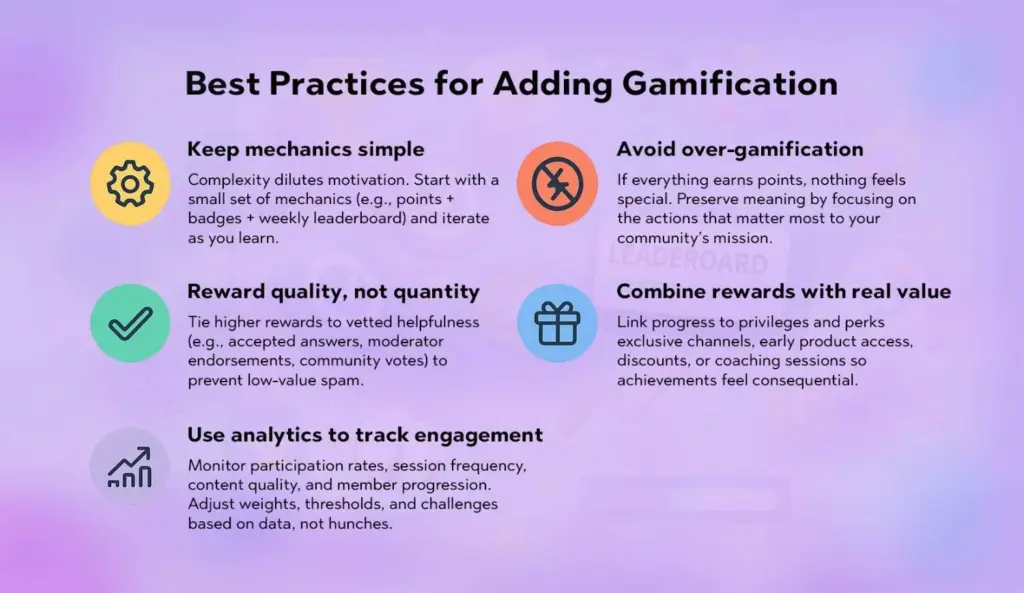
Best Practices for Adding Gamification
1. Keep mechanics simple
Complexity dilutes motivation. Start with a small set of mechanics (e.g., points + badges + weekly leaderboard) and iterate as you learn.
2. Avoid over-gamification
If everything earns points, nothing feels special. Preserve meaning by focusing on the actions that matter most to your community’s mission.
3. Reward quality, not quantity
Tie higher rewards to vetted helpfulness (e.g., accepted answers, moderator endorsements, community votes) to prevent low-value spam.
4. Combine rewards with real value
Link progress to privileges and perks—exclusive channels, early product access, discounts, or coaching sessions—so achievements feel consequential.
5. Use analytics to track engagement
Monitor participation rates, session frequency, content quality, and member progression. Adjust weights, thresholds, and challenges based on data, not hunches.
For an integrated approach, look for community-building tools that make it easy to configure points, badges, levels, and challenges in one place. Explore what’s possible with Thrico’s features.
Common Mistakes to Avoid
1. Giving too many meaningless badges
If badges are too easy or too frequent, they lose prestige. Curate a tiered, thoughtfully named set that tells a story of growth.
2. Creating unfair competition
Leaderboards that never reset or that favor early adopters can discourage newcomers. Use time-bound boards and rotating categories to keep things fair.
3. Not updating challenges regularly
Stale challenges lead to disengagement. Refresh themes, rotate formats (solo vs. team), and align with seasonal community priorities.
4. Lack of reward diversity
Not everyone is motivated by the same rewards. Mix status-based recognition, practical perks, and social appreciation.
5. Ignoring user feedback
Members will tell you what feels meaningful and what feels like noise. Listen, iterate, and show your work (“We rebalanced points based on your feedback.”).
Building a Gamification Strategy: A Step-by-Step Playbook
Define your north-star outcomes. Do you want more quality answers, richer tutorials, higher event attendance, or better onboarding completion? Pick 2–3 metrics that matter.
Map community actions to outcomes. List the behaviors that lead to your outcomes: posting solutions, mentoring newcomers, sharing case studies, and submitting product feedback.
Assign point values based on impact. A helpful answer verified by peers might be worth 10× a simple like. Encourage what moves the needle.
Design a clear progression path. Define levels (e.g., Explorer → Guide → Mentor → Champion), the thresholds for each, and the perks unlocked at every step.
Create a badge taxonomy. Mix foundational badges (first post, first reply), mastery badges (100 verified answers), and seasonal or campaign badges (Hackathon Hero).
Launch time-boxed challenges. Start with weekly or monthly challenges tied to your current goals—e.g., “Welcome Week,” “How-To November,” “Feedback Sprint.”
Add social recognition. Instituting kudos, shoutouts, and “Member of the Month” recognition magnifies the impact of points and badges.
Pilot with a cohort. Test with a small group, gather feedback, and adjust rewards and thresholds to feel fair and motivating.
Measure and iterate. Track participation, quality signals, and retention. Tune your system quarterly to keep it fresh and effective.
Automate with the right tools. Adopt a platform with configurable points, badges, leaderboards, and analytics. See what you can do with Thrico’s community-building tools.
Designing Rewards That Actually Motivate
A reward is only as powerful as the story it tells. Consider a layered approach:
Status rewards: Visible titles, profile frames, limited-edition badges.
Utility rewards: Discounts, credits, templates, priority support, and coaching.
Social rewards: Public shoutouts, spotlights, case study features, team captain roles.
Pair each reward with a clear narrative—why the member earned it and what it says about their contribution. For example, a “Community Mentor” badge isn’t just a graphic; it’s recognition of consistent, high-quality support for others.
Balancing Intrinsic and Extrinsic Motivation
Gamification leans on extrinsic motivators (points, badges, rewards), but long-term engagement depends on intrinsic motivators—purpose, mastery, autonomy, and belonging. Your design should:
Highlight purpose: Tie challenges to the community’s mission so contributions feel meaningful.
Celebrate mastery: Use levels and skill-based badges to recognize expertise and growth.
Promote autonomy: Let members choose from multiple challenge tracks (e.g., teaching, creating, organizing).
Strengthen belonging: Encourage peer recognition (kudos) and team-based goals to create shared wins.
When extrinsic and intrinsic elements reinforce each other, you get durable engagement—not just short-lived spikes.
Accessibility and Inclusivity in Gamification
Engagement should be for everyone. Consider:
Multiple paths to earn: Reward different kinds of contributions (writing, moderating, mentoring, organizing events, creating resources).
Fairness and anti-abuse: Use rate limits, moderation signals, and reputation checks to prevent gaming the system.
Clear language and visuals: Ensure badges and prompts are understandable, with alt text for images and descriptive labels for progress indicators.
Time-zone sensitivity: Run challenges long enough to include global members; announce start/end times with precise dates and time zones.
On-ramps for newcomers: Offer beginner quests to help new members learn the ropes quickly.
Inclusivity isn’t just ethical; it also expands your contributor base and builds a resilient culture.
Measurement: Knowing What Works
To ensure your community engagement gamification efforts are creating real value, track metrics across four dimensions:
Activation New member participation rate Time to first post/comment Onboarding quest completion
Engagement Weekly active contributors (not just readers) Average posts/comments per active member Challenge participation rates
Quality Ratio of accepted/endorsed answers Peer kudos per post Moderator review outcomes
Retention & Growth 4-week and 12-week contributor retention Streak continuity statistics Referral and invite conversions
Use these insights to rebalance points, re-theme challenges, and re-prioritize rewards. A data-informed loop is the difference between a one-off campaign and a sustainable engagement engine.
Gamification isn’t a gimmick; it’s a structured way to reward what matters. The role of gamification in thriving communities is to translate your values into visible signals—so members know what to do, why it matters, and how their efforts add up. With points that prioritize quality, badges that recognize real milestones, leaderboards that reset to keep things fair, levels that unlock meaningful perks, challenges that create exciting rhythms, and streaks that build habits, you can create an environment where contribution feels natural—and delightful.
If you’re ready to design or upgrade your system, consider powering your approach with community building tools that streamline configuration, analytics, and iteration. You can explore what’s possible with Thrico’s features.
Points, badges, levels, and engagement loops are the building blocks of thoughtful gamification. Used well, they motivate participation, make progress feel visible, and help communities turn casual visitors into long-term contributors. This guide distills how each element works, why it matters, and how to combine them into an effective, sustainable system—grounded in Thrico’s approach to modern community engagement.
What Are Points, Badges, Levels, and Engagement Loops?
Points are the basic “currency” members earn for valuable actions—posting, replying, sharing resources, attending events, inviting peers, or completing learning paths. Thoughtful point systems weigh high-impact behaviors (like verified helpful answers) more than low-effort actions to encourage quality over quantity. (Thrico)
Badges are visible markers of achievement and identity—“First Post,” “Top Contributor,” “Community Mentor,” or campaign-themed awards. They signal expertise, reward milestones, and help newcomers quickly recognize trusted members.
Levels (or progression tiers such as Bronze → Silver → Gold → Platinum) show cumulative growth. They unlock privileges and perks—access to private groups, beta features, or event discounts—so members have tangible reasons to keep participating over weeks and months.
Engagement loops are the repeatable cycles that create habits: a member takes an action, receives timely feedback (points, progress bars, kudos, or a badge), and is prompted toward the next meaningful action. Loops are reinforced with streaks, weekly challenges, or seasonal leaderboards to keep momentum fresh.
Together, these elements form a simple pattern: clear actions → instant feedback → visible progress → meaningful rewards. When combined in a community platform like Thrico, they transform routine participation into a motivating journey that sustains retention.
Benefits of Points
1) Motivation through reward accumulation
Points translate effort into an immediately understandable signal: your contributions matter. Members who see points accrue after helpful actions are more likely to continue those behaviors. Aligning point values with your community’s goals (for example, rewarding accepted answers more than quick reactions) nudges quality participation without adding friction.
2) Tracking progress and achievements
Points make progress concrete. They power completion bars, thresholds to unlock levels, and eligibility for seasonal spotlights. Over time, consistently earned points correlate with stronger session frequency and return visits—because members can see their advancement and the next milestone.
Internal link (Gamification basics): Explore how Thrico’s Modules & Features bring engagement mechanics like points and progression into one unified platform: https://thrico.com/modules-and-features/.
Benefits of Badges
1) Social recognition and status
Badges make identity visible. Whether you highlight role-based badges (moderator, expert) or achievement badges (100 helpful answers, event champion), the effect is the same: members feel seen and valued. Public recognition also helps others discover who to learn from or ask for help, improving the quality of peer-to-peer interactions.
2) Encouraging consistent participation
A well-curated badge taxonomy tells a story of growth: foundational milestones early on, mastery badges for deeper contributions, and seasonal or campaign badges to keep things lively. When members know the next badge is within reach, they’re more likely to keep showing up and contributing.
Related reading:The Role of Gamification in Boosting Community Engagement explains why badges, titles, and visible achievement design increase motivation while avoiding vanity metrics. Read it here.
Benefits of Levels
1) Providing clear milestones for users
Levels offer an easy-to-understand roadmap—what you’ve earned and what’s next. Early levels should be quick to reach (to “hook” the behavior), while later tiers require more significant contributions. That cadence creates a satisfying rhythm of wins that keeps people moving forward.
2) Encouraging long-term engagement and retention
Levels shine when they unlock meaningful perks—exclusive spaces, early access, discounts, or responsibilities like mentoring. The result is a virtuous cycle: the more a member participates, the more value (and identity) they unlock, and the more invested they become in returning.
Related reading: Practical implementation tips for levels, streaks, and time-boxed challenges are covered in Using Gamification to Increase Member Activity: Tips & Tricks. Read it here.
Benefits of Engagement Loops
1) Creating habitual actions through feedback loops
Engagement loops turn sporadic actions into habits. When every valuable action earns immediate feedback—points, kudos, a progress nudge—members experience momentum. Streaks and weekly challenges add cadence, while progress meters visualize the “next step,” keeping the loop alive.
2) Increasing repeat visits and user retention
Loops work because they provide recurring reasons to return: protect your streak, finish the challenge, reach the next level, or appear on the weekly leaderboard. Communities that combine these mechanisms see stronger participation in discussions, events, and feedback campaigns.
Related reading: For examples of challenges, streaks, and leaderboards that drive repeat behavior—along with pitfalls to avoid—see The Role of Gamification in Boosting Community Engagement.
Combining Points, Badges, Levels, and Engagement Loops
Isolated mechanics can help, but the real gains appear when you layer them:
Points fuel levels (thresholds) and badges (milestones).
Badges and titles amplify status and guide trust discovery (who’s credible).
Levels tie to perks that matter—exclusive channels, early access, discounts.
Engagement loops (streaks, weekly challenges, seasonal leaderboards) provide recurring prompts that keep the system lively without overwhelming members.
In practice, communities use these combinations to:
Accelerate user-generated content (UGC) by mapping higher point values to helpful posts, verified answers, or detailed tutorials—then celebrating achievements with profile-level badges.
Boost event participation by running time-boxed challenges tied to live AMAs or webinars, awarding badges and level progress for attendance and recaps.
Strengthen onboarding with early, easy wins (first-post badge, “Welcome Week” challenge) followed by a visible path to deeper contribution.
When your platform centralizes these tools—like Thrico’s unified modules and features—it becomes far simpler to configure rewards, track outcomes, and iterate. Explore Thrico Modules & Features.
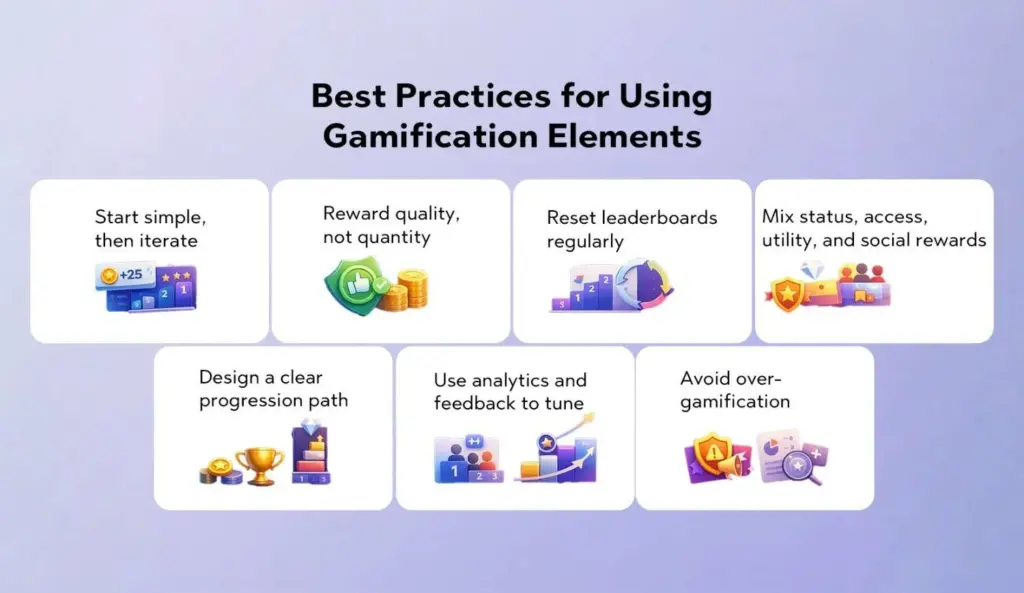
Best Practices for Using Gamification Elements
1. Start simple, then iterate
Launch with a minimal set—points + badges + a weekly leaderboard. Watch how members respond, then layer in levels, streaks, or challenges based on real engagement data. Complexity dilutes motivation.
2. Reward quality, not quantity
Tie the higher point values to peer-validated helpfulness, accepted answers, or moderator endorsements. This reduces spammy behavior and teaches what “good participation” looks like.
3. Reset leaderboards regularly
Use weekly or monthly cycles. Rotating categories and time-bound boards prevent incumbents from dominating forever and give newcomers a fair shot.
4. Mix status, access, utility, and social rewards
Not everyone is motivated by the same thing. Combine visible status (titles, frames) with access (private groups, early features), utility (discounts, templates), and social rewards (public shoutouts).
5. Design a clear progression path
Name levels meaningfully (Explorer → Guide → Mentor → Champion). Keep the first tiers easy; increase difficulty later to sustain long-term engagement. Connect each level to concrete perks.
6. Use analytics and feedback to tune
Track participation rates, streak preservation, challenge completion, and content quality. Share re-balances transparently (“We increased points for accepted answers based on your feedback.”).
7. Avoid over-gamification
If everything earns points, nothing feels special. Focus mechanics on the behaviors that matter most to your community’s mission. Keep themes fresh and avoid badge inflation.
For tactical ideas you can implement right away, see Thrico’s playbooks on gamification and community engagement:
Using Gamification to Increase Member Activity: Tips & Tricks (streaks, weekly prompts, reward mixes).
The Role of Gamification in Boosting Community Engagement (mechanics, pitfalls, and program design).
Where to Go Next
See what’s possible with Thrico’s modules and features—from gamification to discussions, events, and more—so you can design a cohesive engagement system in one place:https://thrico.com/modules-and-features/.
Deep-dive into practical tactics with Thrico’s latest gamification guides:
The Role of Gamification in Boosting Community Engagement (mechanics, examples, pitfalls).
Using Gamification to Increase Member Activity: Tips & Tricks (weekly challenges, streaks, reward design).
Design your system with intention and keep it human. The right blend of points, badges, levels, and engagement loops will turn everyday actions into a meaningful journey—one that members are proud to repeat and grow with over time.
Gamified engagement has become one of the most effective strategies for businesses looking to increase user interaction, motivation, and retention. By incorporating game-like elements such as rewards, points, badges, and challenges, brands can transform ordinary user experiences into highly engaging journeys.
In this blog, we’ll explore examples of gamified engagement, understand why they work, and learn how you can apply these strategies to your business.
Key Takeaway
Successful gamified engagement examples include loyalty programs, fitness apps, and learning platforms that use rewards, progress tracking, and competition to keep users engaged.
Why Gamified Engagement Works
Gamification taps into fundamental human psychology, making it a powerful tool for engagement.
Psychological triggers: Rewards, competition, and achievement motivate users to take action
Increases retention: Users are more likely to return when progress and rewards are involved
Enhances customer experience: Makes interactions fun, interactive, and memorable
Top Examples of Successful Gamified Engagement
1. Starbucks Rewards Program
One of the most recognized successful gamification examples, Starbucks uses a points-based system called “stars.”
Customers earn stars for purchases
Tier-based rewards unlock better perks
Mobile app integration enhances convenience and engagement
This system encourages repeat purchases while making customers feel rewarded.
2. Duolingo Language Learning
Duolingo is a standout among gamified engagement examples in education.
Daily streaks keep users consistent
XP points and leaderboards drive competition
Bite-sized lessons make learning manageable
The platform keeps users motivated through continuous progress and instant feedback.
3. Nike Run Club App
Nike uses gamification to inspire fitness and build community.
Blockchain rewards systems: Transparent and secure incentives
These trends will shape the next generation of gamified engagement strategies.
Conclusion
Gamified engagement is a powerful strategy that helps brands increase user interaction, loyalty, and conversions by making experiences fun and rewarding. From loyalty programs to fitness apps, the best successful gamification examples show how creativity and psychology can drive meaningful user engagement.
Building an engaged community is one of the biggest challenges for brands, platforms, and online groups today. Many communities struggle with low participation, inactive users, and declining retention over time. This is where gamification becomes a powerful solution. By integrating game-like elements such as rewards, competition, and progress tracking, communities can significantly boost user interaction. In this guide, you’ll learn the top gamification features for community engagement, how they work, and how to implement them effectively to drive long-term participation and growth.
What Are the Top Gamification Features for Community Engagement?
The top gamification features for community engagement include points, badges, leaderboards, challenges, and streaks. These elements motivate users to participate actively, reward contributions, and create a sense of progress and competition—ultimately improving retention and overall engagement.
What Is Gamification in Community Engagement?
Gamification in community engagement refers to the use of game-like elements—such as points, badges, challenges, and rewards—to encourage user participation and interaction within a community.
Instead of relying solely on intrinsic motivation, gamification taps into behavioral psychology. It leverages incentives, recognition, and progress tracking to influence user actions. When implemented correctly, gamification transforms passive users into active contributors by making participation more enjoyable and rewarding.
Top Gamification Features That Boost Community Engagement
1. Points & Reward System
Points are one of the most fundamental gamification features for community platforms. Users earn points for completing specific actions such as posting content, commenting, liking posts, or participating in discussions.
Points act as a “currency of effort,” giving users a measurable sense of achievement. This creates a powerful feedback loop: users perform actions → earn points → feel rewarded → repeat behavior.
A well-designed points system encourages consistent participation and helps track user contributions over time. It also lays the foundation for more advanced features like leaderboards and rewards.
2. Badges & Achievements
Badges are milestone-based rewards that users earn for reaching specific goals or accomplishments. These could include completing a certain number of posts, maintaining activity streaks, or contributing valuable content.
Badges serve as visual indicators of achievement and status within the community. They provide recognition and reinforce positive behavior.
More importantly, badges create emotional satisfaction. Users feel acknowledged and valued, which increases their likelihood of continued participation.
3. Leaderboards
Leaderboards rank users based on their performance, activity, or points. They introduce a competitive element that motivates users to stay active and improve their standing.
Competition, when implemented correctly, can significantly boost engagement. Users are naturally driven to outperform others or maintain their position.
Leaderboards also enhance visibility. Top contributors receive recognition, which further encourages participation and builds community dynamics.
4. Challenges & Missions
Challenges and missions are time-based or goal-oriented tasks designed to encourage specific user actions. These can include weekly posting challenges, content creation tasks, or engagement campaigns.
These features are particularly effective for driving short-term engagement spikes. They give users a clear objective and deadline, creating urgency and excitement.
Challenges also help guide user behavior by directing attention to desired activities within the community.
5. Streaks & Progress Tracking
Streaks track consecutive days or sessions of user activity. For example, logging in daily, posting consistently, or completing tasks over multiple days.
This feature taps into habit formation psychology. Once users start building a streak, they are motivated to maintain it.
Breaking a streak often feels like losing progress, which encourages users to stay consistent. This makes streaks one of the most effective gamification features for improving retention.
6. Virtual Currency / Tokens
Virtual currency allows users to earn and spend tokens within the community ecosystem. These tokens can be redeemed for rewards such as exclusive content, perks, or recognition.
This creates an internal economy where users feel incentivized to participate more actively. The ability to “earn and redeem” adds depth to the engagement experience.
It also opens opportunities for monetization and premium experiences within the community.
7. Levels & Progression System
Levels represent a user’s journey within the community—from beginner to expert. As users earn points or complete actions, they progress through different levels.
Progression systems provide a long-term sense of achievement. Users are motivated to “level up” and unlock new benefits, privileges, or recognition.
This feature keeps users engaged over extended periods, as it offers continuous goals to work toward.
8. Team Competitions
Team-based gamification introduces collaboration alongside competition. Users are grouped into teams and compete against others to achieve shared goals.
This fosters a sense of belonging and community bonding. Instead of individual competition, users work together, which strengthens relationships and engagement.
Team competitions are especially effective for large communities where collaboration can drive collective participation.
Why Gamification Features Increase Engagement
Gamification works because it aligns with core human motivations and behavioral triggers.
Reward Loop: Users are incentivized through rewards, reinforcing positive actions
Social Recognition: Public acknowledgment increases user satisfaction
Progress Tracking: Visible growth motivates continued participation
Common Gamification Mistakes That Reduce Engagement
While gamification can be powerful, poor implementation can have the opposite effect.
Over-rewarding low-value actions: Encourages spammy or meaningless participation
Ignoring user intent: Not aligning gamification with user goals reduces effectiveness
Overly complex systems: Confusing mechanics discourage user engagement
Simplicity and relevance are critical. Gamification should feel natural and intuitive, not forced.
Examples of Gamification in Community Platforms
Many successful platforms use gamification to drive engagement:
Thrico uses a points system to reward engagement.
Reddit uses a karma system to reward contributions.
Duolingo leverages streaks to encourage daily learning.
Online learning platforms use badges to recognize achievements.
These examples highlight how gamification features can significantly improve user retention and participation when applied effectively.
Best Practices for Gamification Success
To maximize the impact of gamification, follow these best practices:
Keep systems simple and easy to understand.
Focus on meaningful and high-quality user actions.
Use analytics to track performance and optimize features.
Regularly update challenges and rewards to maintain interest.
Successful gamification evolves with the community and adapts to user behavior.
Build an Engaging Community with Gamification
Looking to boost engagement in your community platform?
Use gamification features like points, badges, leaderboards, and challenges to drive participation and retention. When implemented strategically, these features can transform your community into an active, thriving ecosystem.
Conclusion
Gamification is no longer optional—it’s a necessity for building engaging and sustainable communities in 2026. By incorporating features like points, badges, leaderboards, and challenges, you can motivate users, increase retention, and foster deeper connections.
The key lies in thoughtful implementation. Focus on user value, keep systems simple, and continuously optimize based on behavior. When done right, gamification becomes a powerful engine for long-term community growth.