
Choosing the right gamification platform for your community starts with understanding your engagement goals, member behaviour, reward strategy, integration requirements, analytics needs, and budget. The best platform should do more than award points or display leaderboards. It should encourage meaningful participation, recognise valuable contributions, and help community managers understand what motivates members to return.
Organisations can choose between standalone gamification software and community platforms with built-in gamification capabilities. The right option depends on whether you already have a community environment or need a complete solution for managing member interactions alongside engagement programmes.
For organisations looking to combine community management with gamification, Thrico’s gamification platform offers features such as points, badges, ranks, leaderboards, coins, and rewards. However, before selecting any platform, it is important to evaluate how its capabilities align with your community’s specific requirements.
This guide explains what to look for, how to compare different platforms, which metrics to track, and how to implement a gamification programme that supports long-term community engagement.
What Is a Community Gamification Platform?
A community gamification platform is software that uses game-inspired mechanics to encourage participation, recognise contributions, and motivate members to complete meaningful activities.
Instead of relying entirely on announcements, reminders, or traditional incentives, these platforms introduce structured ways for members to participate and progress. Members might earn points for answering questions, receive badges for sharing expertise, or unlock rewards after completing specific challenges.
Community gamification can support activities such as:
- Participating in discussions and answering questions.
- Publishing useful content and sharing knowledge.
- Attending community events and completing challenges.
- Referring relevant people to the community.
- Helping other members solve problems.
- Contributing feedback and participating in advocacy programmes.
The objective is not simply to make a community competitive. It is to recognise behaviours that create value for members and the organisation.
How Does Gamification Work in an Online Community?
A typical community gamification programme follows five steps:
- Identify valuable activities: Determine which member behaviours support your community goals.
- Assign points or recognition: Establish clear criteria for rewarding eligible actions.
- Introduce progression: Use badges, ranks, challenges, or leaderboards where appropriate.
- Offer relevant rewards: Recognise meaningful contributions through benefits, experiences, or other incentives.
- Measure performance: Review participation data and adjust the programme based on results.
For example, a customer community might recognise members who provide helpful product answers, while a professional association might reward participation in educational events.
The important distinction is that rewards should encourage genuine participation rather than meaningless activity. A programme that rewards the quantity of posts without considering their usefulness may generate activity without improving the community experience.
What Is the Difference Between Gamification Software and a Community Platform?
Standalone gamification software primarily focuses on game mechanics, achievements, incentives, and progress tracking. It can be useful when an organisation already has a community platform and wants to add gamification capabilities.
A community platform, by comparison, provides the environment where members interact. This may include member profiles, discussions, content, connections, events, and community management tools.
Some platforms combine both capabilities, allowing organisations to manage member interactions and engagement programmes within a connected environment.
To understand which approach fits your organisation, explore the differences between gamification software and a community platform.
Why Does Your Community Need Gamification?
Gamification can give members additional reasons to participate, contribute, and return. When designed around meaningful activities, it can complement a community’s existing engagement strategy.
Increase Member Participation
New members may need encouragement to move beyond creating an account. Points, introductory challenges, and participation milestones can provide clear reasons to take that first step.
For established members, structured activities can encourage discussion participation, knowledge sharing, event attendance, and responses to other members.
The key is to make participation accessible. Activities should be relevant to the community and achievable without requiring excessive effort.
Recognise Valuable Contributions
Communities often depend on members who answer questions, share expertise, welcome newcomers, and help others solve problems.
Badges, ranks, and other forms of recognition can make these contributions more visible. They also provide community managers with ways to acknowledge members whose efforts might otherwise go unnoticed.
Recognition should reflect the quality and usefulness of contributions, not just how frequently someone participates.
Encourage Member Retention
Members are more likely to find continued value in a community when they have reasons to return and opportunities to build relationships.
Progress milestones, recurring challenges, and relevant rewards can support repeat participation. However, gamification does not automatically improve retention. Results depend on the quality of the community experience, the relevance of the incentives, and the motivations of its members.
Support Referrals and Community Growth
Referral programmes can encourage existing members to introduce relevant people to a community.
Gamification can help structure these activities through referral milestones and recognition. However, programmes should reward appropriate referrals rather than raw invitation volume, which may encourage spam or low-quality registrations.
Organisations looking to strengthen these activities can explore Thrico’s community platform.
10 Factors to Consider When Choosing a Gamification Platform
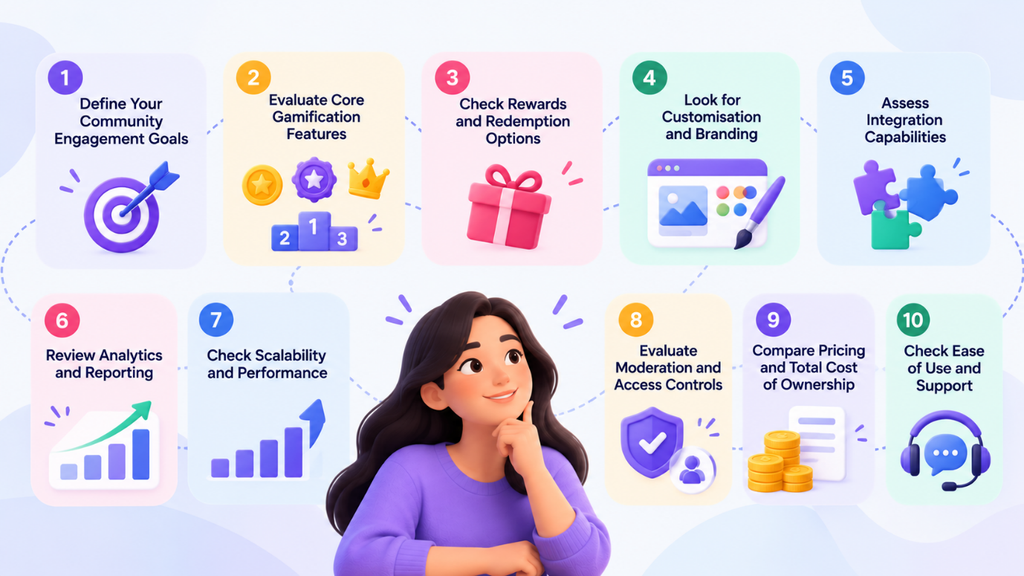
Selecting a platform should begin with your community objectives, not a long list of features. Evaluate each option against your requirements and identify which capabilities will make a measurable difference.
1. Define Your Community Engagement Goals
Before comparing vendors, decide what you want to improve.
Your priorities might include:
- Activating newly registered members.
- Increasing meaningful discussion participation.
- Encouraging useful content contributions.
- Improving event attendance.
- Recognising knowledgeable and helpful members.
- Supporting customer advocacy and referrals.
- Encouraging repeat engagement and retention.
Turn these priorities into measurable objectives. For example, you might want to increase the percentage of new members who complete a meaningful first action within seven days.
Clear objectives make it easier to evaluate platforms and avoid paying for capabilities that do not support your strategy.
2. Evaluate Core Gamification Features
Different gamification mechanics encourage different types of participation. Look for a platform that lets you select and configure the features that suit your audience.
Points: Recognise eligible activities and provide a visible measure of progress.
Badges: Highlight achievements, milestones, expertise, or specific contributions.
Ranks: Show progression based on defined participation or achievement criteria.
Leaderboards: Display progress and encourage friendly competition when appropriate.
Challenges and games: Give members structured activities to complete within a defined period.
Rewards: Provide tangible or experiential recognition for valuable contributions.
Not every community needs every feature. A professional knowledge-sharing community may benefit more from contribution badges than a competitive leaderboard.
Explore Thrico’s gamification features to understand the mechanics available through its offering.
3. Check Rewards and Redemption Options
Rewards can help make participation more appealing, but they need to match member motivations and the purpose of the community.
Depending on the programme, rewards might include exclusive access, special experiences, recognition, community privileges, or other relevant benefits.
Before choosing a platform, investigate:
- Whether reward eligibility can be configured.
- How members earn and redeem rewards.
- Whether redemption rules can be customised.
- Whether rewards can be connected to meaningful achievements.
- How reward availability and programme costs are managed.
Also consider whether the reward structure encourages sustained contribution or simply attracts members interested in collecting incentives.
You can explore Thrico’s community coins and rewards as part of your evaluation.
4. Look for Customisation and Branding
Your gamification programme should reflect your community’s identity rather than feel like a disconnected system.
Look for options to customise point rules, badge criteria, challenges, progression levels, and member experiences.
Branding matters, too. A consistent experience helps members understand how gamification fits into the broader community.
Customisation should also extend to participation rules. Different activities may deserve different levels of recognition, and some actions may not be suitable for rewards at all.
5. Assess Integration Capabilities
A gamification platform may need to connect with systems your organisation already uses.
Depending on your technology environment, these could include e-commerce platforms, communication tools, customer relationship management systems, event management software, or other business applications.
Ask potential providers:
- Which integrations are officially supported?
- Are APIs available where required?
- How is information synchronised between systems?
- Are there additional integration or implementation fees?
- What happens when an integration fails or data becomes inconsistent?
Do not assume that a platform supports every integration your organisation needs. Verify compatibility, availability, and any limitations before making a decision.
6. Review Analytics and Reporting
Gamification should help you understand member behaviour, not simply produce points and rankings.
Useful reporting should help community managers evaluate:
- Member activation and participation.
- Repeat engagement over time.
- Discussion and content contributions.
- Challenge completion.
- Reward redemption.
- Changes in member activity.
- Progress towards defined community objectives.
Consider whether reports can be filtered by relevant member groups or time periods and whether the available data can inform operational decisions.
The most useful analytics connect gamification activity to meaningful outcomes. A rise in points earned is not necessarily evidence of a healthier community.
7. Check Scalability and Performance
Your requirements may change as the community grows.
A platform that works well for a small member group may need additional capabilities to support multiple communities, increasing activity volumes, more complex reward programmes, or larger administrative teams.
Evaluate its ability to accommodate:
- Expected membership growth.
- Multiple community groups and participation rules.
- Increasing content and interaction volumes.
- Additional administrators and moderators.
- Evolving reporting requirements.
- More complex gamification programmes.
Ask providers about relevant usage limits, performance expectations, and any pricing changes associated with growth.
8. Evaluate Moderation and Access Controls
A successful gamification programme needs clear rules and appropriate safeguards.
Without them, members may post repetitive content, manipulate rankings, create artificial referrals, or perform low-value actions simply to accumulate points.
Look for capabilities that support your moderation policies, member permissions, and administrative workflows.
Depending on the platform, relevant controls may include activity monitoring, configurable eligibility rules, role-based permissions, moderation tools, and ways to investigate suspicious participation.
Also consider how administrators can correct errors, review disputed rewards, and respond to misuse.
For organisations evaluating community management alongside gamification, Thrico’s Care Console is worth exploring as part of the wider platform assessment.
9. Compare Pricing and Total Cost of Ownership
The advertised subscription price is only one part of the overall cost.
Your total investment may include:
- Subscription fees.
- Member or usage limits.
- Implementation and onboarding.
- Integration development.
- Customisation.
- Premium features.
- Customer support.
- Ongoing programme administration.
A lower-cost platform may become more expensive if it requires extensive development or several additional tools.
Ask each provider for a clear explanation of pricing, plan limitations, implementation requirements, and expected ongoing costs.
You can review Thrico’s pricing and plans when assessing how the platform fits your budget.
10. Check Ease of Use and Support
Even a feature-rich platform can struggle to deliver value if members find it confusing or administrators need extensive assistance to manage it.
Evaluate the member experience and the administrative experience separately.
Members should be able to understand the rules, track their progress, and discover available activities without unnecessary complexity.
Administrators should be able to configure rules, manage rewards, review reports, and adjust activities efficiently.
Before committing, ask about onboarding, documentation, support availability, training, and the process for introducing new gamification activities.
A demonstration or trial, where available, can help you assess usability before implementation.
How to Compare Different Community Gamification Platforms
Once you have identified your requirements, create a comparison matrix for your shortlisted platforms.
Evaluate each option against the same criteria:
| Evaluation criterion | What to check |
| Gamification features | Points, badges, ranks, challenges, and leaderboards |
| Rewards | Eligibility, configuration, redemption, and reward management |
| Community capabilities | Profiles, discussions, content, events, and member interactions |
| Customisation | Branding, activity rules, badges, and member journeys |
| Integrations | Compatibility, APIs, data synchronisation, and additional costs |
| Analytics | Activation, participation, repeat engagement, and reporting |
| Moderation | Permissions, activity controls, and safeguards against abuse |
| Scalability | Membership limits, performance, and administrative capacity |
| Pricing | Subscription, implementation, integration, and support costs |
| Customer support | Onboarding, documentation, responsiveness, and ongoing assistance |
Assign importance weights to the criteria according to your objectives. For example, integration capabilities may be essential if you already operate a large community, while ease of use may be a higher priority for a smaller team.
Score each platform against the same requirements and document any gaps that need clarification.
Standalone Gamification Software vs an All-in-One Community Platform
Standalone gamification software may be the better fit if your organisation already has an established community environment and only needs additional engagement mechanics.
An all-in-one community platform may be more appropriate if you also need member profiles, discussions, content, events, and community management alongside gamification.
The decision should reflect your existing technology, operational requirements, integration needs, and available resources.
Avoid choosing an all-in-one solution solely because it offers more features. Similarly, avoid adding standalone software without considering the complexity of maintaining multiple systems.
Read more about gamification software versus community platforms before finalising your shortlist.
How to Match a Gamification Platform to Your Community Type
Different communities have different reasons to participate. Your platform should support the activities and outcomes that matter to your particular audience.
Customer and Brand Communities
Customer communities may use gamification to encourage product feedback, peer support, knowledge sharing, user-generated content, and customer advocacy.
Recognition can highlight members who answer questions or help other customers. Referral programmes may also support growth when they reward relevant introductions.
Employee Communities
Employee communities can use recognition and progression to encourage knowledge sharing, collaboration, participation in internal initiatives, and employee advocacy.
The programme should complement workplace culture and avoid turning every interaction into a competition.
Membership Organisations and Associations
Professional associations and membership organisations may prioritise event attendance, networking, educational participation, knowledge exchange, and continued member engagement.
Badges and milestones can recognise participation in learning activities or contributions to the wider professional community.
Creator and Fan Communities
Creator and fan communities may use challenges, exclusive experiences, content participation, recognition, and referrals to encourage members to connect with the community.
The most suitable incentives depend on the audience and the value members expect from their relationship with the creator or brand.
In every case, select a platform based on your audience, desired behaviours, and governance requirements. Explore Thrico’s community solutions to learn more about its broader community offering.
How to Measure the Success of a Gamification Platform
A gamification programme should be evaluated by changes in member behaviour and community outcomes, not by points or leaderboard activity alone.
Establish baseline measurements before launch and review performance regularly.
Member Activation Rate
Measure the percentage of new members who complete a meaningful first action within a defined period.
The action might involve introducing themselves, responding to a discussion, attending an event, or completing another activity relevant to your community.
Participation and Contribution Rate
Track the proportion of members who contribute through discussions, content, events, or other meaningful activities.
Where possible, distinguish between low-value activity and contributions that help other members or advance community objectives.
Repeat Engagement and Retention
Measure how many members return and continue participating over time.
Compare results across relevant periods and member groups to understand whether participation is becoming more consistent.
Challenge Completion and Reward Redemption
Review the percentage of members who start and complete challenges, as well as the proportion of eligible rewards that are redeemed.
Low completion or redemption rates may indicate that an activity is too difficult, insufficiently relevant, or poorly communicated.
Referral and Business Outcomes
Where appropriate, track qualified referrals, customer advocacy, support participation, or other outcomes linked to the community’s objectives.
Use these metrics to understand whether gamification is contributing to broader organisational goals.
For example, a customer community might assess whether more questions are being answered by members rather than requiring intervention from a support team. The appropriate measures will depend on the community’s purpose.
Review your findings regularly and use member feedback alongside quantitative data. Thrico’s community management capabilities can be explored as part of your assessment of the tools needed to manage and monitor your community.
Common Mistakes to Avoid When Choosing a Gamification Platform
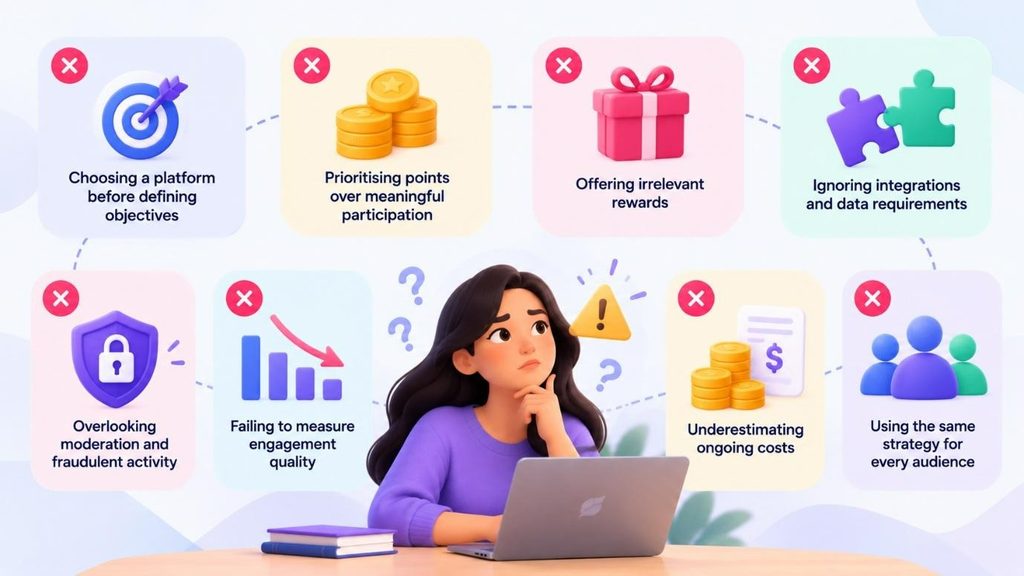
Several mistakes can limit the effectiveness of a community gamification programme.
Choosing a platform before defining objectives: Without clear goals, organisations may invest in features that do not address their actual engagement challenges.
Prioritising points over meaningful participation: Rewarding every action equally can encourage repetitive or low-quality activity.
Offering irrelevant rewards: Incentives that do not match member motivations may fail to encourage participation.
Ignoring integrations and data requirements: Unverified integration assumptions can create additional costs and administrative work.
Overlooking moderation and fraudulent activity: Weak controls can allow members to manipulate points, referrals, or rankings.
Failing to measure engagement quality: Increased activity does not necessarily indicate stronger relationships or better retention.
Underestimating ongoing costs: Implementation, support, integrations, and administration can increase the total cost of ownership.
Using the same strategy for every audience: Different communities require different activities, recognition methods, and reward structures.
A clearly defined strategy and a small initial pilot can help identify these issues before the programme is introduced across the entire community.
How to Implement a Community Gamification Platform Successfully
Selecting the platform is only the beginning. The way you design, introduce, and manage the programme will influence its effectiveness.
Step 1: Identify Priority Behaviours
Choose a small number of actions that create value for the community.
These might include answering questions, publishing useful content, attending events, welcoming new members, or completing learning activities.
Define what counts as a meaningful contribution before assigning rewards.
Step 2: Configure Rules and Rewards
Establish how members earn points, qualify for badges, progress through ranks, complete challenges, and redeem rewards.
Make the rules consistent and easy to understand. Where appropriate, include limits that prevent repetitive or artificial activity from being rewarded.
Step 3: Launch a Pilot Programme
Introduce the programme to a relevant member group before expanding it.
Use the pilot to test the user experience, administrative workload, reward relevance, and effectiveness of the selected activities.
Collect feedback from both participants and community managers.
Step 4: Communicate the Rules Clearly
Explain the purpose of the programme, the activities members can complete, the recognition they can earn, and the conditions associated with rewards.
Clear communication helps members understand how the programme works and reduces confusion about eligibility.
Step 5: Monitor Results and Improve
Compare performance with your baseline measurements.
Review activation, meaningful participation, repeat engagement, challenge completion, reward redemption, and any relevant business outcomes.
Use these findings to adjust activities, rules, and incentives. Gamification should evolve as your community’s needs change.
Is Thrico a Suitable Gamification Platform for Your Community?
Thrico is an option for organisations looking to combine community management with gamification capabilities in a connected environment.
Its published gamification offering includes points, coins, badges, ranks, leaderboards, and rewards. Its broader community platform also covers member interactions and community-building capabilities.
This combination may be worth evaluating if your organisation wants to manage community activities and recognise participation without treating gamification as an entirely separate initiative.
Before making a decision, assess Thrico against the same requirements you would apply to any provider:
- Does the available feature set support your priority engagement goals?
- Can the reward rules accommodate your programme requirements?
- Are the necessary integrations available?
- Do the analytics support your measurement framework?
- Can moderation and access controls meet your governance needs?
- Will the platform accommodate your expected growth?
- Does the pricing fit your budget and implementation resources?
You can start by exploring Thrico’s gamification platform and community solutions.
The right choice is the platform that meets your actual requirements, supports meaningful participation, and provides a practical way to measure the results.
Final Thoughts
Choosing a community gamification platform requires more than comparing points, badges, and leaderboards. Organisations should consider their engagement goals, reward strategy, integrations, analytics, moderation requirements, scalability, and total cost of ownership.
Start by identifying the behaviours that matter most to your community. Shortlist platforms that support those behaviours, compare their capabilities, and test your preferred approach through a pilot programme.
Most importantly, measure success through meaningful participation and community outcomes rather than activity volume alone.
If you are looking for a solution that brings community interactions and gamification together, explore Thrico’s gamification platform to evaluate whether its capabilities align with your goals.
Frequently Asked Questions
The best platform depends on your community goals, required gamification features, integration needs, analytics requirements, budget, and existing technology.
If you already have a community platform, standalone gamification software may be sufficient. If you also need member profiles, discussions, events, and community management, an integrated platform may be a better fit.
Common features include points, badges, ranks, challenges, leaderboards, rewards, customisation, and analytics.
You should also evaluate integration capabilities, moderation controls, scalability, and ease of use. The ideal feature set depends on the behaviours you want to encourage.
Yes. Gamification software focuses primarily on game mechanics, achievements, progression, and incentives.
Community management software provides tools for member profiles, discussions, content, connections, and ongoing interactions. Some platforms combine both capabilities.
Pricing varies according to the provider, subscription model, membership volume, feature set, integrations, implementation requirements, and support services.
Compare the total cost of ownership rather than relying only on the advertised subscription price. Ask providers to clarify usage limits, additional fees, and expected ongoing costs.
Well-designed gamification can encourage participation, recognise useful contributions, and give members reasons to return.
However, outcomes depend on the relevance of the activities, the reward structure, the quality of the community experience, and member motivations. Improvement is not guaranteed.
Track member activation, meaningful participation, repeat engagement, retention, challenge completion, and reward redemption.
Depending on your objectives, you can also measure qualified referrals, customer advocacy, or other business outcomes. Establish a baseline before launch to assess changes over time.
The right combination depends on the activities you want to encourage.
Points can recognise eligible actions, badges can highlight achievements, and rewards can provide additional incentives. Use these mechanics selectively and prioritise meaningful contributions over activity volume.
Many platforms offer integrations, but available options vary by provider and plan.
Verify compatibility with your existing systems, API availability where required, data synchronisation, implementation effort, and additional costs before selecting a solution.
An all-in-one platform may be suitable when you need community management and gamification capabilities within one environment.
Standalone software may be more practical if you already have a suitable community platform and only need additional gamification functionality.
Compare both approaches against your operational requirements, technology environment, and budget.
Establish clear eligibility rules, appropriate permissions, activity monitoring, and moderation procedures.
Avoid rewarding repetitive or artificial activity, and introduce safeguards against spam, fraudulent referrals, and leaderboard manipulation. Review unusual activity and adjust programme rules when necessary.