
Campus ambassador programs help brands, startups, educational institutions, and digital platforms connect with students through trusted representatives on college and university campuses. These students introduce initiatives to their peers, promote relevant opportunities, organise activities, collect feedback, and encourage participation within student communities.
A typical campus ambassador program involves recruitment, onboarding, training, campus outreach, community engagement, performance tracking, and recognition. When structured effectively, it can help organisations build awareness while giving students opportunities to develop communication, leadership, networking, and marketing skills.
However, a successful program requires more than asking students to promote a brand. Organisations need clear objectives, defined responsibilities, appropriate incentives, ongoing support, and measurable outcomes.
For a real example, students can explore the Thrico Campus Ambassador Program to learn more about its application process and stated benefits.
What Is a Campus Ambassador Program?
A campus ambassador program is an initiative in which selected students represent a brand, organisation, product, service, or platform within their educational institution and student network.
Campus ambassadors act as a connection between an organisation and the student community. They communicate information, introduce relevant opportunities, encourage participation, and share feedback about student interests and needs.
For example, a technology startup might recruit students to introduce its platform to fellow students. A university initiative might appoint ambassadors to encourage participation in events, workshops, or educational programmes.
How Is a Campus Ambassador Program Different From Traditional Advertising?
Traditional advertising typically communicates a promotional message through channels such as paid advertisements, websites, and marketing campaigns.
Campus ambassador programs introduce a peer-to-peer element. Students can explain an initiative in a context their classmates understand, answer questions, and encourage participation through existing campus relationships.
These programs also differ from student influencer campaigns, which often focus primarily on an individual’s social media audience and content reach. Campus ambassador roles may include offline events, community participation, referrals, feedback collection, and ongoing engagement.
University-appointed student representatives may have responsibilities related to student welfare, governance, admissions, or institutional communication. A campus ambassador program, by contrast, is generally organised around specific promotional, engagement, or outreach objectives.
The precise responsibilities depend on the organisation and the program’s design.
How Do Campus Ambassador Programs Work?
Most campus ambassador programs follow a structured process that takes students from application and selection to active participation and performance evaluation.
1. Recruitment and Selection
The process begins when an organisation invites students to apply for ambassador positions.
Recruitment may take place through campus networks, social media, student communities, university clubs, or dedicated application pages.
Organisations typically assess candidates based on factors such as communication skills, initiative, reliability, interests, and familiarity with the intended student audience.
Clear eligibility criteria and a straightforward application process help students understand whether the opportunity suits them.
Students interested in representing Thrico can review the Thrico Campus Ambassador Program application for information about the program and its application process.
2. Onboarding and Training
After selection, ambassadors need to understand the organisation they represent.
Onboarding typically covers the organisation’s mission, products or services, campaign objectives, communication guidelines, and expected responsibilities.
Training may also explain how ambassadors should answer common questions, share approved information, organise activities, and report their progress.
Effective onboarding helps students communicate accurately and confidently without making unsupported claims or promising benefits that the organisation has not confirmed.
3. Campus Outreach and Promotion
Once trained, ambassadors introduce the organisation to relevant student groups.
Depending on the program, activities may include:
- Sharing approved campaign information on social media.
- Introducing the organisation to student clubs and societies.
- Promoting relevant workshops, events, or opportunities.
- Organising campus activities and information sessions.
- Encouraging interested students to register or participate.
- Answering questions and directing students to official resources.
The best outreach approach depends on the audience and the initiative being promoted. A relevant campus event or useful peer recommendation may create more value than repeatedly publishing promotional messages.
4. Community Engagement and Participation
Campus ambassadors can contribute more than promotional activity. They can help students discover opportunities, participate in discussions, connect with peers, and become involved in community initiatives.
Organisations can support these activities through dedicated student communities, online resources, event updates, and communication channels.
For example, a digital community can provide a shared environment where students discover activities, exchange information, and maintain connections beyond individual campus events.
Organisations exploring this approach can learn about Thrico’s community platform for academia, which focuses on connecting students, alumni, faculty, and mentors.
5. Performance Tracking and Recognition
The final stage involves evaluating activities and recognising contributions according to the program’s stated rules.
Depending on the objectives, organisations may track verified referrals, registrations, event participation, student engagement, completed activities, and the quality of feedback collected.
Recognition may include certificates, rewards, public acknowledgement, learning opportunities, or other benefits offered by the program.
Clear evaluation criteria help ambassadors understand how their efforts are assessed and allow organisations to identify what is working.
What Does a Campus Ambassador Do?
A campus ambassador’s responsibilities depend on the organisation, audience, and program objectives. Some roles focus mainly on awareness and outreach, while others involve event coordination, community participation, and feedback collection.
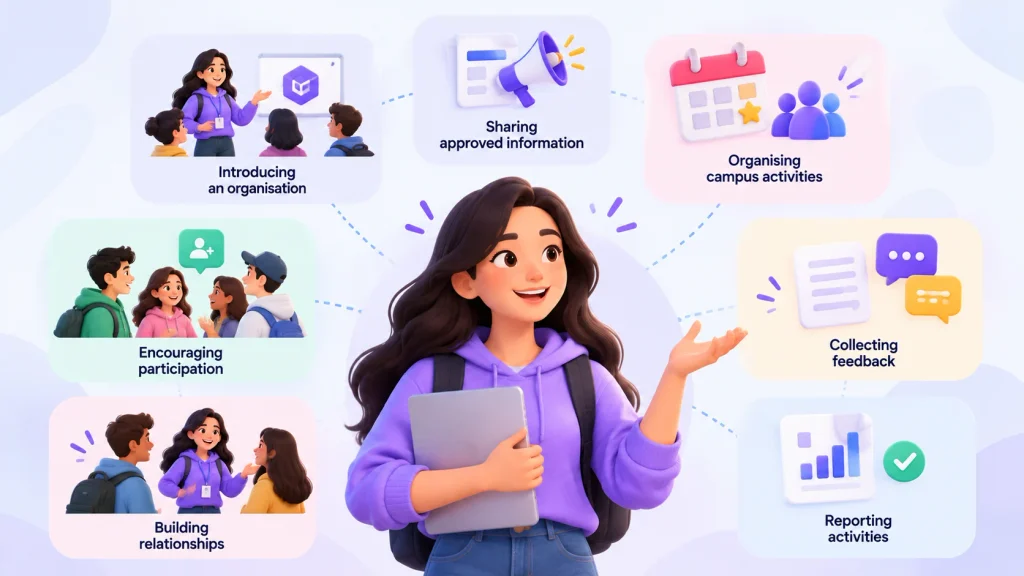
Common responsibilities include:
Introducing an organisation: Explaining the brand, platform, product, or initiative to fellow students.
Sharing approved information: Communicating updates, opportunities, announcements, and campaign details through suitable channels.
Organising campus activities: Helping coordinate events, workshops, information sessions, and student engagement initiatives.
Encouraging participation: Directing interested students towards registrations, referrals, events, or relevant community activities.
Collecting feedback: Sharing student questions, concerns, preferences, and suggestions with the organisation.
Building relationships: Connecting students with relevant resources, opportunities, and other community members.
Reporting activities: Providing updates on outreach efforts, participation, event outcomes, and other agreed performance measures.
Not every ambassador is expected to perform all these tasks. Organisations should communicate the role’s scope, time commitment, and expected deliverables before students accept a position.
Students can visit the Thrico Campus Ambassador Program to review the information provided about its specific opportunity.
What Are the Benefits of Campus Ambassador Programs?
A well-designed campus ambassador program can create value for students, organisations, and educational institutions. The benefits depend on the program’s structure, support, activities, and objectives.
Benefits for Students
Campus ambassador opportunities can help students develop practical skills while participating in initiatives beyond their academic coursework.
Potential benefits include:
- Communication skills: Practising how to explain ideas, answer questions, and communicate with different audiences.
- Leadership experience: Taking responsibility for activities, coordinating initiatives, and motivating peers.
- Networking opportunities: Building relationships with students, professionals, and organisational representatives.
- Marketing exposure: Learning about outreach, campaign planning, audience engagement, and promotional communication.
- Recognition: Receiving certificates, acknowledgements, or other benefits where offered.
- Career development: Gaining experience that may help students discuss relevant skills during future applications and interviews.
Some programs also offer rewards, mentorship, or paid opportunities.
For example, Thrico lists rewards, networking, recognition, and a potential paid internship opportunity on its Campus Ambassador Program page. Students should review the program’s current terms and eligibility requirements because these benefits are specific to that offering and are not guaranteed across all campus ambassador programs.
Benefits for Brands and Organisations
Campus ambassador programs provide organisations with a way to develop relationships with student audiences through relevant campus networks.
Potential advantages include:
Greater student awareness: Ambassadors can introduce an organisation to students who may not encounter its traditional marketing campaigns.
Peer recommendations: Students can explain an opportunity in familiar terms and direct interested peers towards official information.
Direct audience feedback: Conversations with students can help organisations understand questions, preferences, and barriers to participation.
Campus-level engagement: Ambassadors can help coordinate events and activities that bring interested students together.
Community development: Ongoing ambassador relationships can support stronger connections between an organisation and its student audience.
Results depend on ambassador selection, the quality of the offering, campaign relevance, and the effectiveness of the program’s management.
Benefits for Colleges and Universities
Campus ambassador initiatives can complement student engagement activities by encouraging leadership, peer learning, participation, and connections with external opportunities.
Depending on the program, students may gain experience coordinating events, communicating initiatives, and helping fellow students discover relevant resources.
Institutions looking to strengthen student, faculty, mentor, and alumni relationships can explore Thrico’s community platform for academia.
Any external program should align with institutional policies and clearly communicate its relationship with the college or university.
How to Build a Successful Campus Ambassador Program
Creating a successful campus ambassador program requires a clear plan for recruitment, participation, support, and evaluation.
1. Define Clear Program Goals
Start by identifying what the organisation wants to achieve.
Possible objectives include increasing brand awareness, encouraging registrations, promoting events, collecting student feedback, or growing a student community.
Translate these goals into measurable targets.
For example, if the primary objective is event participation, track registrations and actual attendance rather than relying only on social media impressions.
Clear goals also help organisations decide which students to recruit and what activities to prioritise.
2. Identify and Recruit Suitable Students
Develop eligibility criteria that reflect the responsibilities of the role.
Look for students who demonstrate communication skills, initiative, reliability, and an understanding of the intended audience.
The recruitment process should explain the program’s purpose, expected time commitment, duration, selection criteria, and available benefits.
A transparent process helps attract students who understand the role and are interested in contributing.
3. Set Clear Roles and Expectations
Before ambassadors begin, document what they are expected to do.
This may include outreach activities, event participation, content-sharing guidelines, reporting deadlines, communication standards, and a code of conduct.
Explain which claims ambassadors can make, how they should handle questions they cannot answer, and whom they should contact for support.
Clear expectations reduce confusion and help students represent the organisation consistently.
4. Provide Meaningful Incentives
Incentives should reflect the program’s objectives and the interests of participating students.
Depending on the initiative, these may include certificates, rewards, recognition, mentorship, learning opportunities, or paid assignments.
Explain the eligibility criteria and conditions for receiving each benefit. If an opportunity is conditional, communicate those conditions clearly.
Organisations should also recognise valuable contributions rather than measuring success exclusively through the volume of promotional activity.
5. Support Ongoing Communication
Ambassadors need regular information and a reliable way to ask questions.
Provide approved campaign materials, program updates, activity guidance, and a clear point of contact.
Regular check-ins can help organisations identify problems, gather ideas, and maintain participation.
Ambassadors should also have opportunities to share feedback about student interests and campaign performance.
6. Measure Performance and Improve
Review results against the objectives established at the beginning of the program.
Identify which activities attract relevant participants, which communication channels work best, and where ambassadors need additional guidance.
Use performance data and ambassador feedback to refine recruitment, training, activities, and incentives.
A successful program should evolve based on evidence rather than repeating the same activities without evaluating their effectiveness.
How Can Digital Communities Support Campus Ambassador Programs?
Managing ambassadors across several colleges or universities can create communication and coordination challenges.
Digital communities can provide a shared environment where ambassadors access updates, exchange ideas, discuss activities, and maintain connections beyond individual campus events.
Depending on the platform, useful capabilities may include:
- Dedicated spaces for student groups and ambassadors.
- Content sharing and community conversations.
- Event announcements and activity updates.
- Opportunities to exchange ideas and feedback.
- Recognition for participation and contributions.
- Engagement insights to help review community activity.
These capabilities can support coordination while making information easier to access.
For example, an organisation with ambassadors across multiple campuses could use a digital community to share approved campaign resources and communicate upcoming activities. Ambassadors could also exchange experiences and suggest improvements based on their local student audiences.
Organisations can explore Thrico’s community-building solution to understand its approach to digital connections, participation, and events.
Its content and engagement capabilities provide additional context for sharing updates, stories, and community contributions.
A digital platform supports the program’s operations, but it does not replace clear objectives, appropriate training, ongoing communication, or genuine relationship-building.
Common Campus Ambassador Program Challenges
Even well-planned programs can face challenges. Identifying them early helps organisations provide better support and maintain meaningful participation.
Low Participation After Onboarding
Some ambassadors may become less active after the initial excitement of joining.
How to address it: Set achievable expectations, provide regular guidance, and offer meaningful activities. Check whether the workload and incentives remain appropriate.
Unclear Roles and Responsibilities
Ambassadors may struggle when they do not know which tasks to prioritise or how their performance will be evaluated.
How to address it: Share written guidelines, deadlines, reporting expectations, and contact details for questions or escalation.
Inconsistent Communication
Outdated information and irregular updates can make it difficult for ambassadors to communicate accurately.
How to address it: Maintain a reliable communication channel and distribute approved resources whenever campaign details change.
Difficulty Measuring Results
Counting promotional posts or social media followers may not show whether the program is achieving its objectives.
How to address it: Track outcomes such as verified registrations, event attendance, meaningful participation, and feedback quality.
Incentives That Do Not Match Student Interests
Students may lose motivation if the benefits are unclear or do not reflect the effort required.
How to address it: Ask ambassadors what they value, explain available benefits transparently, and ensure recognition follows consistent rules.
Over-Reliance on Promotional Posts
A program focused entirely on promotion may struggle to build lasting student relationships.
How to address it: Encourage genuine conversations, helpful information, relevant events, and opportunities for students to participate beyond promotional campaigns.
Addressing these challenges requires regular communication and a willingness to adjust the program based on student feedback.
How Thrico Can Support Student and Campus Communities
Campus ambassador programs often form part of a broader student engagement strategy.
Organisations and educational institutions may need ways to connect students, share information, encourage conversations, support mentorship, and maintain participation over time.
Thrico’s academia solution focuses on student and alumni communities, mentorship, career connections, and engagement.
Organisations can also explore Thrico’s community platform overview to understand its broader approach to community building.
These resources may be relevant to organisations evaluating digital tools for their student communities. However, specific campus ambassador workflows, automation capabilities, and integrations should be verified against current product documentation before implementation.
The most suitable solution is one that fits the organisation’s actual requirements and complements its recruitment, communication, and engagement processes.
How to Measure Campus Ambassador Program Success
Measuring performance helps organisations understand whether their program is delivering meaningful outcomes.
Start by choosing metrics that match the program’s objectives.
Number of Recruited and Active Ambassadors
Track how many students join the program and how many remain active during a defined period.
This helps distinguish recruitment success from sustained participation.
Ambassador Activity and Retention
Measure participation in agreed activities and monitor how consistently ambassadors remain involved.
Review changes over time to identify when additional guidance or support may be needed.
Verified Referrals and Registrations
If the program aims to attract new participants, track registrations or referrals that can be attributed to ambassador activities.
Use clear attribution rules and focus on relevant, genuine registrations rather than raw invitation volume.
Event Registrations and Attendance
For event-focused programs, compare registrations with actual attendance.
This helps determine whether ambassador outreach is attracting participants who follow through.
Student Participation and Engagement
Track participation in discussions, community activities, workshops, or other initiatives relevant to the program.
Where possible, distinguish meaningful involvement from passive exposure to promotional content.
Feedback Collected and Acted Upon
Record the questions, concerns, and suggestions ambassadors share.
Also review which feedback leads to practical changes. Collecting feedback is more valuable when the organisation has a process for responding to it.
Cost per Acquisition
When the program aims to attract customers, users, or registrations, calculate acquisition costs where relevant.
Include appropriate program expenses and use a consistent definition of a successful acquisition.
Ambassador and Participant Satisfaction
Gather feedback from ambassadors and participating students to understand their experience.
Questions might cover communication quality, workload, activity relevance, support, and clarity of the program’s benefits.
Review these metrics over a defined period and interpret them in context. Follower counts and impressions can provide useful information about reach, but they should not be the only measures of success when the primary objective is meaningful student participation.
Conclusion
Campus ambassador programs help organisations connect with student communities through peer communication, campus outreach, and ongoing engagement. They can also give students opportunities to develop communication, leadership, networking, and practical marketing skills.
The most effective programs begin with clear goals, recruit suitable students, define responsibilities, provide useful training, and recognise meaningful contributions. Consistent communication and measurable outcomes help organisations identify what works and improve the program over time.
Digital communities can further support these efforts by giving ambassadors and students a shared place to access information, exchange ideas, and maintain connections.
For students interested in representing an organisation, visit the Thrico Campus Ambassador Program to review the available program information and application details.
Organisations looking to strengthen student engagement, mentorship, and alumni connections can also explore Thrico’s academia solution.
Frequently Asked Questions
The purpose is to connect an organisation with students through selected campus representatives. Ambassadors may introduce initiatives, share information, promote events, encourage participation, collect feedback, and help build relationships with student communities.
Most programs involve recruitment, selection, onboarding, training, campus outreach, community engagement, and performance tracking. Organisations define responsibilities and objectives, provide support, and evaluate results against agreed criteria.
Eligibility depends on the organisation and program. Some opportunities are open to students from multiple institutions, while others target specific colleges, courses, or student groups. Applicants should review the program’s eligibility criteria and responsibilities before applying.
Some campus ambassador programs offer payment, while others provide certificates, rewards, recognition, learning opportunities, or networking benefits. Compensation depends on the specific program and its terms. Students should confirm whether an opportunity is paid and understand any conditions before accepting a role.
Useful skills include communication, initiative, reliability, organisation, teamwork, and the ability to understand a student audience. Depending on the role, event coordination, content creation, networking, and basic marketing skills may also be helpful.
Organisations can track active ambassadors, activity completion, verified referrals, registrations, event attendance, student engagement, feedback quality, and satisfaction. The most relevant metrics depend on the program’s objectives.