A customer success community is a dedicated digital space where customers actively engage with a brand and each other to solve problems, learn best practices, and get more value from the product or service. Unlike generic social channels, a success community is purpose-built to improve outcomes across the customer lifecycle—onboarding, adoption, expansion, and advocacy.
Definition and purpose At its core, a successful community helps customers succeed. It enables them to:
Ask questions and find answers faster.
Share real-world tactics and templates with peers.
Access curated resources—playbooks, webinars, product tutorials—at any time.
Give product feedback that informs the roadmap.
Celebrate wins, milestones, and certifications.
Difference between support forums and success communities A traditional support forum is reactive: customers report issues, and agents resolve them. A successful community is proactive and holistic. It includes troubleshooting, yes, but it also nurtures skill-building, product mastery, and networking. You’ll find user groups, role-based spaces, challenges, and customer-led sessions—all designed to drive outcomes, not just close tickets.
Challenges Brands Face in Building Communities
Even the best-intentioned community initiatives struggle without the right foundation. The most common hurdles include:
1. Low engagement
Communities falter when content is generic, navigation is confusing, or interactions feel one-sided. If members don’t see immediate value—answers, connections, or recognition—they won’t return.
2. Scattered customer conversations
When discussions happen across email, social platforms, disparate forums, and internal tools, it’s impossible to sustain momentum or measure impact. Members have to hunt for answers, and teams duplicate effort.
3. Lack of insights and measurement
Without analytics, brands can’t tell which topics resonate, who’s influential, or how community activity correlates with product adoption and retention. That makes it hard to secure executive support and budget.
Unified Community Platform by Thrico
Thrico solves these challenges with a unified community platform designed for modern customer success teams. It centralizes the member journey while giving admins the control and visibility they need to scale.
1. Centralized discussions, events, and resources
With Thrico, discussions, knowledge bases, polls, and various other value-based modules live in one place. Members can move fluidly between a how-to article, an open discussion thread, and a sign-up for an upcoming workshop—no context switching, no broken links.
Members expect consumer-grade usability. Thrico’s intuitive navigation, powerful search, and responsive design keep the community accessible from any device. Whether a CSM shares a link during a call or a customer checks a thread on the train, the experience remains consistent and fast.
Engagement-Driven Features That Boost Participation
A thriving community doesn’t happen by accident; it’s engineered. Thrico includes engagement mechanics that reward contribution, make real-time collaboration effortless, and keep the calendar lively.
1. Gamification (points, badges, leaderboards)
Recognition is a magnet for participation. Thrico’s gamification lets you:
Assign points for valuable behaviors—answering questions, likes or shares, publishing jobs, or hosting events.
Award badges for skill milestones, certifications, and community roles (e.g., “Product Pro,” “Adoption Ace”).
Show leaderboards that celebrate top contributors weekly, monthly, and all-time.
This system encourages repeat visits, surfaces trustworthy voices, and turns product champions into visible role models.
2. Real-time chat and discussions
Beyond asynchronous threads, Thrico supports real-time chat for quick wins: “Is anyone using the new API?” “Can someone share their workflow?” It’s a low-friction on-ramp that often leads members to deeper resources and events.
3. Events and webinars
Calendars and registration are built in. Host onboarding workshops, feature Q&As, customer panels, or certification prep. Event videos can be made available in the community, turning every session into long-tail content that keeps delivering value.
Knowledge Sharing & Self-Support Enablement
Empowered customers are loyal customers. Thrico structures knowledge for discovery and encourages peer-to-peer support, which reduces time to value and support workload.
1. Discussion forums and knowledge bases
Threads organize around topics, personas, and product areas. Accepted answers and “best reply” markers guide readers to trusted solutions. Knowledge base articles can embed videos, images, and code snippets to meet users where they are.
2. Peer-to-peer support
Members often prefer advice from practitioners who’ve been there. Thrico makes it easy to tag experts, invite them into threads, and reward them for contributions. Over time, the community cultivates a bench of MVPs who spread best practices organically.
3. Reduced support ticket load
When customers find answers on their own (or with peer help), fewer cases reach your agents. Repetitive “how do I” questions shift from the queue to the community, where one accepted answer can help hundreds. Your support and success teams can then focus on complex, high-impact work.
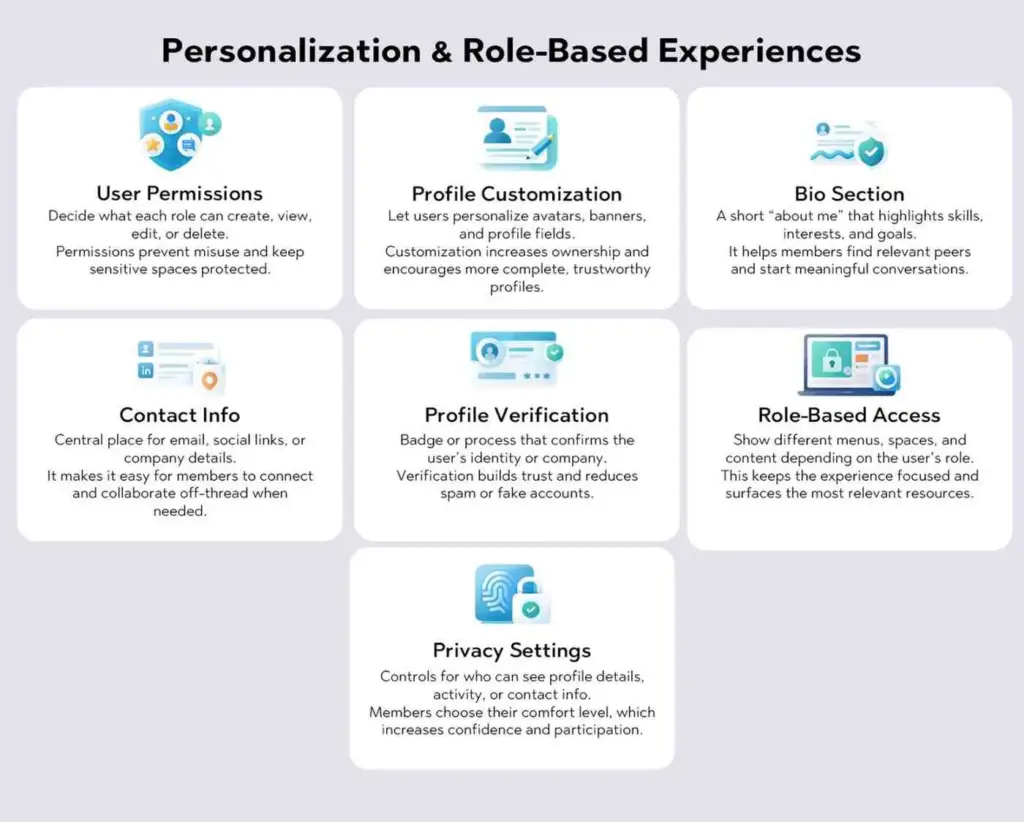
Personalization & Role-Based Experiences
Generic portals feel noisy. Thrico helps you deliver tailored journeys that match each member’s role, goals, and stage in the lifecycle.
1. User Permissions
Decide what each role can create, view, edit, or delete. Permissions prevent misuse and keep sensitive spaces protected.
2. Profile Customization
Let users personalize avatars, banners, and profile fields. Customization increases ownership and encourages more complete, trustworthy profiles.
3. Bio Section
A short “about me” that highlights skills, interests, and goals. It helps members find relevant peers and start meaningful conversations.
4. Contact Info
Central place for email, social links, or company details. It makes it easy for members to connect and collaborate off-thread when needed.
5. Profile Verification
A badge or process that confirms the user’s identity or company. Verification builds trust and reduces spam or fake accounts.
6. Role-Based Access
Show different menus, spaces, and content depending on the user’s role. This keeps the experience focused and surfaces the most relevant resources.
7. Privacy Settings
Controls for who can see profile details, activity, or contact info. Members choose their comfort level, which increases confidence and participation.
Communities create a goldmine of insight. Thrico turns raw activity into clear signals you can use to improve the product, your content strategy, and your customer success motion.
1. Engagement metrics
Track active members, new posts, replies, time to first response, accepted answers, event registrations, and watch-time on recordings. Trends and cohort analysis help you spot what’s working and where to course-correct.
2. Member behavior tracking
Understand which topics attract different segments, which articles drive repeat visits, and who is influencing peers. Identify rising champions, at-risk accounts with declining activity, and content gaps that need closing.
3. Feedback and sentiment signals
Surface recurring themes across threads—praise, pain points, requests—and quantify sentiment over time. Share these insights with product and marketing to prioritize roadmap items and messaging that truly resonates.
Scalable & Secure Infrastructure
As your community grows, so do the stakes. Thrico is built to keep your brand safe, your members protected, and your team efficient.
1. Moderation tools
Set clear guidelines and enforce them with configurable moderation: keyword filters, flagged content queues, role-based approvals, and audit trails. Empower trusted champions as volunteer moderators with scoped permissions.
2. Privacy and data security
Protect member data with robust access controls and strong authentication. Granular permissions ensure the right people see the right spaces. Compliance-ready practices help you meet organizational and regional requirements.
3. Enterprise-ready scalability
From hundreds to hundreds of thousands of members, the platform scales with you. As engagement and content volume rise, Thrico maintains performance and reliability so your experience remains responsive and consistent.
Learn more about admin controls and infrastructure safeguards in Thrico’s feature set.
Long-Term Business Impact
When communities are integral to the customer journey, they become a durable growth engine. Thrico helps translate participation into measurable outcomes.
1. Improved customer retention
Members who get rapid answers, learn from peers, and feel recognized are less likely to churn. The community reduces friction during onboarding, surfaces quick wins, and creates a sense of belonging that keeps customers engaged.
2. Increased product adoption
Role-based guides, event series, and expert-led threads expand usage into advanced features and new modules. Customers discover use cases they wouldn’t have tried alone, leading to higher lifetime value.
3. Stronger brand advocacy
Leaderboards, badges, and spotlight stories encourage champions to share successes publicly. Advocacy earns trust in the market, shortens sales cycles, and feeds a pipeline of peer references and customer speakers.
Summary of Thrico’s value for customer success Thrico brings together everything you need to build a high-impact customer success community: centralized content and conversations, event management, gamification, personalization, and analytics. The result is a cohesive member experience that makes customers more capable, connected, and committed.
Why communities are critical to brand growth In an era where products evolve quickly and buying committees expect proof of value, communities are a strategic advantage. They scale expertise, compress time-to-value, and turn your best customers into the teachers your next customers need. With Thrico, you launch not just a forum but a flywheel for engagement, adoption, and advocacy.
What Enterprises Need From a White-Label Community Platform
1. Full brand ownership
Enterprises don’t want a skin on top of someone else’s product; they want a space that feels like their own. White-label software should put your identity front and center—logos, typography, color systems, navigation patterns, and even your domain and email branding—to maintain trust and consistency everywhere the member interacts.
2. Scalability and performance
As programs mature, audiences expand across regions, lines of business, and use cases. The platform must handle sustained activity—discussions, content, chat, and events—without degrading responsiveness, and it should support modular growth so teams can add capabilities while keeping the experience coherent.
3. Security and compliance
Enterprise requirements demand control over data and access: granular roles, audit trails, consent management, and governance that meet regional privacy expectations. This isn’t optional; it’s foundational to long-term community health and executive confidence.
4. Integration readiness
Communities become most valuable when they plug into the systems you already use—CRM, marketing automation, learning, payments, SSO—so that identity, personalization, and reporting flow cleanly across the stack.
Complete White-Label Customization With Thrico
1. Custom domain and branding
Thrico’s approach to white-labeling centers on brand integrity. You bring your domain and identity assets; the platform ensures those choices show up consistently across UI elements, components, and communications, so the environment looks and feels like an owned property rather than a third-party network.
2. UI/UX flexibility
Beyond colors and logos, enterprises need navigation and layout control to map their content strategy—spaces, collections, and surface areas aligned with how their audience learns, collaborates, and takes action. Thrico emphasizes flexible layouts and component-level controls that keep the experience on-brand while letting product and program teams iterate quickly.
3. Brand-consistent member experience
From first click to daily habit loops, consistency reduces cognitive load. Thrico ties theming to the practical touchpoints members see—cards, badges, buttons, profile surfaces, and email white-labeling—so every interaction reinforces who you are and why the community exists.
Enterprise-Grade Scalability and Performance
1. High-traffic handling
Communities thrive when conversation, content, and events compound. The underlying model in Thrico brings together profiles, forums, groups, and real-time chat—designed to support long-form knowledge, quick coordination, and programmatic events at scale, without forcing teams to juggle separate systems.
2. Global user access
Enterprises often run regional programs, alumni hubs, partner networks, and customer communities simultaneously. Thrico’s focus on cohesive web and mobile experiences ensures members can participate wherever they are, with responsive interfaces and familiar patterns that travel across devices.
3. Modular architecture
As needs evolve, teams can introduce new modules (e.g., events, learning flows, or enhanced moderation) and reorganize information architecture—spaces, tags, collections—while keeping the brand layer intact. That modularity is key to sustainable scale.
Advanced Security, Privacy, and Access Control
1. Role-based permissions
Enterprise governance requires well-defined roles—admins, moderators, editors, contributors, champions—each with clear creation and publishing rights. Thrico highlights granular admin roles and auditability, letting teams set boundaries that match internal policies and external expectations.
2. Moderation tools
Healthy conversation doesn’t happen by luck. Thrico pairs structured forums and group chats with moderation features like reporting, muting, and filters, helping teams protect discourse quality while empowering trusted champions to participate in stewardship.
3. Data protection and compliance readiness
Controlling where data lives and who can access it is non-negotiable at the enterprise level. The white-label approach described by Thrico prioritizes governance—consent management, export options, and role-based oversight—so your brand can meet evolving privacy standards.
Engagement-Focused Community Features
1. Discussions, chat, and events
Thrico combines topic-based forums (for durable knowledge, accepted answers, and best practices) with real-time group chats for fast coordination. Program teams can then anchor momentum with a calendar of webinars, office hours, and cohort sessions—each feeding a content library members can return to later.
2. Gamification and rewards
Power users and everyday contributors both respond to recognition. Thrico’s philosophy emphasizes points, badges, and leaderboards as repeatable nudges that turn participation into habit—helpful for activation, retention, and surfacing trustworthy voices in crowded spaces.
3. Content and knowledge sharing
A native CMS streamlines publishing—posts, articles, announcements, and updates—organized by categories, tags, and collections. Editorial workflows like scheduling and role-based publishing help large teams keep a consistent cadence without bouncing between tools.
Built-In Analytics and Actionable Insights
1. Engagement tracking
Measuring what matters is essential for executive buy-in. Thrico encourages tracking user activation, response times, content contribution distribution, event attendance and replays, and cohort retention—practical indicators of whether programs are working.
2. Member behavior analysis
Understanding which spaces, formats, and topics resonate—then iterating your programming accordingly—turns community management into a product practice. Thrico’s guidance stresses reviewing dashboards regularly and adjusting prompts, office hours, and champion programs to improve outcomes.
3. Community performance metrics
Use activation rate, 30/60/90-day retention, and advocacy signals (UGC, referrals, case studies) to quantify momentum and guide investment. Treat these as north-star metrics for programs like onboarding cohorts, expert AMAs, and progressive challenges.
Seamless Integrations With Enterprise Tech Stacks
1. CRM, marketing, and support tools
A modern community platform should connect to CRM and automation systems so member activity can inform lifecycle journeys and reporting. Thrico calls out alignment with CRM and email tools, plus SSO options for a frictionless, secure experience.
2. APIs and automation workflows
Enterprises often need exports, data pipelines, and automation to move insights into executive dashboards. Thrico’s selection criteria include API access and analytics export so teams can extend the platform with their own workflows and governance standards.
Multi-Use Case Support for Enterprises
1. Customer success communities
SaaS and product-led organizations can centralize knowledge, capture durable answers in forums, and host events that accelerate onboarding and adoption—tying engagement to measurable retention.
2. Partner ecosystems
Partners benefit from shared spaces, structured knowledge, and announcements that live right next to discussion and chat. With role-based access, vendors can offer enablement content while protecting sensitive areas.
3. Internal employee communities
Enterprises use white-label platforms to foster knowledge-sharing and collaboration within the organization, creating searchable documentation and peer networks that survive org changes and time zones.
Faster Deployment and Lower Total Cost of Ownership
1. Quick setup and onboarding
Thrico positions white-labeling as a way to launch quickly—configuring identity, spaces, roles, and content flows without heavy engineering. The result is faster time-to-value with a clear, iterative rollout path anchored in early cohorts and programming rhythms.
2. Reduced development and maintenance costs
Instead of building a community layer from scratch, teams rely on Thrico’s modules for profiles, discussions, CMS, events, gamification, and analytics—reducing integration overhead and ongoing maintenance while preserving brand control.
Long-Term Strategic Value for Enterprises
1. Improved retention and loyalty
By owning the relationship (rather than renting it from third-party networks) and by designing on-brand experiences, enterprises can cultivate durable member habits that translate into loyalty and lifetime value.
2. Stronger brand advocacy
Communities create space for collaboration and co-creation—beta groups, feedback loops, and UGC—that convert engaged members into champions and references over time.
3. Sustainable community growth
With the right analytics, cadence, and integration to the business stack, programs become repeatable and scalable. Thrico outlines a phased playbook—strategy, architecture, launch, iteration, monetization—to keep growth sustainable and measurable.
Conclusion
Recap why Thrico stands out Thrico brings the pillars enterprises expect in a white-label community platform: deep brand customization (domain, theme, components), robust engagement modalities (forums, chat, events, CMS, gamification), analytics that track real outcomes, and integrations and SSO that tie the community to the broader tech stack. Governance—roles, audits, moderation—sits alongside, so security and privacy remain first-class.
Why enterprises prefer white-label community platforms When your brand controls the experience and data, you can build consistent journeys, comply with policies, and compound value across regions and programs. Thrico’s guidance and feature approach show how a branded community becomes a durable growth engine rather than another isolated channel. For a deeper tour of modules that power this, explore Thrico’s community building tools.
Points, badges, levels, and engagement loops are the building blocks of thoughtful gamification. Used well, they motivate participation, make progress feel visible, and help communities turn casual visitors into long-term contributors. This guide distills how each element works, why it matters, and how to combine them into an effective, sustainable system—grounded in Thrico’s approach to modern community engagement.
What Are Points, Badges, Levels, and Engagement Loops?
Points are the basic “currency” members earn for valuable actions—posting, replying, sharing resources, attending events, inviting peers, or completing learning paths. Thoughtful point systems weigh high-impact behaviors (like verified helpful answers) more than low-effort actions to encourage quality over quantity. (Thrico)
Badges are visible markers of achievement and identity—“First Post,” “Top Contributor,” “Community Mentor,” or campaign-themed awards. They signal expertise, reward milestones, and help newcomers quickly recognize trusted members.
Levels (or progression tiers such as Bronze → Silver → Gold → Platinum) show cumulative growth. They unlock privileges and perks—access to private groups, beta features, or event discounts—so members have tangible reasons to keep participating over weeks and months.
Engagement loops are the repeatable cycles that create habits: a member takes an action, receives timely feedback (points, progress bars, kudos, or a badge), and is prompted toward the next meaningful action. Loops are reinforced with streaks, weekly challenges, or seasonal leaderboards to keep momentum fresh.
Together, these elements form a simple pattern: clear actions → instant feedback → visible progress → meaningful rewards. When combined in a community platform like Thrico, they transform routine participation into a motivating journey that sustains retention.
Benefits of Points
1) Motivation through reward accumulation
Points translate effort into an immediately understandable signal: your contributions matter. Members who see points accrue after helpful actions are more likely to continue those behaviors. Aligning point values with your community’s goals (for example, rewarding accepted answers more than quick reactions) nudges quality participation without adding friction.
2) Tracking progress and achievements
Points make progress concrete. They power completion bars, thresholds to unlock levels, and eligibility for seasonal spotlights. Over time, consistently earned points correlate with stronger session frequency and return visits—because members can see their advancement and the next milestone.
Internal link (Gamification basics): Explore how Thrico’s Modules & Features bring engagement mechanics like points and progression into one unified platform: https://thrico.com/modules-and-features/.
Benefits of Badges
1) Social recognition and status
Badges make identity visible. Whether you highlight role-based badges (moderator, expert) or achievement badges (100 helpful answers, event champion), the effect is the same: members feel seen and valued. Public recognition also helps others discover who to learn from or ask for help, improving the quality of peer-to-peer interactions.
2) Encouraging consistent participation
A well-curated badge taxonomy tells a story of growth: foundational milestones early on, mastery badges for deeper contributions, and seasonal or campaign badges to keep things lively. When members know the next badge is within reach, they’re more likely to keep showing up and contributing.
Related reading:The Role of Gamification in Boosting Community Engagement explains why badges, titles, and visible achievement design increase motivation while avoiding vanity metrics. Read it here.
Benefits of Levels
1) Providing clear milestones for users
Levels offer an easy-to-understand roadmap—what you’ve earned and what’s next. Early levels should be quick to reach (to “hook” the behavior), while later tiers require more significant contributions. That cadence creates a satisfying rhythm of wins that keeps people moving forward.
2) Encouraging long-term engagement and retention
Levels shine when they unlock meaningful perks—exclusive spaces, early access, discounts, or responsibilities like mentoring. The result is a virtuous cycle: the more a member participates, the more value (and identity) they unlock, and the more invested they become in returning.
Related reading: Practical implementation tips for levels, streaks, and time-boxed challenges are covered in Using Gamification to Increase Member Activity: Tips & Tricks. Read it here.
Benefits of Engagement Loops
1) Creating habitual actions through feedback loops
Engagement loops turn sporadic actions into habits. When every valuable action earns immediate feedback—points, kudos, a progress nudge—members experience momentum. Streaks and weekly challenges add cadence, while progress meters visualize the “next step,” keeping the loop alive.
2) Increasing repeat visits and user retention
Loops work because they provide recurring reasons to return: protect your streak, finish the challenge, reach the next level, or appear on the weekly leaderboard. Communities that combine these mechanisms see stronger participation in discussions, events, and feedback campaigns.
Related reading: For examples of challenges, streaks, and leaderboards that drive repeat behavior—along with pitfalls to avoid—see The Role of Gamification in Boosting Community Engagement.
Combining Points, Badges, Levels, and Engagement Loops
Isolated mechanics can help, but the real gains appear when you layer them:
Points fuel levels (thresholds) and badges (milestones).
Badges and titles amplify status and guide trust discovery (who’s credible).
Levels tie to perks that matter—exclusive channels, early access, discounts.
Engagement loops (streaks, weekly challenges, seasonal leaderboards) provide recurring prompts that keep the system lively without overwhelming members.
In practice, communities use these combinations to:
Accelerate user-generated content (UGC) by mapping higher point values to helpful posts, verified answers, or detailed tutorials—then celebrating achievements with profile-level badges.
Boost event participation by running time-boxed challenges tied to live AMAs or webinars, awarding badges and level progress for attendance and recaps.
Strengthen onboarding with early, easy wins (first-post badge, “Welcome Week” challenge) followed by a visible path to deeper contribution.
When your platform centralizes these tools—like Thrico’s unified modules and features—it becomes far simpler to configure rewards, track outcomes, and iterate. Explore Thrico Modules & Features.
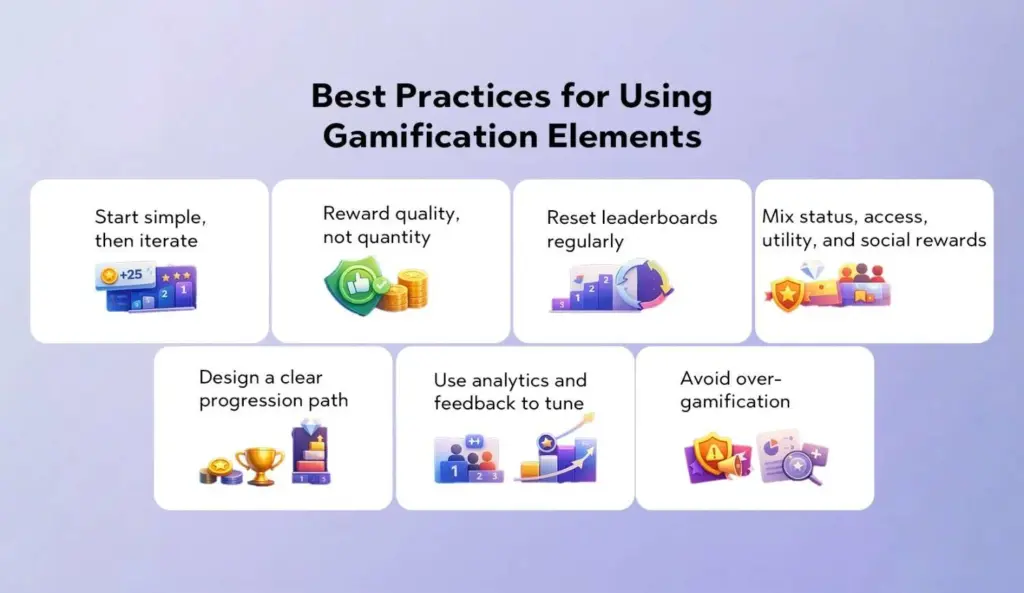
Best Practices for Using Gamification Elements
1. Start simple, then iterate
Launch with a minimal set—points + badges + a weekly leaderboard. Watch how members respond, then layer in levels, streaks, or challenges based on real engagement data. Complexity dilutes motivation.
2. Reward quality, not quantity
Tie the higher point values to peer-validated helpfulness, accepted answers, or moderator endorsements. This reduces spammy behavior and teaches what “good participation” looks like.
3. Reset leaderboards regularly
Use weekly or monthly cycles. Rotating categories and time-bound boards prevent incumbents from dominating forever and give newcomers a fair shot.
4. Mix status, access, utility, and social rewards
Not everyone is motivated by the same thing. Combine visible status (titles, frames) with access (private groups, early features), utility (discounts, templates), and social rewards (public shoutouts).
5. Design a clear progression path
Name levels meaningfully (Explorer → Guide → Mentor → Champion). Keep the first tiers easy; increase difficulty later to sustain long-term engagement. Connect each level to concrete perks.
6. Use analytics and feedback to tune
Track participation rates, streak preservation, challenge completion, and content quality. Share re-balances transparently (“We increased points for accepted answers based on your feedback.”).
7. Avoid over-gamification
If everything earns points, nothing feels special. Focus mechanics on the behaviors that matter most to your community’s mission. Keep themes fresh and avoid badge inflation.
For tactical ideas you can implement right away, see Thrico’s playbooks on gamification and community engagement:
Using Gamification to Increase Member Activity: Tips & Tricks (streaks, weekly prompts, reward mixes).
The Role of Gamification in Boosting Community Engagement (mechanics, pitfalls, and program design).
Where to Go Next
See what’s possible with Thrico’s modules and features—from gamification to discussions, events, and more—so you can design a cohesive engagement system in one place:https://thrico.com/modules-and-features/.
Deep-dive into practical tactics with Thrico’s latest gamification guides:
The Role of Gamification in Boosting Community Engagement (mechanics, examples, pitfalls).
Using Gamification to Increase Member Activity: Tips & Tricks (weekly challenges, streaks, reward design).
Design your system with intention and keep it human. The right blend of points, badges, levels, and engagement loops will turn everyday actions into a meaningful journey—one that members are proud to repeat and grow with over time.
Community monetization is the practice of earning revenue from an engaged audience through structured value exchanges. Marketplace features—like listings, integrated payments, memberships, and digital downloads—give creators, brands, and community owners the tools to sell directly, reward participation, and scale income without leaving the platform.
What Is Community Monetization?
Community monetization means generating revenue from an engaged audience by matching valuable offerings—content, access, products, or services—to member needs. It’s not “paywall everything”; it’s designing mutually beneficial value exchanges where members willingly pay for deeper outcomes: learning, credibility, convenience, or status.
Learning platforms: cohort-based programs, private study groups, templates, and tutoring.
Niche groups: professional associations, hobbyist clubs, and local groups trading skills, equipment, and collectibles.
At its core, monetization only works when the value is real and felt. Members pay because they gain clarity, time, results, belonging, or recognition. That’s the engine of sustainable community economics.
What Are Marketplace Features in Community Platforms?
Marketplace features are native commerce tools built into a community platform. Instead of bolting on scattered apps, a marketplace consolidates the member journey—from discovery to payment to delivery—inside one trusted environment. Typical components include:
Product & service listings: Catalog items (digital or physical), services (coaching, design, audits), bundles, and limited-time offers. Rich listings show media, descriptions, inventory, and policies.
Integrated payment systems: Secure checkout, saved payment methods, tax/VAT handling, refunds, and receipts. Less friction means higher conversion.
Subscription & membership tools: Tiered access, recurring billing, trials, coupons, and upgrade/downgrade paths. Great for predictable cash flow.
Digital downloads and gated access: Files, templates, courses, libraries, and posts that unlock after purchase or membership.
Seller and buyer profiles: Ratings, reviews, verification, and portfolios that signal quality and build trust.
Because the marketplace lives where conversation happens, members move from discussion → discovery → purchase without context switching—one of the biggest killers of conversion.
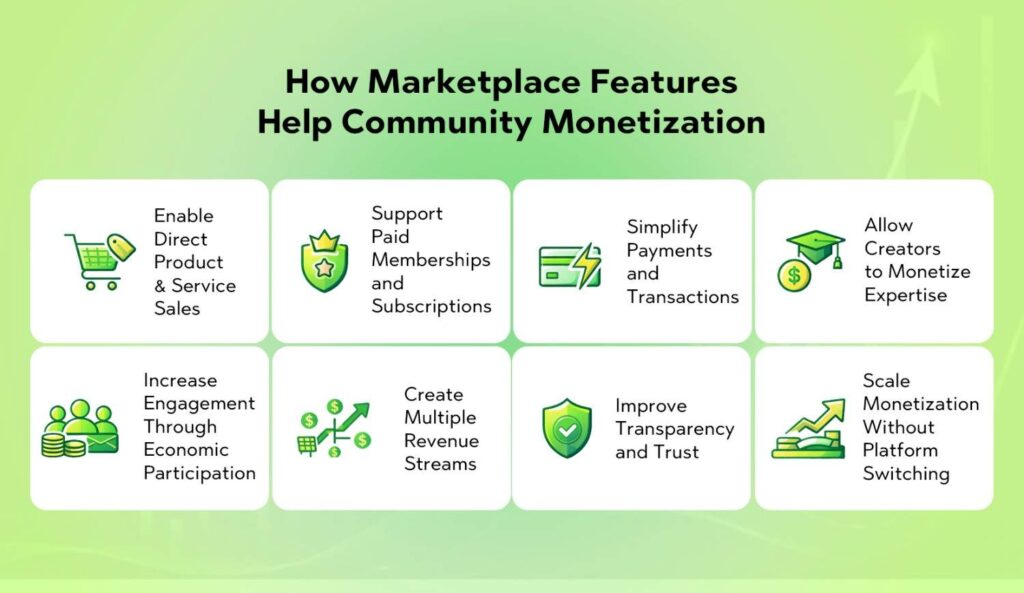
How Marketplace Features Help Community Monetization
1. Enable Direct Product & Service Sales
Marketplace listings let members sell digital products (templates, presets, e-books, mini-courses, sound packs) and physical goods (merch, kits, art prints) alongside services (coaching, critiques, audits, design sprints). This removes dependency on third-party storefronts where fees, algorithms, and policies can change overnight.
Why it matters:
Less leakage: Members aren’t pushed off-platform, which preserves session momentum and reduces drop-off.
Higher trust: Buyers already know the seller from community interactions; the platform’s reputation carries over to purchases.
Faster iteration: Creators test offers quickly, gather feedback in comments, and ship updates that members can immediately see.
Example play: A design community hosts “Critique Fridays.” Sellers offer 45-minute review slots directly in the marketplace. The event drives attention; the listing converts that attention into paid outcomes.
2. Support Paid Memberships and Subscriptions
Membership tiers convert passive readers into committed supporters and learners. The marketplace handles recurring billing, proration, trials, and one-click upgrades, while the community logic controls gated channels and role-based permissions.
Why it matters:
Predictable revenue: Recurring income stabilizes operations and funds better programming.
Value layering: Offer tiers (Starter, Pro, VIP) with escalating benefits—private channels, AMAs, templates, or office hours.
Clear progression: Members can “level up” their involvement, mirroring gamification benefits like points, badges, and levels that reward deeper participation.
Quick framework:
Tier 1—Supporter: community access + monthly digest.
Built-in checkout, invoicing, and payouts remove friction. Members prefer the path of least resistance; saved cards, local currencies, tax-inclusive pricing, and instant receipts raise conversion and reduce support tickets.
Why it matters:
Higher trust: Transactions occur inside the environment where relationships already exist.
Cleaner records: Unified analytics make ROI obvious—no spreadsheet archaeology.
Pro tip: Default to inclusive pricing (tax and fees clear up front) and provide a transparent refund policy pinned in marketplace guidelines.
4. Allow Creators to Monetize Expertise
A marketplace can productize knowledge beyond static content:
Coaching & consulting: bookable slots with automated reminders.
Workshops & cohorts: scheduled events with capped seats and waitlists.
Office hours & clinics: group Q&A monetized as “one-to-many” leverage.
Templates & playbooks: repeatable systems that scale infinitely.
Why it matters: Creators move from a time-for-money ceiling to semi-passive or one-to-many models that compound. The community itself becomes a lead qualifier, making sales warmer, shorter, and more ethical.
5. Increase Engagement Through Economic Participation
When members buy and sell, they stop being lurkers and start being stakeholders. Commerce becomes an engagement loop: discussion sparks an idea → listing launches → buyers give feedback → improvements ship → more discussion.
We can enhance this loop with gamification strategies and user engagement techniques, such as:
Points for first purchase, first sale, reviews left, or helpful replies on listing pages.
Badges for verified sellers, “Top Helper,” or “Launch Streak” (four consecutive monthly drops).
Levels that unlock higher listing limits, boosted visibility, or fee discounts.
Engagement loops: notification nudges (“3 people saved your product”), progress meters (“5 sales to reach Silver Seller”), and time-limited quests (“Review 3 purchases this week to unlock a coupon”).
These levers reinforce positive behavior and compound gamification benefits—motivation, recognition, and social proof—without cheapening the community.
6. Create Multiple Revenue Streams
Marketplace ecosystems diversify income:
Courses & cohorts: premium learning tied to community accountability.
Events: virtual summits, sprints, hackathons, and meetups with ticketing.
Digital products: libraries of assets that sell 24/7.
Services: “done-with-you” or “done-for-you” offerings for members who want speed.
Sponsorship slots: tasteful, relevant partners showcased in a marketplace-adjacent area (not interruptive).
Job board & gigs: paid listings that circulate talent inside the community.
Diverse streams reduce reliance on ads—often a mismatched incentive that pushes volume over value—and insulate revenue from sudden platform changes.
Verified profiles: identity or portfolio checks for sellers.
Clear dispute flows: defined timelines, evidence requirements, and platform mediation.
Public policies: shipping, refund, and turnaround expectations standardized at the platform level.
Transparency doesn’t just prevent problems—it increases conversion. When members see consistent standards, they buy with confidence, and sellers commit to excellence.
8. Scale Monetization Without Platform Switching
Context switching kills momentum. With marketplace features:
Everything is managed in one ecosystem: content, chat, listings, payments, fulfillment, analytics.
Unified UX: shared design language and navigation reduce cognitive load.
Retention gains: members return for conversations and stay to buy—or vice versa.
Operating inside one stack creates a compounding flywheel: the more you ship, the better your insights; the better your insights, the better your offers; the better your offers, the stronger the community.
Benefits of Marketplace-Driven Community Monetization
Sustainable revenue growth: Recurring memberships plus evergreen digital products provide baseline stability, while launches and events create spikes.
Stronger community loyalty: Members invest financially and emotionally, which increases belonging and lifetime value per user.
Better creator and member retention: Sellers stay for demand; buyers stay for access, updates, and reputation effects (e.g., badges and levels).
Data-driven monetization insights: Unified analytics reveal top categories, conversion bottlenecks, cohort retention, and CLV by tier.
Fair value distribution: Revenue pathways for both hosts and members align incentives and reduce burnout.
Who Can Benefit Most From Marketplace Features?
Creator-led communities: writers, filmmakers, musicians, photographers, and streamers who want to own their audience and margins.
Learning and coaching platforms: educators who can package knowledge as courses, playbooks, office hours, and certifications.
Professional and niche networks: designers, developers, data scientists, marketers, or collectors—any group where peer-to-peer value exists.
Brand-owned communities: consumer brands with superfans eager for early access, limited drops, or co-created products.
SaaS and Web3 communities: tool makers and protocol communities monetizing templates, plugins, verified services, or governance-enabled perks.
If your community can teach, fix, build, curate, or certify, a marketplace is a natural fit.
Challenges to Consider When Monetizing Communities
Over-monetization risks: If every interaction becomes a sales pitch, trust erodes. Keep community-first spaces free and vibrant.
Quality control of listings: Require minimum standards (clear descriptions, fulfillment times, example deliverables), and curate featured items.
Payment compliance and fees: Understand tax/VAT, chargebacks, and payout timing. Be transparent about platform fees.
Community trust and moderation: Enforce codes of conduct, anti-fraud measures, and conflict-of-interest policies for moderators who also sell.
Mitigate these risks with clear guidelines, graduated seller privileges (levels), and transparent enforcement.
Best Practices for Monetizing Communities With Marketplace Features
1. Start with value before monetization Ship free, high-signal content and rituals first (weekly threads, show-and-tells). Monetization should feel like a natural extension of value, not a pivot.
2. Offer clear pricing and benefits Use simple plans with 2–3 tiers. For each tier, state: Who is this for? What outcomes can they expect? What’s inside? Avoid feature bloat that confuses buyers.
3. Highlight top creators and sellers Showcase verified sellers on a home carousel. Use badges like “Editor’s Pick,” “Most Helpful,” or “Fast Responder.” Recognition is a core user engagement technique.
4. Use analytics to optimize offerings Track: free-to-paid conversion, average order value, churn by tier, time-to-first-sale, review velocity, and search term trends. Iterate your marketplace taxonomy around real demand.
5. Keep transactions community-first Bake in engagement loops that reward feedback and helpfulness: points for reviews, levels that unlock perks, and monthly community picks chosen by vote.
6. Design trustworthy policies Post clear refund windows, dispute processes, and fulfillment SLAs. Require sellers to acknowledge policies at listing submission.
7. Reduce friction at checkout Support local currencies, one-click renewals, and simple receipts. Offer coupons sparingly; overuse trains people to wait for discounts.
8. Protect quality with curation Approve new sellers via a lightweight review. Gate higher listing limits and boosted placement behind seller levels based on ratings and fulfillment history.
9. Onboard sellers with playbooks Provide listing templates, pricing heuristics, and fulfillment checklists. Offer a seller Q&A channel for rapid feedback.
10. Integrate gamification thoughtfully Use points, badges, and levels to reinforce pro-social behaviors: helpful reviews, on-time delivery, and resource sharing. Avoid pay-to-win mechanics that distort trust.
Want a primer on engagement mechanics? Seegamification basics for an overview of points, badges, levels, and the psychology of motivation.
Future of Community Monetization With Marketplaces
Creator economy growth: More individuals will build portfolio incomes from audiences they own—memberships plus productized services.
Integrated commerce + community models: Chat, content, courses, and checkout will live together. The “platform” becomes the product.
AI-driven recommendations: Personalization will match members to offers based on behavior, outcomes, and peer networks—without being creepy.
Decentralized and niche marketplaces: Tokenized access, provenance for digital goods, and micro-communities with deep expertise.
The through-line: trust plus convenience. Communities that combine both will outcompete generic marketplaces and algorithmic feeds.
Practical Blueprint: Turn Conversations Into Commerce (Step-by-Step)
Phase 1 — Foundation (Weeks 1–2)
Map member jobs-to-be-done: What outcomes do they hire the community for?
Define 2–3 membership tiers and a single flagship offer (course, clinic, or template).
Publish marketplace guidelines, refund policy, and listing standards.
Phase 2 — Pilot (Weeks 3–4)
Recruit 5–10 trusted members as founding sellers.
Launch with limited inventory to learn quickly.
Add engagement loops: points for first purchase, reviews, and launch feedback.
Phase 3 — Scale (Weeks 5–8)
Introduce seller levels (Bronze, Silver, Gold) tied to on-time delivery and ratings.
Expand categories based on search and sales data.
Layer in badges (Top Helper, Rising Star) and seasonal “market days.”
Phase 4 — Optimize (Ongoing)
Run monthly audits of conversion drop-offs.
Spotlight high-ROI use cases as case studies.
Tune pricing and bundles by cohort behavior and LTV.
Example Monetization Map (for Inspiration)
Free layer: weekly office hours, public challenges, curated reading list.
Ethical Monetization: Keep the Soul of Your Community
Monetization should amplify your mission, not warp it. A few grounding principles:
Value before virality: Resist the temptation to inflate promises to juice sales. Sustainable communities win on trust.
Transparency over tricks: Price clearly. Avoid dark patterns (fake scarcity, hidden fees).
Recognition over rivalry: Gamify prosocial behavior—helpfulness, reliability, and mentorship.
Consentful data: Use analytics to improve relevance, not to pressure or manipulate.
Access pathways: Offer scholarships or community-earned paths to premium tiers so contribution—not just cash—unlocks opportunity.
Final Thoughts
A marketplace isn’t just a way to “collect payments”—it’s a participation engine. When commerce happens inside the conversation, you unlock loops that deepen engagement, reward contribution, and compound revenue. Combine native marketplace tools with gamification strategies—points, badges, levels, and purposeful engagement loops—and you’ll create a community economy that serves everyone: hosts, creators, and members.
Ready to explore modules that support listings, payments, memberships, and engagement mechanics? Check out gamification basics to see how the right building blocks accelerate sustainable growth.
2026 is shaping up to be the year communities get smarter, more diverse, and more profitable. White-label community platforms—software that lets organizations host branded, members-only spaces under their own domain and apps—sit at the center of this shift. Brands, educators, and enterprises are investing in them to own their audience, data, and revenue streams. In this article, we’ll unpack the 2026-ready trends to watch and the adoption signals leaders should track.
Why White-Label Community Platforms Are Growing
The growth isn’t hype; it’s a pragmatic response to how digital engagement, privacy norms, and brand economics are changing.
Ownership of audience & data: Third-party networks decide who sees your posts and what gets measured. With a white-label platform, you control the database, consent records, and member insights—without fighting an algorithm for reach.
Brand control vs. social media dependency: Social networks are great for discovery, not for durable relationships. White-label spaces let you craft the experience: navigation, visual identity, content architecture, and even tone.
Need for private, secure digital communities: From alumni groups to product cohorts and customer advisory boards, many interactions are better in invitation-only or paid spaces with verified accounts and policy-driven moderation.
Monetization & engagement opportunities: Paid memberships, gated courses, events, and sponsorships work best where the brand sets pricing, packaging, and analytics—not a third party. White-label platforms make those levers native.
Key Trends Shaping White-Label Community Platforms in 2026
1. AI-Powered Community Moderation & Insights
1. Automated moderation. Expect more precise, context-aware moderation that goes beyond profanity filters. Modern AI can interpret intent (e.g., spam vs. honest mistakes), flag harassment in nuanced ways, and escalate only the edge cases to human moderators. The result? Safer spaces at scale, without burning out community managers.
2. Sentiment analysis. AI will synthesize member sentiment across posts, replies, DMs, and surveys to spot momentum or malaise in near real-time. Think heat maps of “topics that energize” and “threads that frustrate,” plus alerts when sentiment dips among power users or key cohorts.
3. Engagement recommendations. Recommendation engines will propose content formats (polls, AMAs, challenges), timing (e.g., “Post at 10:15 AM IST; engagement peaks then”), and suggested prompts to revive quiet segments. They’ll also surface members at risk of churn and propose re-engagement flows (DMs, nudges, or targeted perks).
2. Deeper Personalization & Member Journeys
1. Role-based access. No more one-size-fits-all feeds. White-label systems will let you define roles (e.g., customer, partner, mentor, internal) and map them to default spaces, permissions, and perks. This keeps mixed communities coherent without “gatekeeping” friction.
2. Personalized feeds & notifications. Members should see what they value most—events in their timezone, threads from their cohort, and content matched to their skill level. Notifications will get smarter: bundling low-priority pings, surfacing “missed highlights,” and letting members tune frequency by category.
3. Behavioral targeting. Journey logic will adapt to signals like “read three onboarding posts but never introduced themselves” or “attended two events but skipped the last three.” Expect auto-prompts (“Say hi to your cohort”), unlocks (bonus modules after milestones), and dynamic offers (trial extensions for near-inactive members).
3. Built-In Monetization Features
1. Paid memberships. Tiered memberships—starter, pro, enterprise—will be easier to configure with free trials, regional pricing, coupon logic, and instant upgrades/downgrades. Crucially, member value will be proven via in-product dashboards: “content consumed, events attended, peers connected,” not vanity metrics.
2. Courses & gated content. Communities won’t send learners to yet another LMS. Instead, course modules, lesson drip schedules, certificates, and cohort forums will live where the conversations already are. Expect templated learning paths, embedded quizzes, and automated completion nudges.
3. Event & subscription management. Webinars, office hours, masterminds, and local meetups will tie directly to membership tiers. Think: integrated ticketing, waitlists, capacity limits, calendar sync, and post-event auto-publishing of replays to the right roles.
4. Integration With Business & Marketing Tools
1. CRM, marketing automation. Your community should enrich contact records with intent signals: topics of interest, activity streaks, and purchase triggers. Bidirectional sync with CRM and marketing automation ensures sales sees community champions, and marketing nurtures leads with relevant artifacts (threads, guides, case studies).
2. Analytics dashboards. Native dashboards should go beyond DAU/MAU. Look for cohort health, content-to-conversion paths, topic momentum, retention by tier, activation funnel (discover → join → engage → contribute → advocate), and LTV uplift among community participants vs. non-participants.
3. Payment gateways. Choose platforms with global payment support (cards, UPI, wallets, invoices), tax handling, and trials/refunds that don’t require manual gymnastics. Revenue data should roll into analytics so you can measure ROI per program (e.g., “Cohort A yields 25% higher expansion revenue”).
4. Mobile-First & App-Like Experiences
1. Progressive web apps. PWAs now rival native apps for speed, push support, and offline behavior. For many communities, a PWA offers the right balance: discoverable on the web, installable on home screens, and easier to update than multiple app-store builds.
2. Push notifications. Push will shift from “megaphone” to “assistant.” Expect batched digests, context-aware prompts (e.g., “Your thread has 5 new replies—reply now?”), and quiet hours that actually stick. For global communities, timezone-aware scheduling is a must.
3. Offline & low-bandwidth optimization. Videos with adaptive bitrates, cached lessons, and text-first modes keep engagement inclusive—especially valuable for learners and field teams with limited connectivity.
5. Stronger Data Privacy & Compliance
1. GDPR & regional compliance. Cross-border communities need consent logs, data-subject request workflows, and regional data residency options. In 2026, compliance isn’t a checkbox; it’s a design principle that shapes how you collect, store, and process community data.
2. First-party data ownership. With third-party cookies fading, community interactions are a goldmine of first-party data—earned transparently via value exchange. Make sure your platform clarifies ownership and portability in contracts and admin controls.
3. Secure user authentication. SSO (SAML/OIDC), MFA, social logins (where appropriate), and device/session policies are now baseline. Granular admin roles and audit logs help enterprises satisfy security reviews without slowing down community ops.
How White-Label Platforms Will Replace Traditional Social Communities
The shift isn’t about abandoning social networks; it’s about moving the center of gravity to owned spaces.
1. Algorithm control vs. owned platforms
Social networks: Your reach fluctuates with opaque algorithm changes.
Owned platforms: You set the rules—what’s pinned, who sees which spaces, and how onboarding unfolds.
Long-term engagement vs. reach-only metrics
Social networks: Great for impressions, weak for structured progress.
Owned platforms: Members move through defined journeys—onboarding, learning paths, mentorships—producing measurable outcomes (skills, revenue, adoption).
2. Brand trust & authenticity
Social networks: Ads, trolls, and random content erode trust.
Owned platforms: Verified members, clear codes of conduct, and consistent brand voice build psychological safety. That’s what encourages contributions, referrals, and advocacy.
Bottom line: In 2026, expect smart brands to treat social channels as top-of-funnel discovery while the relationship, value, and revenue live inside their white-label community.
Who Should Invest in White-Label Community Platforms in 2026?
1. Brands & D2C companies. Own the post-purchase relationship. Turn customers into loyalists with onboarding tracks, drop-in Q&A, and user-generated content that compounds SEO and social proof. Premium tiers can bundle VIP support, early access, and private events.
2. Coaches & educators. Cohort courses, masterminds, and membership academies thrive when learning and discussion coexist. Integrated curricula, progress tracking, and certificates raise completion rates—and lifetime value—without scattering students across apps.
3. SaaS & B2B communities. Drive product adoption with role-based spaces (admins, end users, champions). House feature updates, templates, and office hours in one place. Map community engagement to expansion and retention by syncing with your CRM.
4. Enterprises & internal teams. Internal communities reduce email clutter and surface expertise. Knowledge bases stay alive through discussions, and cross-functional guilds accelerate innovation. SSO, audit trails, and data residency keep IT happy.
What to Look for in a Future-Ready White-Label Community Platform
Scalability: Handles thousands of concurrent users, global traffic, and media without lag; supports multi-workspace or multi-tenant setups.
Custom branding: Full control of domains, theming, navigation, and UI components to match your design system.
AI & analytics: Built-in moderation, sentiment, journey automation, and dashboards that tie engagement to outcomes.
Security & integrations: Enterprise SSO/MFA, audit logs, role granularity, plus connectors for CRM, marketing automation, data warehouses, and ubiquitous payment gateways.
The Road Ahead for White-Label Community Platforms
By late 2026, the most successful communities will be owned, intelligent, and adaptable. Owned—because trust and economics require controlling your member experience and data. Intelligent—because AI will power moderation, journeys, and insights that compound over time. Adaptable—because platforms will flex across devices, roles, and regional rules without sacrificing speed or security. Keep your strategy focused on value creation, not vanity engagement—and the technology will serve your members, not the other way around.
Modern brand communities aren’t side projects or social add‑ons—they’re revenue engines that also deepen relationships. A brand community is a dedicated space where customers, prospects, partners, and advocates gather to learn, collaborate, and get value that goes beyond the product. In this guide, we break down exactly how community revenue and brand loyalty reinforce each other—showing practical monetization paths while strengthening trust over the long term.
Why Communities Matter for Revenue & Brand Loyalty
Communities concentrate attention, relationships, and data into an owned environment. That combination makes them unusually effective for both income and affinity.
Direct access to engaged audiences. You’re speaking to people who actively opted in. That means lower noise, richer feedback loops, and far better conversion on announcements, launches, and campaigns.
First‑party data ownership. Interactions, preferences, and behavior live in your system—not a rented social feed. With consent and transparency, that first‑party data powers smarter personalization and better offers.
Lower customer acquisition costs (CAC). Peer referrals, organic discovery, and member‑led content reduce paid media dependency. Communities reuse the same effort across many members—think replays, threads, and playbooks that keep paying off.
Stronger emotional brand connection. Humans don’t bond with banner ads; they bond with people and progress. When members feel seen, helped, and celebrated, loyalty grows—and so does their willingness to buy, renew, and advocate.
How Communities Generate Revenue
Healthy communities monetize by creating value first and then packaging access, service, or outcomes. Here are the most reliable levers.
1. Paid Memberships & Subscriptions
Paid programs work when they deliver ongoing value that members can’t get elsewhere.
Tiered access. Offer Starter → Pro → Enterprise (or Student → Practitioner → Leader) with increasing privileges: private channels, office hours, templates, early access, or concierge support. Tiers let you match value to willingness‑to‑pay while keeping the public face accessible.
Exclusive content & features. Ship research digests, benchmarks, cohort circles, or library access behind the paywall. For product‑led brands, consider feature flags or “members‑only” betas.
Predictable recurring revenue. Subscriptions transform sporadic launches into steady cash flow. Use annual options for cash runway and monthly for accessibility; let members upgrade/downshift without friction.
Implementation notes
1. Align each tier with clear outcomes (e.g., “publish a portfolio,” “ship your first automation,” “master admin workflows”).
2. Bundle live touchpoints (AMAs, clinics) with a consistent cadence.
3. Show progress with badges, streaks, and milestone certificates—see Communities. Generate Revenue for gamified modules that keep motivation high.
2. Courses, Events & Premium Content
Education is the fastest way to prove value and capture demand inside your community.
Workshops, masterclasses, webinars. Short, practical sessions drive spikes of engagement and act as conversion on‑ramps to memberships or higher‑touch programs.
Certification programs. Role‑based tracks (Admin, Analyst, Coach, Creator) provide signaling power for members and a strong moat for brands. Certified members become advocates who lift your reputation.
Community‑exclusive launches. Release templates, toolkits, or micro‑products to members first. The combination of scarcity + privilege lifts conversion and creates a hero experience for your core audience.
Packaging ideas
Drip lessons to maintain momentum and reduce overwhelm.
Offer cohort‑based versions of flagship courses to drive peer accountability.
Bundle seat licenses for teams; price by cohort size or outcome (e.g., “deploy in 30 days”).
3. Product & Service Upsells
Community surfaces intent you won’t see in ads or email alone—making upsells feel helpful, not pushy.
Early access to new products. Turn your members into a living beta group. They get perks and a voice; you get signal and velocity.
Community‑only offers. Target bundles or upgrades at members who’ve hit milestones (e.g., 3 events attended; 10 helpful replies). Personalize the pitch using first‑party data.
Feedback‑driven product improvements. Use “feature councils” and “design partner” programs inside your community. When people co‑create, they buy more, renew faster, and refer others.
Practical playbook
Tag conversations by feature and segment: adoption risk, expansion interest, friction.
Automate warm handoffs to sales or success when engagement crosses a threshold.
Publish transparent changelogs and roadmap updates to close the loop.
4. Sponsorships & Partnerships
If your community has attention and trust, aligned partners will pay to access it—without polluting the experience.
Brand collaborations. Co‑branded events, guides, or kits that genuinely help members can create net positive value (new expertise, discounts, reach). Vet partners for culture fit.
Sponsored challenges or content. Run themed sprints, case‑study series, or AMAs with clear labeling. Keep editorial control and ensure sponsors contribute real know‑how.
Value‑aligned partnerships. Think tools that integrate with your product, recruiters who understand the craft, or marketplaces your members already use. Take a revenue share while elevating outcomes for members.
Guardrails
Cap frequency and maintain a strict code of conduct.
Post a public sponsor policy and keep ads out of private support spaces.
Measure member sentiment after sponsored moments and iterate.
5. Marketplace & Peer‑to‑Peer Opportunities
Communities become economic networks when members can hire, trade, and collaborate.
Member services. Enable freelancers and agencies to list offers (implementation, audits, coaching). Take a small platform fee and highlight top‑rated providers.
Job boards. Curate roles that match your craft. Charge employers, offer members early looks or referral bonuses, and measure placement rates as a community KPI.
Creator monetization. Give power users a path to earn (premium threads, templates, office hours). Shared upside increases contribution quality and retention.
Operations tips
Use verified profiles, reputation signals, and dispute guidelines.
Provide template contracts and payment rails.
Celebrate success stories prominently to boost flywheel momentum.
How Communities Build Long‑Term Brand Loyalty
Revenue follows trust. Here’s how community mechanics cultivate loyalty that lasts.
Two‑way communication. Unlike broadcast channels, communities let members ask, challenge, and co‑create. Transparent roadmaps and open AMAs show that the brand listens—and acts.
Peer‑to‑peer validation. People believe people. Reviews, case studies, and “show‑your‑work” threads reduce risk and nudge fence‑sitters to commit.
Emotional investment through participation. When members teach, mentor, or ship projects together, identity forms around the brand’s mission. That emotional glue outlasts discounts.
Recognition & belonging. Badges, shout‑outs, and “member spotlights” tap intrinsic motivation. Belonging turns passive customers into active advocates who recommend, defend, and build with you.
The Flywheel Effect: Engagement → Loyalty → Revenue
A well‑run community compounds because each stage feeds the next.
4. Revenue funds better community experiences. More moderators, better content, stronger events—fueling fresh engagement and restarting the loop at a higher level.
How to measure the flywheel
Track activation (first post, first event), contribution rate, renewal/upgrade rate, and referral velocity.
Compare LTV and NRR for community participants vs. non‑participants.
Instrument cohorts by join month to visualize lift over time.
Community‑Led Growth vs Traditional Marketing
Community‑led growth doesn’t replace marketing; it re‑centers it around customer outcomes.
Paid ads vs owned audiences. Ads rent attention; communities own it. Ads are still great for acquisition—but the compounding value lives where you control experience, data, and pacing.
Short‑term conversions vs lifetime value. Launch spikes are exciting; LTV pays the bills. Communities turn one‑time buyers into multi‑year advocates whose feedback shapes the roadmap.
Broadcast messaging vs conversations. Emails and posts shout; communities converse. Conversation is where objections surface and are resolved, making selling feel like helping.
Play nicely together
Use paid to bring the right people to your welcome path.
Nurture with community artifacts—member stories, template libraries, recorded clinics.
Graduate qualified members to customer advocacy programs and case‑study pipelines.
What Types of Communities Monetize Best?
Some shapes of community are naturally closer to value—and therefore to revenue.
Brand communities (D2C, SaaS). Home bases for customers and fans: product tips, launch previews, and peer support. Monetize with memberships, add‑ons, and certification programs.
Professional & creator communities. Skills‑driven groups where members trade playbooks and gigs. Monetize with job boards, marketplaces, sponsor content, and cohort courses.
Education & coaching communities. Cohorts, academies, and masterminds where progress is the product. Monetize with tiered curricula, office hours, and alumni networks.
Enterprise & customer communities. Internal guilds, partner portals, and customer advisory boards. Monetize indirectly through expansion revenue, reduced churn, and lower support costs.
Fit check
Can your audience benefit from repeat interactions?
Does your product or expertise create ongoing, compounding value?
Can members help each other in ways you can’t scale 1:1?
Best Practices for Monetizing Communities Without Losing Trust
Trust is the moat. Monetize with care and intention.
Lead with value, not sales. Ship free, practical value before asking for payment: quick wins, templates, and relevant intros. Teach people how to succeed first.
Transparent pricing. Publish what’s included, who it’s for, and how to cancel. Offer scholarships or regional pricing to maintain inclusivity.
Member‑first monetization. Make offers that advance member goals. Avoid intrusive upsells in private help spaces and keep sponsored items clearly labeled.
Long‑term focus over quick wins. Optimize for renewals, referrals, and outcomes—not just launch day revenue. Maintain healthy moderator ratios and community guidelines that protect safety and signal quality.
Governance checklist
Codify a clear code of conduct and enforcement process.
Create opt‑in notification bundles to prevent fatigue.
Publish sponsor and affiliate policies.
Establish data use/consent flows that members can understand at a glance.
Final Takeaway
When thoughtfully designed, a community is both a profit center and a loyalty engine. Engagement creates trust; trust unlocks loyalty; loyalty compounds into revenue that you can reinvest to create even more member value. Brands that operationalize this loop—supported by the right modules, governance, and measurement—win on both community revenue and brand loyalty.
A discussion forum is one of the most powerful tools for bringing people together around shared interests, goals, or challenges. Whether it’s a brand community, learning space, or professional network, forums create a space for conversation, collaboration, and trust. However, simply launching a forum does not guarantee engagement. Active communities require intentional design and consistent effort. That’s where discussion forum best practices come in—helping community builders foster meaningful participation, healthy interactions, and long-term growth.
What Is a Discussion Forum?
A discussion forum is an online platform where users can start conversations, ask questions, share insights, and respond to others through structured threads and topics. Unlike one-way content platforms, forums are built around interaction and dialogue.
Common Use Cases of Discussion Forums
Discussion forums are widely used across industries and purposes, including:
Customer support and product feedback communities
Learning and education platforms
Professional and industry-specific networks
Hobby, interest, or fan-based communities
Internal employee or partner communities
In each case, the forum acts as a central hub for knowledge sharing and peer-to-peer interaction.
Difference Between Forums and Social Media Groups
While forums and social media groups may appear similar, they serve different purposes. Social media groups are typically driven by algorithms, short-lived visibility, and external distractions. Discussion forums, on the other hand, are designed for structured conversations, long-term knowledge retention, and deeper engagement. Threads are searchable, discussions remain accessible, and the focus stays on the community rather than a constantly changing feed.
Why Active Communities Matter in Discussion Forums
Building a forum is only half the work. Its true value lies in how active and engaged the community becomes.
1. Stronger User Engagement
Active forums encourage members to return frequently, participate in discussions, and contribute valuable insights. When users see consistent activity, they are more likely to join conversations themselves, creating a positive engagement loop.
2. Better Knowledge Sharing and Trust
Discussion forums thrive on collective intelligence. Active participation allows members to learn from one another, solve problems faster, and build trust within the community. Over time, this shared knowledge becomes a valuable resource that strengthens the forum’s credibility and usefulness.
Key Discussion Forum Best Practices
1. Define Clear Community Guidelines
Clear community guidelines set expectations and create a safe environment for discussion.
a. Posting Rules
Establish rules around respectful communication, relevance, and content quality. Let members know what is encouraged and what is not allowed. Clear rules reduce confusion and discourage low-quality or harmful posts.
b. Moderation Clarity
Transparency around moderation is essential. Members should understand how moderation works, what actions moderators can take, and how issues are resolved. This clarity builds trust and reduces friction within the community.
2. Encourage Meaningful Conversations
Engagement is not about volume—it’s about value.
a. Focus on Quality Over Quantity
A smaller number of thoughtful discussions is more valuable than a high volume of shallow posts. Encourage members to share experiences, insights, and well-considered opinions rather than quick reactions.
b. Ask Open-Ended Questions
Open-ended questions invite deeper responses and ongoing discussion. Instead of yes-or-no prompts, use questions that encourage storytelling, problem-solving, or reflection. These types of conversations naturally keep threads active longer.
3. Appoint Active Moderators
Moderators play a critical role in sustaining healthy forums.
a. Role of Moderators
Moderators guide conversations, welcome new members, enforce guidelines, and keep discussions productive. They also model positive behavior by engaging respectfully and constructively.
b. Maintaining Healthy Discussions
Active moderators help prevent conflicts from escalating, redirect off-topic conversations, and ensure that all members feel heard. Their presence reassures users that the forum is well-managed and worth investing time in.
4. Make Onboarding Simple for New Members
First impressions matter, especially in online communities.
a. Easy Sign-Up Process
Reduce friction during registration. A complicated sign-up process can discourage participation before it even begins. Keep forms simple and allow members to join discussions quickly.
b. Clear Navigation and Orientation
New members should immediately understand where to start. Clear navigation, introductory posts, and pinned “start here” threads help users find relevant discussions and feel confident participating.
5. Reward Active Participation
Recognition motivates continued engagement.
Badges, Points, and Recognition
Gamification elements such as badges, points, or visible recognition encourage members to contribute regularly. Highlighting helpful contributors reinforces positive behaviour and shows appreciation for active members.
How to Increase Engagement in a Discussion Forum
Even well-structured forums need ongoing engagement strategies.
1. Use Content Prompts
Discussion prompts give members a reason to participate. Weekly questions, challenges, or opinion-based topics spark conversation and help overcome the fear of posting.
2. Create Regular Discussion Topics
Consistency builds habits. When members know that new discussions appear regularly—such as weekly themes or monthly debates—they’re more likely to return and engage.
3. Recognize and Highlight Members
Publicly acknowledging contributions through shout-outs or featured posts strengthens relationships and encourages others to participate. Recognition turns passive members into active contributors.
Common Mistakes That Kill Forum Engagement
Understanding what to avoid is just as important as knowing what to do.
1. Over-Moderation
While moderation is essential, excessive control can stifle conversation. Removing posts too quickly or enforcing rules too rigidly can make members hesitant to participate.
2. Ignoring Inactive Members
Inactive members often leave quietly. Without re-engagement efforts, forums slowly lose momentum. Simple check-ins or targeted prompts can help bring members back into conversations.
3. Poor UX and Navigation
If users struggle to find relevant discussions or understand how to participate, engagement drops. Cluttered layouts, confusing categories, and slow performance all negatively impact forum activity.
Tools and Features That Help Build Active Communities
The right features make participation easier and more rewarding.
1. Notifications
Timely notifications alert members to replies, mentions, or new discussions. This pulls users back into the forum and keeps conversations moving forward.
2. Search and Tagging
Search functionality and topic tags help members find relevant discussions quickly. Easy discovery increases participation and prevents repeated questions.
3. Mobile Responsiveness
Many users access forums from mobile devices. A mobile-friendly design ensures members can engage anytime, anywhere, without friction.
To support these capabilities effectively, a well-structured Discussion Forum feature is essential, allowing communities to scale conversations while keeping them organized and engaging. https://thrico.com/modules-and-features/
How to Measure Discussion Forum Success
Tracking the right metrics helps you understand what’s working and where improvements are needed.
1. Active Users
Measure how many members participate within a given time period. A growing number of active users is a strong indicator of community health.
2. Engagement Rate
Engagement rate includes posts, replies, and reactions relative to total members. This metric reveals how involved your community truly is.
3. Thread Participation
Look at how many members contribute to individual threads. High participation across multiple threads suggests balanced engagement rather than reliance on a few voices.
Conclusion
Building an active discussion forum takes more than launching a platform—it requires intention, consistency, and a strong focus on people. By following proven discussion forum best practices, encouraging meaningful conversations, empowering moderators, and recognizing contributors, communities can thrive over the long term. Active forums foster trust, knowledge sharing, and lasting relationships. With the right approach and ongoing care, your discussion forum can become the foundation of a truly engaged online community.
The digital landscape has never been noisier. Every second, millions of posts, videos, articles, and updates flood social media platforms around the world. For users, navigating this ocean of content has become more exhausting than enjoyable — and for platforms, failing to address this challenge means losing users to competitors who do it better.
This is precisely why the curated feed feature has moved from being a “nice to have” to an absolute business imperative. In 2026, social platforms that fail to offer a truly personalised social media feed risk stagnating engagement, bleeding active users, and losing their competitive edge.
This blog dives deep into why curated feeds are the backbone of modern social media, how they work, and what every platform builder needs to know to stay ahead.
Key Takeaway
In 2026, curated feeds were essential for social platforms to improve user engagement, reduce content overload, and deliver personalised experiences using AI-driven recommendations.
The Evolution of Social Media Feeds
To understand why curated feeds matter so much today, it helps to trace how social media content delivery has evolved over the years.
1. Chronological Feeds (Early Social Media):
When platforms like Facebook and Twitter first launched, feeds were simple reverse-chronological streams. You followed someone, and their posts appeared in order of recency. This worked well when social graphs were small and post volumes were manageable.
2. Algorithm-Based Feeds:
As platforms scaled, purely chronological feeds became impractical. Platforms introduced ranking algorithms that prioritised posts based on engagement signals like likes, comments, and shares. While this improved relevance, it also led to echo chambers and complaints about reduced organic reach.
3. Shift Toward Hyper-Personalisation:
Today, we are firmly in an era of hyperpersonalization. Users do not just want relevant content — they expect it. Modern curated content feeds adapt in real time, learning from user behaviour, interaction patterns, and even implicit signals, like how long someone pauses on a post.
What is a Curated Feed Feature?
A curated feed is a personalised content stream that shows users relevant posts based on their interests, behaviours, and preferences— instead of presenting just chronological or random content.
At its core, a modern curated feed feature relies on three pillars:
• AI-Driven Content Selection: Machine learning models analyse thousands of signals to decide which content is most likely to resonate with each specific user at any given moment.
• User Behaviour Analysis: Every click, scroll, share, and skip is data. The system continuously learns from user actions to refine what gets shown and what gets filtered out.
• Interest-Based Filtering: Users can declare their interests explicitly (through onboarding or preferences), while the system also infers them implicitly through behaviour over time.
Together, these components make curated social media feeds far more effective than any static or purely chronological approach. To explore how platforms can integrate this capability, visit Thrico’s Curated Feed module at https://thrico.com/modules-and-features/
Why Curated Feeds Are Essential in 2026
Several converging forces make 2026 the year when curated feeds are no longer optional for any serious social platform.
1. Information Overload is Increasing
Global internet users now generate an almost incomprehensible volume of content daily. There are more creators, platforms, and content formats than ever before—short videos, long-form articles, podcasts, live streams, stories, and more.
Without meaningful filtering, users feel overwhelmed and disoriented rather than entertained and informed. A well-designed curated content feed acts as a personalised editor, cutting through the noise and surfacing only what truly matters to each user. This directly reduces decision fatigue and encourages longer, more meaningful sessions on the platform.
2. Personalized User Experience Drives Engagement
Personalisation is no longer a premium feature — it is a baseline expectation. When users open a social platform and immediately see content aligned with their passions, professional interests, or social circles, they engage more deeply.
A personalised social media feed increases the probability of likes, comments, shares, and saves with each scroll. Higher engagement signals platform health, strengthens community bonds, and makes advertisers and brand partners more willing to invest in the platform.
3. Higher User Retention
Acquiring users is expensive. Retaining them is where the real value lies. Curated feeds are one of the most powerful tools for improving user retention because they create a “sticky” experience that keeps people coming back.
When every visit to a platform feels rewarding—when users consistently discover content that surprises, informs, or entertains them—they form habits. They return daily. They become advocates who invite friends and family. Platforms that fail to curate effectively see higher churn and lower lifetime user value.
4. Improved Content Discovery for Creators
Curated feeds do not just benefit users — they are transformative for content creators too. An intelligent and fair platform algorithm ensures that quality content reaches the right audience, regardless of follower count or posting frequency.
This democratises content distribution. A niche expert, a small business, or an emerging voice can reach genuinely interested users through a well-designed, curated social media feed. This attracts more creators to the platform, which in turn enriches the content pool and creates a virtuous cycle.
5. Competitive Advantage in a Crowded Market
The social media market is extraordinarily competitive. New platforms launch regularly, and users have more choices than ever. In this environment, differentiation is everything.
Platforms that invest in sophisticated, curated feed features win users who abandon rivals offering poor, irrelevant, or repetitive content experiences. Superior personalisation becomes a brand promise— a reason for users to stay loyal even when competitors try to poach them.
Real-World Examples of Curated Feeds Done Right
The most successful platforms in the world have all made curated feeds central to their product strategy:
• Instagram – Explore Page Personalisation: Instagram’s Explore page uses deep learning to surface photos, videos, and reels tailored to each user’s taste. The result is a discovery engine that keeps users browsing well beyond their core following.
• TikTok – The “For You” Feed Algorithm: TikTok’s For You Page (FYP) is widely considered the gold standard of curated content feeds. It achieves hyperpersonalization with just a few interactions, making even new users feel the platform “gets” them immediately.
• LinkedIn —Industrial-Relevant Content Feed: LinkedIn curates professional content based on skills, industry, connections, and career stage. This keeps the platform valuable for professionals seeking relevant insights rather than generic social noise.
• YouTube – AI-Based Video Recommendations: YouTube’s recommendation engine drives a significant portion of total watch time on the platform. Its ability to suggest content that matches viewer history and predicted interests has made it the world’s dominant video platform.
Key Features of an Effective Curated Feed
Not all curated feeds are created equal. The most effective implementations share a common set of technical and UX capabilities:
• AI and Machine Learning Algorithms: The backbone of any modern curated feed. These models process behavioural data on a large scale to produce real-time personalisation.
• Real-Time Personalisation: The feed must adapt continuously—not just during login but with every scroll, tap, and pause.
• User Control Options: Allowing users to set filters, declare interests, and mute topics gives them agency and increases trust in the platform.
• Content Relevance Scoring: Every piece of content should be assigned a score based on its fit with each user’s profile, ensuring the most resonant content rises to the top.
• Feedback Loop Mechanisms: Signals like likes, shares, watch time, and skip rates must feed back into the algorithm constantly to keep recommendations fresh and accurate.
Benefits of Curated Feeds for Social Platforms
Implementing a strong curated feed feature delivers measurable benefits across the entire platform ecosystem:
• Increased Engagement Time: Users spend more time on platforms that consistently show them relevant, interesting content.
• Better Ad Targeting: Personalisation data enables more precise advertising, making campaigns more effective for brands and more relevant for users.
• Higher Monetisation Potential: Engaged, retained users translate directly into stronger revenue streams— whether through advertising, subscriptions, or premium features.
• Improved User Satisfaction: When users feel understood and valued by a platform, satisfaction scores rise, and negative sentiment (often driven by irrelevant spam or low-quality content) decreases significantly.
How to Implement a Curated Feed Feature
Building an effective curated content feed requires both technical investment and a thoughtful product strategy. Here is a step-by-step approach:
• Collect User Behaviour Data: Establish robust data pipelines to capture engagement signals — clicks, views, dwell time, shares, and more. The more granular the data, the more accurate the personalisation.
• Use AI Recommendation Systems: Deploy machine learning models trained on behavioural data. Collaborative filtering, content-based filtering, and hybrid models are common approaches used by leading platforms.
• Segment Your Audience: Group users by interest clusters, demographics, or behavioural patterns to create baseline personalisation before individual preference data accumulates.
• Continuously optimise the algorithm: A curated feed is never truly “finished.” Regular A/B testing, model retraining, and performance analysis are essential to keep the feed fresh, accurate, and effective.
Challenges of Curated Feeds to Navigate Thoughtfully
Curated feeds offer tremendous benefits, but responsible platforms must also acknowledge and address their inherent challenges:
• Filter Bubbles: Overly narrow personalisation can trap users in content echo chambers, limiting exposure to diverse perspectives. Platforms should intentionally inject content diversity into curated feeds.
• Privacy Concerns: Collecting behavioural data on a scale raises legitimate questions about user privacy. Transparent data practices and robust consent mechanisms are non-negotiable.
• Algorithm Bias: AI models can inadvertently reflect and amplify societal biases present in training data. Regular audits and fairness testing are essential.
• Content Manipulation Risks: Malicious actors can attempt to game recommendation algorithms through coordinated engagement. Strong content moderation and anomaly detection must accompany curated feed systems.
Future Trends in Curated Feeds (2026 and Beyond)
The evolution of curated feeds is far from complete. Several emerging trends are poised to redefine how personalised social media feeds work in the years ahead:
• I-Powered Hyper-Personalisation: Future systems will offer even finer-grained personalization— accounting not just for interests but also for mood, context, time of day, and even emotional state signals derived from interaction patterns.
• Voice and Visual-Based Content Discovery: As voice interfaces and visual search mature, users will be able to discover content through spoken requests and image-based prompts rather than typed keywords.
• Decentralised Social Platforms: Emerging decentralised platforms are experimenting with user-owned data and open recommendation protocols, potentially shifting power away from opaque, centralised algorithms.
• User-Controlled Algorithms: A growing movement toward “transparent algorithms” will give users more direct control over their feed logic—letting them adjust weighting, exclude topics, and understand why specific content was recommended.
Conclusion
Curated feeds are no longer optional — they are a fundamental necessity for any social platform that wants to thrive in 2026 and beyond. In a world drowning in content, the platforms that win will be those that make every user feel like the platform was built specifically for them.
From reducing information overload to boosting engagement, improving retention, and empowering content creators, a well-executed curated feed feature touches every dimension of platform success. The technology is mature, the user expectation is established, and the competitive pressure is undeniable.
For platform builders ready to take the next step, Thrico’s curated feed module offers a powerful, ready-to-deploy solution. Explore the full suite of features at athttps://thrico.com/modules-and-features/ and see how a smarter feed can transform your community.
Gamified engagement has become one of the most effective strategies for businesses looking to increase user interaction, motivation, and retention. By incorporating game-like elements such as rewards, points, badges, and challenges, brands can transform ordinary user experiences into highly engaging journeys.
In this blog, we’ll explore examples of gamified engagement, understand why they work, and learn how you can apply these strategies to your business.
Key Takeaway
Successful gamified engagement examples include loyalty programs, fitness apps, and learning platforms that use rewards, progress tracking, and competition to keep users engaged.
Why Gamified Engagement Works
Gamification taps into fundamental human psychology, making it a powerful tool for engagement.
Psychological triggers: Rewards, competition, and achievement motivate users to take action
Increases retention: Users are more likely to return when progress and rewards are involved
Enhances customer experience: Makes interactions fun, interactive, and memorable
Top Examples of Successful Gamified Engagement
1. Starbucks Rewards Program
One of the most recognized successful gamification examples, Starbucks uses a points-based system called “stars.”
Customers earn stars for purchases
Tier-based rewards unlock better perks
Mobile app integration enhances convenience and engagement
This system encourages repeat purchases while making customers feel rewarded.
2. Duolingo Language Learning
Duolingo is a standout among gamified engagement examples in education.
Daily streaks keep users consistent
XP points and leaderboards drive competition
Bite-sized lessons make learning manageable
The platform keeps users motivated through continuous progress and instant feedback.
3. Nike Run Club App
Nike uses gamification to inspire fitness and build community.
Blockchain rewards systems: Transparent and secure incentives
These trends will shape the next generation of gamified engagement strategies.
Conclusion
Gamified engagement is a powerful strategy that helps brands increase user interaction, loyalty, and conversions by making experiences fun and rewarding. From loyalty programs to fitness apps, the best successful gamification examples show how creativity and psychology can drive meaningful user engagement.
Building an engaged community is one of the biggest challenges for brands, platforms, and online groups today. Many communities struggle with low participation, inactive users, and declining retention over time. This is where gamification becomes a powerful solution. By integrating game-like elements such as rewards, competition, and progress tracking, communities can significantly boost user interaction. In this guide, you’ll learn the top gamification features for community engagement, how they work, and how to implement them effectively to drive long-term participation and growth.
What Are the Top Gamification Features for Community Engagement?
The top gamification features for community engagement include points, badges, leaderboards, challenges, and streaks. These elements motivate users to participate actively, reward contributions, and create a sense of progress and competition—ultimately improving retention and overall engagement.
What Is Gamification in Community Engagement?
Gamification in community engagement refers to the use of game-like elements—such as points, badges, challenges, and rewards—to encourage user participation and interaction within a community.
Instead of relying solely on intrinsic motivation, gamification taps into behavioral psychology. It leverages incentives, recognition, and progress tracking to influence user actions. When implemented correctly, gamification transforms passive users into active contributors by making participation more enjoyable and rewarding.
Top Gamification Features That Boost Community Engagement
1. Points & Reward System
Points are one of the most fundamental gamification features for community platforms. Users earn points for completing specific actions such as posting content, commenting, liking posts, or participating in discussions.
Points act as a “currency of effort,” giving users a measurable sense of achievement. This creates a powerful feedback loop: users perform actions → earn points → feel rewarded → repeat behavior.
A well-designed points system encourages consistent participation and helps track user contributions over time. It also lays the foundation for more advanced features like leaderboards and rewards.
2. Badges & Achievements
Badges are milestone-based rewards that users earn for reaching specific goals or accomplishments. These could include completing a certain number of posts, maintaining activity streaks, or contributing valuable content.
Badges serve as visual indicators of achievement and status within the community. They provide recognition and reinforce positive behavior.
More importantly, badges create emotional satisfaction. Users feel acknowledged and valued, which increases their likelihood of continued participation.
3. Leaderboards
Leaderboards rank users based on their performance, activity, or points. They introduce a competitive element that motivates users to stay active and improve their standing.
Competition, when implemented correctly, can significantly boost engagement. Users are naturally driven to outperform others or maintain their position.
Leaderboards also enhance visibility. Top contributors receive recognition, which further encourages participation and builds community dynamics.
4. Challenges & Missions
Challenges and missions are time-based or goal-oriented tasks designed to encourage specific user actions. These can include weekly posting challenges, content creation tasks, or engagement campaigns.
These features are particularly effective for driving short-term engagement spikes. They give users a clear objective and deadline, creating urgency and excitement.
Challenges also help guide user behavior by directing attention to desired activities within the community.
5. Streaks & Progress Tracking
Streaks track consecutive days or sessions of user activity. For example, logging in daily, posting consistently, or completing tasks over multiple days.
This feature taps into habit formation psychology. Once users start building a streak, they are motivated to maintain it.
Breaking a streak often feels like losing progress, which encourages users to stay consistent. This makes streaks one of the most effective gamification features for improving retention.
6. Virtual Currency / Tokens
Virtual currency allows users to earn and spend tokens within the community ecosystem. These tokens can be redeemed for rewards such as exclusive content, perks, or recognition.
This creates an internal economy where users feel incentivized to participate more actively. The ability to “earn and redeem” adds depth to the engagement experience.
It also opens opportunities for monetization and premium experiences within the community.
7. Levels & Progression System
Levels represent a user’s journey within the community—from beginner to expert. As users earn points or complete actions, they progress through different levels.
Progression systems provide a long-term sense of achievement. Users are motivated to “level up” and unlock new benefits, privileges, or recognition.
This feature keeps users engaged over extended periods, as it offers continuous goals to work toward.
8. Team Competitions
Team-based gamification introduces collaboration alongside competition. Users are grouped into teams and compete against others to achieve shared goals.
This fosters a sense of belonging and community bonding. Instead of individual competition, users work together, which strengthens relationships and engagement.
Team competitions are especially effective for large communities where collaboration can drive collective participation.
Why Gamification Features Increase Engagement
Gamification works because it aligns with core human motivations and behavioral triggers.
Reward Loop: Users are incentivized through rewards, reinforcing positive actions
Social Recognition: Public acknowledgment increases user satisfaction
Progress Tracking: Visible growth motivates continued participation
Common Gamification Mistakes That Reduce Engagement
While gamification can be powerful, poor implementation can have the opposite effect.
Over-rewarding low-value actions: Encourages spammy or meaningless participation
Ignoring user intent: Not aligning gamification with user goals reduces effectiveness
Overly complex systems: Confusing mechanics discourage user engagement
Simplicity and relevance are critical. Gamification should feel natural and intuitive, not forced.
Examples of Gamification in Community Platforms
Many successful platforms use gamification to drive engagement:
Thrico uses a points system to reward engagement.
Reddit uses a karma system to reward contributions.
Duolingo leverages streaks to encourage daily learning.
Online learning platforms use badges to recognize achievements.
These examples highlight how gamification features can significantly improve user retention and participation when applied effectively.
Best Practices for Gamification Success
To maximize the impact of gamification, follow these best practices:
Keep systems simple and easy to understand.
Focus on meaningful and high-quality user actions.
Use analytics to track performance and optimize features.
Regularly update challenges and rewards to maintain interest.
Successful gamification evolves with the community and adapts to user behavior.
Build an Engaging Community with Gamification
Looking to boost engagement in your community platform?
Use gamification features like points, badges, leaderboards, and challenges to drive participation and retention. When implemented strategically, these features can transform your community into an active, thriving ecosystem.
Conclusion
Gamification is no longer optional—it’s a necessity for building engaging and sustainable communities in 2026. By incorporating features like points, badges, leaderboards, and challenges, you can motivate users, increase retention, and foster deeper connections.
The key lies in thoughtful implementation. Focus on user value, keep systems simple, and continuously optimize based on behavior. When done right, gamification becomes a powerful engine for long-term community growth.