Signs Your Business Needs a Dedicated Community Platform
Many businesses start building communities where their audience already spends time. That could mean a Facebook Group, LinkedIn Group, WhatsApp community, Slack workspace, Discord server, or even an email list. These channels can be useful when a community is small and its needs are simple.
However, as membership and activity increase, managing conversations, events, content, engagement, member data, moderation, and branding across multiple platforms can become difficult.
The key question is: How do you know when your business has outgrown informal community channels and needs a dedicated community platform?
In this guide, we’ll cover nine signs that indicate it may be time to move toward a more structured community environment.
What Is a Dedicated Community Platform?
A dedicated community platform is a centralized digital environment where a business or organization can manage its community, members, content, discussions, events, networking, engagement, moderation, and analytics in one place.
Unlike a basic social media group, a dedicated platform can provide greater control over the member experience, branding, community structure, and available features.
For businesses considering this transition, a platform such as Thrico can bring multiple community functions together, including feeds, connections, communities, events, discussion forums, gamification, jobs, marketplace capabilities, analytics, moderation, and branded web and mobile experiences.
Dedicated Community Platform vs Social Media Group
| Social Media Group | Dedicated Community Platform |
|---|---|
| Limited control | Greater platform control |
| Platform-dependent | Branded environment |
| Limited customization | More customizable experience |
| Basic platform analytics | Community-focused insights |
| Features depend on the social network | Multiple community features |
| Dependent on third-party platform | Greater control over the community experience |
This does not mean social media groups have no value. They can remain useful for discovery and audience acquisition. The difference is that a dedicated platform gives businesses more infrastructure for managing an established community.
9 Signs Your Business Needs a Dedicated Community Platform
1. Your Community Is Spread Across Too Many Platforms
One of the earliest signs of a growing community is fragmentation.
You may have:
- A WhatsApp group for announcements
- A Facebook or LinkedIn Group for discussions
- Slack for communication
- Email for newsletters
- A separate tool for events
- Another system for collecting feedback
Each tool may work individually, but members can end up receiving different information in different places.
Your team also has to monitor multiple channels, maintain different member lists, answer questions repeatedly, and coordinate activities across platforms.
A community management platform can provide a more centralized environment where members can access conversations, content, activities, and community resources.
The goal isn’t necessarily to eliminate every external channel. Instead, it is to create a central destination for your community.
2. You’re Struggling to Keep Members Engaged
Having thousands of members doesn’t necessarily mean you have a healthy community.
You may notice that:
- Members join but rarely participate
- Discussions receive few responses
- Event attendance is declining
- The same small group contributes repeatedly
- Members consume content without interacting
- Previously active members become inactive
These are signs that your community may need more structured engagement opportunities.
A dedicated platform can support different participation formats, such as discussions, events, polls, notifications, networking, recognition, and gamification.
However, technology alone doesn’t create engagement. The platform needs to support a clear community strategy and give members a reason to return.
Learn more about community engagement features that can help businesses create more opportunities for member participation.
3. Your Business Is Losing Control Over the Member Experience
When your community exists entirely on another company’s platform, you operate within its rules.
Changes to algorithms, features, policies, layouts, notifications, or access can affect how members interact with your community.
You may also have limited control over:
- Branding
- User experience
- Community navigation
- Content organization
- Member journeys
- Custom functionality
There is an important difference between building an audience on someone else’s platform and creating a dedicated environment for your community.
A branded community platform can give businesses greater control over how members experience the community.
For brands, associations, educational institutions, creators, and professional networks, this can become increasingly important as the community develops into a long-term business asset.
4. Your Community Has Outgrown Basic Communication Tools
WhatsApp, Slack, Discord, and similar tools can be excellent for communication.
The challenge starts when communication is no longer the only thing your community needs.
A growing community may require:
- Structured discussions
- Member profiles
- Networking
- Events
- Content discovery
- Gamification
- Moderation
- Analytics
- Jobs
- Marketplace functionality
- Member recognition
Trying to manage all of these activities through separate tools can create operational complexity.
This is where the concept of community infrastructure becomes important.
Instead of asking, “Which messaging tool should we use?”, businesses may need to ask:
“What infrastructure do our members need to participate, connect, discover, and engage?”
A dedicated platform can bring more of these experiences into a centralized environment.
5. You Can’t Properly Measure Community Performance
Another major sign is when your team cannot confidently answer basic community questions.
For example:
- How many members are active?
- Which content generates the most engagement?
- Which members contribute regularly?
- How many members return after joining?
- Which events generate the highest participation?
- Where are members becoming inactive?
- Which activities contribute to retention?
Social media analytics can tell you about certain interactions, but they may not provide the complete picture of your community’s health.
A dedicated community environment can make it easier to monitor community-specific metrics such as participation, engagement, member activity, and retention.
For example, Thrico includes analytics and insights as part of its community management capabilities, allowing organizations to better understand community activity and growth.
The important point is that analytics should support decisions—not simply provide a dashboard full of numbers.
6. Your Community Needs More Than Discussions
A discussion forum can be the foundation of a community, but mature communities often become much broader.
Members may want to:
- Attend events
- Network with other members
- Find jobs
- Discover opportunities
- Participate in challenges
- Earn recognition
- Access exclusive content
- Share stories
- Exchange recommendations
- Buy or sell relevant products or services
If your community is evolving beyond conversations, you may need more than a group chat or discussion board.
Thrico brings multiple community experiences together through its community platform features, including discussions, events, networking, gamification, jobs, marketplace capabilities, analytics, and other modules.
The right feature set will depend on your community model. A professional association, customer community, university network, and creator community may have very different requirements.
7. You Want Your Community to Become a Business Growth Channel
A community can provide value beyond engagement.
When managed effectively, a strong community can contribute to:
- Customer retention
- Referrals
- Brand advocacy
- User-generated content
- Customer feedback
- Product education
- Customer success
- Lead generation
- Brand loyalty
For example, engaged customers may share their experiences, recommend a product to others, provide feedback, or help new members understand how to use a product.
This is one reason community-led growth has become an important strategy for businesses.
However, community-led growth doesn’t mean turning every discussion into a sales opportunity. The foundation should remain member value.
When members consistently receive useful information, connections, support, recognition, or opportunities, business outcomes can develop as a result of that engagement.
8. Your Community Needs Stronger Branding and Ownership
As a community becomes more important to your organization, its identity may need to become more closely connected with your brand.
You may want:
- Your own branding
- A branded web experience
- A branded mobile experience
- Custom member journeys
- Community-specific roles
- Controlled content
- Custom governance
- A consistent experience across community activities
This can be especially relevant for:
- Enterprises
- Professional associations
- Universities
- Creator businesses
- Customer communities
- Professional networks
- Startups
A dedicated platform can help create a community environment where the brand and member experience are more closely connected.
For Thrico, branded community experiences are part of the broader platform approach rather than treating the community as simply another social media group.
9. Your Team Is Spending Too Much Time Managing Community Operations
Sometimes the strongest sign isn’t a member problem—it’s an operational problem.
Your community team may spend hours:
- Managing multiple groups
- Approving members
- Moderating conversations
- Organizing events
- Publishing content
- Tracking engagement
- Answering repetitive questions
- Managing member information
- Collecting data from different tools
- Coordinating announcements
As the community grows, these tasks can become increasingly difficult to manage manually.
Centralizing community operations can help reduce the number of disconnected systems your team needs to monitor.
However, automation should not replace human community management. Moderators and community managers still play an important role in creating relationships, resolving issues, encouraging participation, and maintaining community standards.
What Happens When a Business Delays Investing in a Dedicated Community Platform?
Not every business needs a dedicated platform immediately. But delaying the transition for too long can create operational and member-experience problems.
Fragmented Member Experience
Members may have to move between several platforms to find information and participate in activities.
Declining Engagement
When conversations, content, and events are disconnected, members may find it harder to participate consistently.
Limited Data and Insights
Information about members and their activities can remain scattered across different systems.
Increasing Manual Work
Community teams may spend more time performing repetitive administrative tasks.
Difficulty Scaling
Processes that work for 100 members may become difficult to manage with thousands of members.
Weak Brand Ownership
The community experience remains tied to third-party platforms rather than being fully connected to the organization’s brand.
Missed Growth Opportunities
A fragmented community can make it harder to identify opportunities around advocacy, referrals, feedback, retention, and member value.
These outcomes aren’t guaranteed, but they are useful warning signs when evaluating whether your existing setup is still appropriate.
Does Every Business Need a Dedicated Community Platform?
No.
A dedicated platform isn’t automatically the right choice for every business.
You may not need one when:
- Your community is very small
- You’re still testing whether a community model works
- Members have little reason to interact regularly
- There is no clear community purpose
- Your existing tools adequately meet your current needs
- You don’t have the resources to actively manage the community
Starting small can actually be a sensible approach.
The decision becomes more compelling when your community starts becoming a strategic business asset and your existing tools create limitations around engagement, management, branding, analytics, or scalability.
When Is the Right Time to Invest in a Community Platform?
A simple maturity framework can help.
Stage 1: Experiment
Small audience → Existing channels may be enough
At this stage, the priority is understanding whether people actually want to participate in your community.
Stage 2: Validate
Growing engagement → Establish a community strategy
Start defining member segments, content, engagement activities, community guidelines, and success metrics.
Stage 3: Scale
More members + more activities → Consider dedicated infrastructure
When discussions, events, networking, content, and member management start becoming difficult to coordinate, a dedicated platform may become more valuable.
Stage 4: Optimize
Need for analytics + branding + automation + deeper engagement → Dedicated platform becomes increasingly relevant
At this stage, the community may have become an important part of the business strategy.
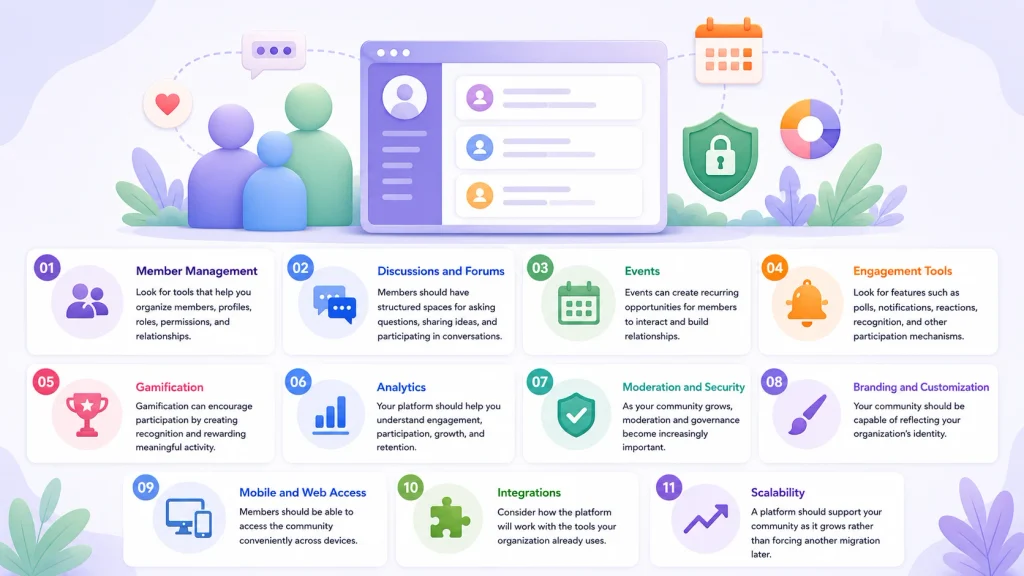
What Should You Look for in a Dedicated Community Platform?
If you’ve identified several of the signs above, evaluate platforms based on your actual community requirements.
Member Management
Look for tools that make member onboarding, profiles, roles, permissions, and organization easier to manage.
Discussions and Forums
Members should have structured spaces for conversations rather than relying entirely on chronological chat.
Events
Consider event creation, registration, communication, and participation tracking.
Engagement Tools
Look for features such as polls, notifications, reactions, challenges, recognition, and other participation mechanisms.
Gamification
Gamification can encourage participation through points, badges, rankings, challenges, or recognition when used appropriately.
Analytics
Your platform should help you understand activity, engagement, participation, and community growth.
Moderation and Security
Consider moderation workflows, roles, permissions, reporting mechanisms, and security controls.
Branding and Customization
If community ownership is important, evaluate how much you can customize the member experience.
Mobile and Web Access
Consider where your members are most likely to participate and whether the platform supports the required experiences.
Integrations
Check whether the platform can work with the other systems your organization already uses.
Scalability
A platform should be able to support your expected community growth without forcing you to rebuild your infrastructure later.
Dedicated Community Platform vs Social Media: Which Should Businesses Choose?
It doesn’t always have to be an either/or decision.
Social media can be useful for audience discovery and reach, while a dedicated community platform can provide a more structured environment for deeper member relationships.
| Factor | Social Media | Dedicated Community Platform |
|---|---|---|
| Audience discovery | Strong | More limited |
| Brand ownership | Limited | Greater control |
| Community structure | Basic to moderate | More purpose-built |
| Member data | Platform-controlled | Greater community-level control |
| Customization | Limited | More extensive |
| Community features | Platform-dependent | Purpose-built modules |
| Analytics | Marketing-focused | Community-focused |
| Long-term control | Lower | Higher |
Key Takeaway
Social media can help businesses attract audiences, while a dedicated platform can provide a more controlled environment for building deeper member relationships.
A business can therefore use social channels for discovery while directing its most engaged members toward a dedicated community environment.
How to Move From Social Groups to a Dedicated Community Platform
Moving from multiple social groups to a dedicated platform should be treated as a community transition rather than simply a technology migration.
Step 1: Define the Community’s Purpose
Be clear about why the community exists and what value members should receive.
Step 2: Identify Core Member Segments
Understand who your members are and what different groups need from the community.
Step 3: Audit Existing Channels
Document where conversations, events, content, member information, and feedback currently live.
Step 4: Identify Engagement Gaps
Look for inactive channels, declining participation, repeated questions, and fragmented member experiences.
Step 5: Select Required Features
Prioritize the features your community actually needs instead of selecting a platform based on the largest feature list.
Step 6: Create Community Guidelines
Define acceptable behavior, moderation processes, member responsibilities, and content standards.
Step 7: Migrate or Onboard Members
Communicate the reason for the transition and make the onboarding process as simple as possible.
Step 8: Launch With Founding Members
Start with active members who can create conversations and demonstrate the value of the new community.
Step 9: Create Engagement Loops
Use content, discussions, events, recognition, and member interactions to encourage people to return.
Step 10: Measure Retention and Participation
Track meaningful metrics rather than focusing only on total membership.
For additional guidance, see these best practices for launching a digital community.
How a Dedicated Community Platform Supports Long-Term Growth
A dedicated platform is ultimately valuable when it helps a community create more consistent value for its members and the organization behind it.
Member Growth
Communities can use onboarding, referrals, events, and valuable content to attract new members.
Member Engagement
Discussions, events, content, networking, gamification, and recognition can create more opportunities to participate.
Member Retention
Members are more likely to remain active when the community consistently provides useful information, relationships, support, opportunities, or recognition.
Business Growth
A healthy community can contribute to advocacy, feedback, referrals, customer relationships, education, and other business outcomes.
However, the platform itself isn’t the growth strategy. The platform is infrastructure that supports the community strategy.
Final Takeaway
A dedicated community platform isn’t something every business needs from day one. Existing tools such as Facebook Groups, WhatsApp, Slack, LinkedIn, and Discord can be perfectly adequate while a community is small or still being tested.
The need changes when the community becomes harder to manage and more important to the business.
If conversations are fragmented, engagement is declining, your team is spending too much time on manual management, analytics are insufficient, or you need stronger branding and more community functionality, it may be time to consider dedicated infrastructure.
For businesses that have reached that stage, Thrico provides a centralized community platform designed to bring member management, engagement, discussions, events, networking, analytics, moderation, gamification, and branded community experiences into one environment.
The right decision, however, should always start with your members, community goals, operational requirements, and long-term strategy—not simply the availability of a new platform.
Frequently Asked Questions
A dedicated community platform is a centralized environment where organizations can manage members, discussions, content, events, networking, engagement, moderation, analytics, and other community activities.
Look for signs such as fragmented communication, declining engagement, increasing manual work, limited analytics, lack of branding control, growing membership, and a need for features beyond basic discussions.
Potential benefits include greater control over the member experience, centralized community management, structured engagement, community-focused analytics, stronger branding, and greater scalability.
It can be, depending on the community’s size and requirements. However, businesses may need a dedicated platform when they require greater control, advanced community features, deeper analytics, branding, or a more structured member experience.
A social media group operates within a third-party social network and its available features. A dedicated community platform is designed specifically to provide a more controlled and structured environment for managing a community.
Pricing varies significantly depending on the platform, number of members, features, customization, integrations, support, and deployment requirements. Businesses should compare pricing against their actual community requirements rather than looking only at the starting price.
Important features can include member management, discussions, events, engagement tools, analytics, moderation, gamification, branding, mobile and web access, integrations, and scalability.
A platform alone cannot guarantee better retention. However, it can provide infrastructure for discussions, support, education, networking, feedback, events, and other experiences that can strengthen ongoing customer relationships.
Yes. A community can provide spaces where customers ask questions, find information, share experiences, and learn from other members. Businesses should still determine which support issues require private or direct assistance.
Start by defining the purpose of the new community, auditing existing channels, identifying member needs, selecting required features, creating guidelines, communicating the transition, onboarding members, and measuring engagement after launch.