
Community-Led Growth: The New Marketing Strategy
Community-led growth is a business strategy where customers, users, advocates, and members actively contribute to brand growth through conversations, feedback, referrals, user-generated content, events, and peer-to-peer interactions. Instead of relying only on paid acquisition, brands build relationships within an owned community that can support engagement, retention, advocacy, and long-term growth.
As customer acquisition becomes increasingly competitive, businesses are looking for ways to build deeper relationships rather than depending entirely on one-way advertising. Community-led growth provides a complementary growth engine by turning customers and users into active participants in the brand ecosystem.
Brands looking to create a dedicated environment for conversations, engagement, events, and member relationships can explore Thrico’s community management platform.
What Is Community-Led Growth?
Community-led growth (CLG) is a growth strategy in which a business uses an active community of customers, users, prospects, creators, professionals, or advocates to support acquisition, engagement, retention, referrals, and customer loyalty.
Unlike traditional marketing, where the brand typically creates and distributes the majority of the message, community-led growth encourages members to participate in creating value.
A community-led growth strategy can involve:
- Customer discussions
- Peer-to-peer support
- User-generated content
- Product feedback
- Events and networking
- Member advocacy
- Referrals
- Reviews and recommendations
- Knowledge sharing
- Customer education
The goal is not simply to build a large community. The objective is to create a community where members receive meaningful value while their participation also contributes to business growth.
How Does Community-Led Growth Work?
A simple community-led growth framework is:
Join → Engage → Contribute → Connect → Advocate → Refer → Grow
Here is how the cycle works:
- Join: A customer, prospect, professional, creator, or other relevant user becomes a community member.
- Engage: The member participates in discussions, events, polls, or other activities.
- Contribute: Members share knowledge, questions, experiences, content, or feedback.
- Connect: Members develop relationships with peers, experts, employees, or other participants.
- Advocate: Positive experiences encourage members to recommend the brand or community.
- Refer: Members generate referrals, reviews, recommendations, or new member introductions.
- Grow: New members enter the community and continue the cycle.
Community-led growth depends heavily on meaningful participation, which is why brands need effective community engagement features such as discussions, feedback and polls.
Why Is Community-Led Growth Becoming Important?
Community-led growth is becoming increasingly relevant as businesses face higher competition for customer attention and acquisition.
Several factors are contributing to this shift.
Rising Customer Acquisition Costs
Businesses across many industries compete for visibility through paid search, social advertising, influencer campaigns, and other acquisition channels. As competition increases, acquiring every new customer through paid channels can become more expensive.
Communities provide another way to create ongoing value among existing customers and prospects.
Declining Effectiveness of One-Way Marketing
Traditional advertising generally communicates from the brand to the audience. Modern customers, however, often want opportunities to ask questions, compare experiences, share opinions, and interact with other people.
Communities create a two-way environment where customers can participate rather than simply consume marketing messages.
Growing Demand for Authentic Interactions
Customers may trust experiences shared by peers differently from traditional promotional claims. Reviews, discussions, customer stories, recommendations, and peer-to-peer advice can provide context that conventional advertising often cannot.
Personalization Expectations
Customers increasingly expect brands to understand their interests and provide relevant experiences. Communities can help businesses understand member needs through conversations, participation patterns, questions, polls, and feedback.
Importance of Trust
Trust develops through repeated interactions. When customers see other members sharing genuine experiences, answering questions, and participating in discussions, the community can become a valuable source of social proof.
Strong community engagement can also contribute to stronger customer relationships and customer loyalty through meaningful engagement and advocacy.
User-Generated Content
Members can create reviews, discussions, tutorials, recommendations, case studies, questions, and other content. This can reduce the pressure on brands to produce every piece of content themselves while creating authentic resources for other members.
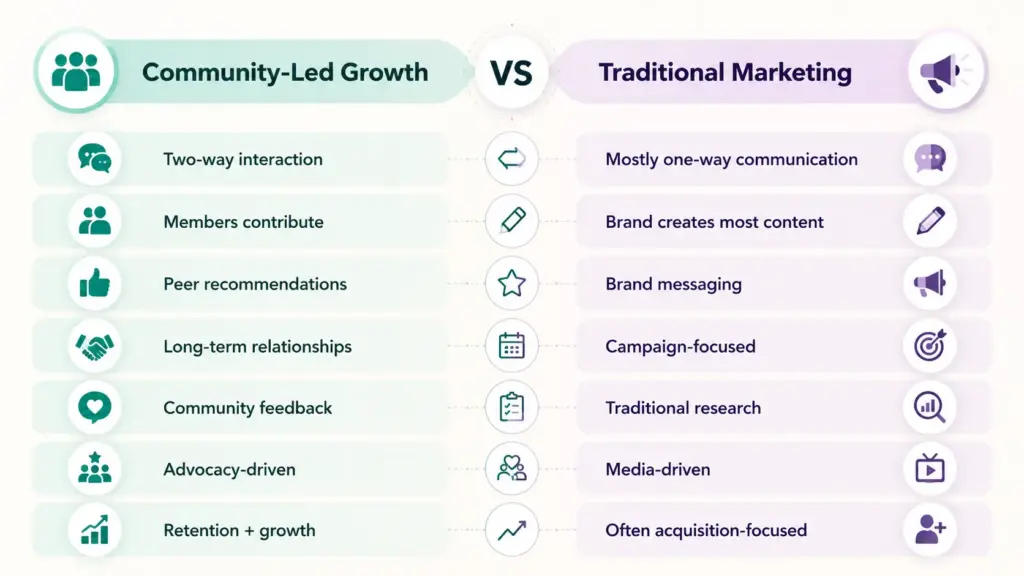
Community-Led Growth vs Traditional Marketing
Community-led growth and traditional marketing are not necessarily competing approaches. They can work together as part of an integrated growth strategy.
| Community-Led Growth | Traditional Marketing |
| Two-way interaction | Mostly one-way communication |
| Members contribute | Brand creates most content |
| Peer recommendations | Brand messaging |
| Long-term relationships | Campaign-focused |
| Community feedback | Traditional research |
| Advocacy-driven | Media-driven |
| Focus on retention and growth | Often acquisition-focused |
The key difference is participation.
Traditional marketing generally focuses on communicating a message to an audience, while community-led growth creates an environment where the audience can interact, contribute, and influence the broader customer experience.
Community-led growth works best when it complements existing acquisition, content, and performance marketing channels.
What Are the Core Elements of a Community-Led Growth Strategy?
A successful community-led growth strategy requires more than simply launching an online group. Businesses need to create a clear purpose, encourage participation, understand members, and connect community activity with measurable business outcomes.
1. Clear Community Purpose
People need a reason to join and remain active.
Before launching a community, ask:
- Why should people join?
- What problem does the community solve?
- Who is the community for?
- What value will members receive?
- What makes the community different from existing channels?
A clear purpose helps prevent the community from becoming another inactive promotional channel.
2. The Right Member Profile
Community size is less important than member relevance and participation.
Potential members can include:
- Existing customers
- Prospects
- Creators
- Industry experts
- Partners
- Brand advocates
- Alumni
- Employees, where relevant
The ideal audience depends on the community’s business objective.
For example, a SaaS company may build a customer community around product education and peer support, while a professional association may focus on networking and knowledge sharing.
3. Meaningful Engagement
Engagement should provide value rather than simply increase activity numbers.
Useful engagement formats include:
- Discussions
- Q&A sessions
- Polls
- Events
- Challenges
- Knowledge sharing
- Networking
- Feedback sessions
- Expert discussions
- Member spotlights
Brands can use gamification strategies for community engagement to encourage useful participation through challenges, rewards, and recognition.
4. User-Generated Content
User-generated content (UGC) is one of the most valuable components of community-led growth.
Members can create:
- Reviews
- Tutorials
- Discussions
- Case studies
- Questions
- Recommendations
- Product experiences
- Educational resources
UGC can provide authentic social proof while giving other members useful information.
For example, a customer asking how another user solved a specific problem can receive a practical answer from someone with first-hand experience.
5. Recognition and Gamification
Recognition can encourage members to continue contributing.
Common approaches include:
- Points
- Badges
- Levels
- Leaderboards
- Challenges
- Rewards
- Member recognition
The objective should not be to gamify every interaction. Instead, recognition should reinforce valuable community behaviors such as answering questions, sharing knowledge, attending events, or helping other members.
Brands can use points, badges, levels and engagement loops to recognise valuable member actions and encourage repeat participation.
6. Community Feedback Loops
A community should not be treated only as a promotional channel.
An effective feedback loop looks like:
Member Feedback → Insight → Product or Content Improvement → Community Update → More Participation
For example, if members repeatedly request a particular product feature, educational resource, or event topic, the business can use that feedback to inform future decisions.
When members can see that their feedback leads to meaningful action, they have a stronger reason to participate.
7. Community Advocacy
Community members can gradually move through different stages:
Member → Active Contributor → Power User → Advocate → Brand Champion
Advocacy can include:
- Referrals
- Reviews
- Recommendations
- Social sharing
- Testimonials
- Event participation
- Product advocacy
- Peer support
As members become more engaged, they can contribute to revenue and brand loyalty through referrals, recommendations, advocacy, and deeper relationships with the brand.
How to Build a Community-Led Growth Strategy
Building community-led growth requires a structured approach. The following process can help businesses move from community creation to measurable business impact.
Step 1 — Define the Business Goal
Start with the outcome the community should support.
Possible goals include:
- Customer retention
- Brand awareness
- Customer advocacy
- Product feedback
- Lead generation
- Customer education
- Referral growth
- Revenue
- Customer support
A community created primarily for customer support will require different activities and metrics from a community designed for lead generation or professional networking.
Step 2 — Identify Your Community Audience
Define the people who are most likely to receive and contribute value.
Consider:
- Ideal member
- Existing customers
- Prospects
- Advocates
- Industry experts
- Partners
- Creators
Avoid trying to attract everyone. A focused community often creates more meaningful conversations than a large but loosely connected audience.
Step 3 — Choose the Right Community Model
Different businesses can use different community models.
Customer Community
Designed primarily for customer support, education, product discussions, and retention.
Brand Community
Focused on building customer relationships, loyalty, advocacy, and brand participation.
Professional Community
Built around networking, knowledge sharing, career development, and industry discussions.
Creator Community
Designed for creators, influencers, collaborators, and content professionals.
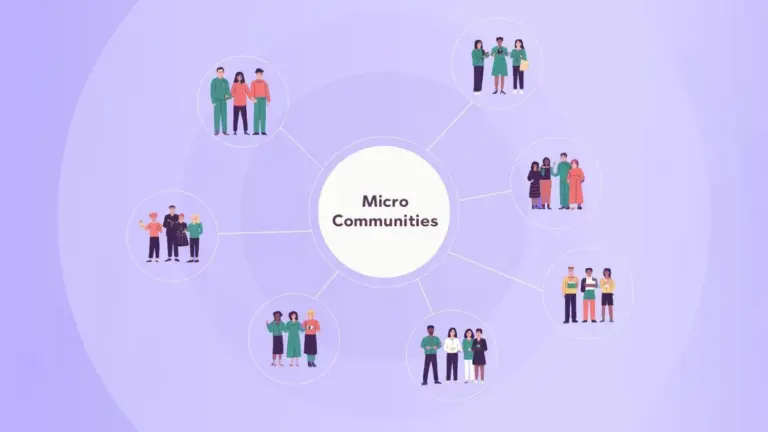
Micro-Community
Focused on a specific audience, interest, customer segment, or use case.
For audiences with specific interests or use cases, micro-communities can create more focused and relevant member experiences.
Step 4 — Choose Your Community Platform
The platform can significantly influence the member experience.
Important selection criteria include:
- Branding and customization
- Mobile experience
- Discussions
- Events
- Messaging
- Analytics
- Moderation
- Gamification
- Integrations
- Scalability
- Data ownership
The platform should support the community’s purpose rather than forcing the business to adapt its strategy around available features.
Step 5 — Create an Onboarding Experience
The first interaction can influence whether a new member becomes active or remains inactive.
A structured onboarding process can include:
- Welcome message
- Member profile setup
- Community guidelines
- Introductory post
- Recommended groups
- Suggested content
- First action
- Personalized onboarding
A structured onboarding process can improve user interaction and retention in community platforms by giving new members a clear path to participation.
Step 6 — Create Engagement Loops
A strong community creates reasons for members to return.
A simple engagement loop is:
Action → Recognition → Feedback → Reward → Repeat Action
For example:
Ask a question → Receive answers → Become a contributor
Or:
Share knowledge → Receive recognition → Continue contributing
Or:
Attend an event → Connect with members → Participate in a discussion
The objective is to create recurring value rather than relying only on scheduled promotional posts.
Step 7 — Build a Community Content Strategy
A community content strategy can include:
- Educational content
- Discussions
- Polls
- Events
- AMAs
- Expert sessions
- Member stories
- Product updates
- Challenges
- User-generated content
The content mix should encourage participation instead of turning the community into another content distribution channel.
Step 8 — Turn Members Into Advocates
Not every member will become an advocate, and that is normal.
Businesses can encourage advocacy through:
- Recognition
- Referral programmes
- Ambassador programmes
- Exclusive access
- Member spotlights
- Rewards
- Co-created content
The most effective advocacy usually develops after members have already experienced meaningful value from the community.
Step 9 — Measure and Optimise
Community success should not be measured only by member count.
Track:
- Active members
- Engagement rate
- Contribution rate
- Member retention
- Member-generated content
- Event participation
- Referral rate
- Advocacy
- Conversion
- Customer lifetime value
A community with 5,000 registered members but very little activity may provide less business value than a smaller community with highly engaged members.
Community-Led Growth Metrics to Track
| Goal | Metrics |
| Community Growth | New Members, Growth Rate |
| Engagement | Posts, Comments, Reactions |
| Contribution | Active Contributors, UGC |
| Retention | Member Retention, Churn |
| Advocacy | Referrals, Reviews, Mentions |
| Business Impact | Leads, Conversions, Revenue |
| Community Health | Participation Rate, Sentiment |
The most important community-led growth metrics include active members, engagement rate, contribution rate, retention, user-generated content, referrals, advocacy, and business conversions. The right metrics depend on the community’s primary business objective.
How Does Community-Led Growth Drive Business Growth?
Community-led growth can be understood as a growth flywheel:
More Members
↓
More Conversations
↓
More User-Generated Value
↓
More Trust
↓
More Engagement
↓
More Advocacy and Referrals
↓
More Members
As the community becomes more useful, members can contribute more knowledge, experiences, recommendations, and content. That value can make the community more attractive to prospective members.
Over time, the community can influence several stages of the customer journey, including discovery, education, engagement, retention, advocacy, and referrals.
However, the flywheel does not automatically work simply because a community exists. Businesses need active participation, effective moderation, relevant content, strong onboarding, and continuous measurement.
Community-Led Growth Examples
The following examples are hypothetical and illustrate how different businesses could apply community-led growth.
SaaS Example
A software company creates a customer community where users share workflows, troubleshooting tips, integrations, and best practices.
Existing customers receive peer support, while new users can discover practical solutions. As participation increases, the community can support product education, engagement, retention, and advocacy.
D2C Example
A consumer brand creates a community where customers share product experiences, usage ideas, reviews, and recommendations.
Member-generated content can provide social proof for prospective customers, while discussions help existing customers get more value from the product.
Education Example
An education business creates a community where students, instructors, alumni, and industry experts share knowledge.
Students receive access to peer discussions and networking opportunities, while experts can contribute through sessions, AMAs, and educational content.
Professional Association Example
A professional association creates a digital community where members participate in discussions, attend events, exchange industry knowledge, and build professional relationships.
The community strengthens the value of membership by providing ongoing interaction beyond individual events.
Community-Led Growth Challenges
Community-led growth can deliver significant value, but it also requires ongoing effort.
Common challenges include:
1. Low Initial Participation
New communities often struggle to generate conversations because there are not enough active members initially.
2. Community Becoming Inactive
A community can lose momentum when discussions become repetitive or members do not see enough value in returning.
3. Poor Onboarding
Members may leave if they do not understand what to do after joining.
4. Lack of Clear Purpose
A community without a clear reason to exist can quickly become another promotional channel.
5. Excessive Promotional Content
Constant product promotion can reduce trust and discourage genuine participation.
6. Difficult Moderation
As activity increases, businesses may need clear guidelines and moderation processes to maintain quality.
7. Vanity Metrics
Large member numbers do not necessarily indicate a healthy community.
8. Lack of Executive Support
Community-led initiatives often require long-term investment in people, content, technology, and measurement.
9. Poor Member Experience
Slow communication, confusing navigation, irrelevant notifications, or difficult participation can reduce engagement.
10. Failure to Connect Community Activity to Business Outcomes
Community activity should eventually be connected to relevant outcomes such as retention, referrals, customer satisfaction, conversions, or revenue.
How to Keep a Community Engaged Over Time
Launching a community is only the beginning. Long-term engagement requires consistent value.
Businesses can maintain participation through:
- A consistent content calendar
- Regular events
- Member recognition
- Polls
- Challenges
- Expert sessions
- Personalized communication
- Sub-groups
- Member feedback
- Community milestones
- Member-generated content
- Exclusive resources
Avoid depending on one engagement tactic. A combination of discussions, events, educational content, recognition, networking, and member participation can create a more sustainable experience.
Is Community-Led Growth Right for Every Business?
Community-led growth is not universally suitable for every business.
It can be particularly valuable for:
- SaaS companies
- Consumer brands
- Education businesses
- Creator businesses
- Professional associations
- Membership organisations
- Startups
- Customer-centric businesses
It may require more effort for businesses where customers have:
- Highly transactional purchasing behavior
- Very low repeat interaction
- Extremely short customer journeys
- No clear shared interest
- Limited motivation to interact with other customers
The key question is not whether a business should have a community. Instead, businesses should ask whether customers can receive meaningful value from interacting with each other and with the brand.
Community-Led Growth vs Community-Led Marketing
Community-led marketing and community-led growth are related but not identical.
Community-led marketing generally means using a community as a marketing channel to distribute content, engage audiences, promote products, or generate awareness.
Community-led growth is broader. It uses community participation and relationships to influence multiple parts of the growth journey, including:
- Acquisition
- Engagement
- Education
- Product feedback
- Retention
- Advocacy
- Referrals
- Customer loyalty
- Business growth
In simple terms:
Community-led marketing = community as a marketing channel.
Community-led growth = community as a growth ecosystem.
Community-Led Growth Checklist
Use this checklist when developing a community-led growth strategy:
- Define the community purpose
- Identify ideal members
- Choose the appropriate community model
- Select a suitable platform
- Create a structured onboarding process
- Establish community guidelines
- Build engagement loops
- Create a content strategy
- Encourage user-generated content
- Recognise valuable contributors
- Use gamification where appropriate
- Create feedback loops
- Develop advocacy programmes
- Track community health
- Measure retention and engagement
- Track referrals and conversions
- Connect community activity to business outcomes
- Continuously optimise the member experience
Frequently Asked Questions
Community-led growth is a business strategy where customers, users, advocates, and other members actively contribute to growth through engagement, user-generated content, feedback, referrals, advocacy, events, and peer-to-peer interactions.
Community-led growth typically follows a cycle of Join → Engage → Contribute → Connect → Advocate → Refer → Grow. Members receive value from the community while their participation creates additional value for other members and the business.
Community-led growth can help brands build stronger customer relationships, encourage user-generated content, collect feedback, support retention, develop advocacy, and generate referrals. It can complement paid acquisition and other traditional marketing channels.
Community-led marketing primarily uses a community as a marketing channel, while community-led growth uses community participation and relationships to influence acquisition, engagement, retention, advocacy, referrals, and broader business growth.
Start by defining the business objective and target members. Then choose a community model and platform, create onboarding and engagement processes, encourage user-generated content, develop advocacy programmes, and measure metrics such as engagement, retention, referrals, and conversions.
The key elements include a clear community purpose, relevant members, meaningful engagement, user-generated content, recognition, feedback loops, advocacy, effective onboarding, community content, and measurable business outcomes.
Communities can help businesses grow by creating environments for customer education, peer interaction, feedback, content creation, referrals, advocacy, and retention. Their impact depends on the quality of participation and the connection between community activity and business objectives.
Important metrics include active members, engagement rate, contribution rate, member retention, user-generated content, event participation, referrals, advocacy, conversions, and revenue. The most relevant metrics depend on the community’s specific goal.
Businesses can increase engagement through useful discussions, polls, events, challenges, expert sessions, member recognition, personalized communication, user-generated content, networking opportunities, and consistent community programming.
A community can strengthen customer loyalty by creating ongoing value through peer interaction, education, support, recognition, networking, feedback opportunities, and exclusive experiences. Meaningful participation can make customers feel more connected to the brand and other members.
Community-led growth can support retention by helping customers receive more value from products or services, access peer support, build relationships, participate in educational activities, and provide feedback to the business.
Members who receive meaningful value may voluntarily recommend the brand, share experiences, write reviews, participate in referral programmes, create content, or advocate for products and services. Recognition and ambassador programmes can further encourage valuable advocacy.
Yes, community-led growth can work for small businesses when customers share a relevant interest or need for ongoing interaction. Smaller businesses can begin with a focused audience and prioritize meaningful participation rather than trying to build a large community immediately.
Gamification can encourage participation by recognising valuable actions through points, badges, levels, challenges, leaderboards, or rewards. It works best when it supports meaningful community behaviors rather than encouraging activity for its own sake.
User-generated content provides authentic experiences, recommendations, discussions, reviews, tutorials, and other resources created by members. It can increase community value, provide social proof, encourage participation, and reduce reliance on brand-created content.