
Building a successful alumni network requires more than occasional newsletters and reunion invitations. Universities need to create a consistent experience that helps graduates connect, learn, contribute, and discover opportunities.
Here are 10 practical strategies institutions can implement.
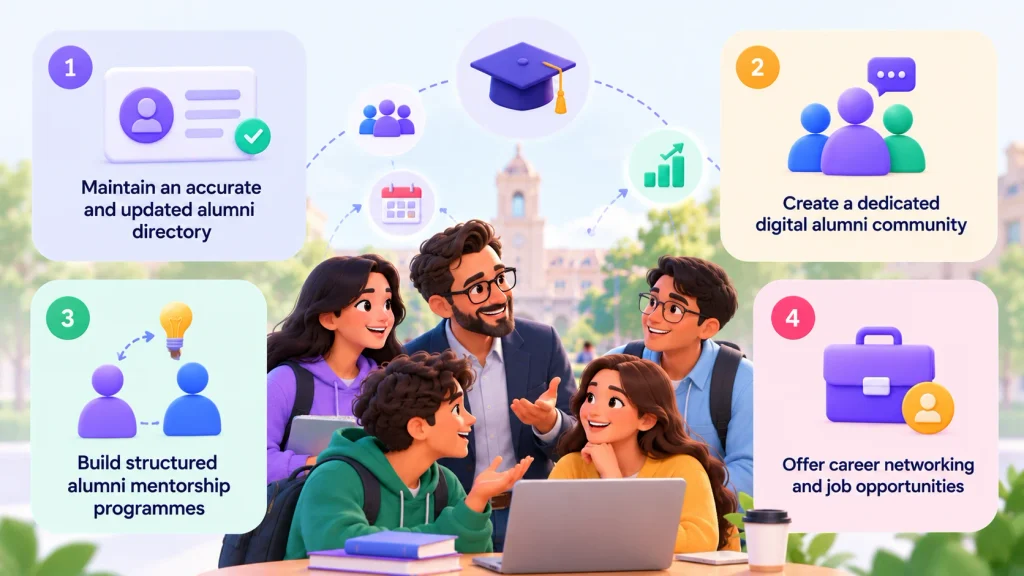
1. Maintain an Accurate and Updated Alumni Directory
An accurate alumni directory helps universities connect graduates with relevant people, mentors, employers, and professional opportunities.
Over time, graduates change jobs, move to different cities, start businesses, and develop new interests. Outdated contact information can make it difficult for institutions to maintain relationships with their alumni.
Make it easy for graduates to update information such as:
- Current professional role and organisation.
- Industry or area of expertise.
- Graduation year and academic department.
- Current city or region.
- Professional interests and mentoring preferences.
Where appropriate, alumni should also be able to specify which information they want to share with other members.
The directory should do more than store records. It should help alumni discover relevant connections and opportunities.
For example, a recent graduate looking for guidance in product management could use professional profiles to identify experienced alumni who are willing to mentor students or early-career professionals.
Universities should establish appropriate privacy controls and explain how alumni information is collected, maintained, and used.
2. Create a Dedicated Digital Alumni Community
A dedicated digital community gives graduates a central place to maintain relationships with their university and fellow alumni.
Without a shared environment, alumni activities may become fragmented across email newsletters, social media groups, spreadsheets, and separate event platforms. This can make information difficult to find and conversations harder to sustain.
A digital alumni community can bring together:
- Member profiles and professional information.
- Discussion spaces and community conversations.
- Industry-specific and regional groups.
- University announcements and alumni updates.
- Networking and mentorship opportunities.
- Events, workshops, and professional activities.
A well-organised community also allows alumni to participate beyond annual reunions. Members can exchange advice, share achievements, ask questions, and discover opportunities whenever they are available.
Universities should prioritise a simple, accessible member experience and provide clear reasons for alumni to return regularly.
Explore Thrico’s community platform for academia to learn more about its approach to connecting students, alumni, faculty, and mentors.
3. Build Structured Alumni Mentorship Programmes
Mentorship is one of the most practical ways universities can connect experienced graduates with current students and recent alumni.
Graduates can share insights about career choices, industry expectations, professional skills, and the transition from education to employment. Students gain opportunities to learn from people who have navigated similar decisions.
However, successful mentorship requires structure.
Universities should define:
- Who can participate as a mentor or mentee.
- Which career fields and academic areas the programme covers.
- How mentors and mentees are matched.
- Expected participation and meeting frequency.
- Guidelines for communication and professional conduct.
- How participants can provide feedback or request support.
Mentorship can begin with a focused pilot involving a few departments, graduating cohorts, or career fields.
For example, a university could initially connect final-year engineering students with alumni working in software development, manufacturing, or research.
After reviewing participation and feedback, the institution can refine the matching process and expand the programme.
Mentorship should be voluntary, expectations should be realistic, and universities should avoid assuming that every graduate has the time or interest to mentor others.
4. Offer Career Networking and Job Opportunities
Career development can provide alumni with a compelling reason to remain connected to their university.
Recent graduates may be looking for their first professional opportunity, while experienced alumni may want to expand their networks, explore career changes, or recruit suitable candidates.
Universities can support these needs by creating opportunities to:
- Share relevant job openings and internships.
- Connect alumni with employers.
- Organise industry-specific networking sessions.
- Encourage professional introductions.
- Facilitate alumni-to-alumni referrals.
- Share career development resources.
- Host discussions about industry trends and emerging skills.
For example, alumni working in finance could participate in a professional group where members share industry insights, discuss career pathways, and post relevant opportunities.
These activities can also benefit employers by helping them connect with graduates who have relevant educational backgrounds and skills.
Career opportunities should be clearly presented, and institutions should establish appropriate processes for verifying listings where necessary.
The goal is to make the alumni network professionally useful without turning every interaction into a recruitment exercise.
5. Organise Regular Alumni Events
Events provide opportunities for alumni to reconnect, exchange ideas, and maintain relationships with their university.
Traditional reunions remain valuable, but universities can create more consistent engagement by offering different types of events throughout the year.
Consider organising:
- Annual alumni reunions.
- Virtual networking sessions.
- Regional alumni meetups.
- Industry talks and expert panels.
- Career development workshops.
- Alumni-led lectures.
- Entrepreneurship and innovation sessions.
- Professional networking events.
A recurring event calendar helps graduates understand when and how they can participate.
Universities should also consider what happens after an event ends. Sharing relevant resources, providing recordings where appropriate, and encouraging follow-up discussions can extend the value of each gathering.
For example, after an alumni panel on entrepreneurship, participants could continue discussing business challenges, resources, and professional connections in a dedicated community space.
Event success should be evaluated through attendance, repeat participation, feedback, and meaningful follow-up interactions rather than registrations alone.
6. Recognise Alumni Achievements and Contributions
Alumni recognition helps universities celebrate the professional achievements, creativity, leadership, and contributions of their graduates.
Recognition can also inspire current students and strengthen relationships between the institution and its alumni community.
Universities can introduce activities such as:
- Alumni achievement spotlights.
- Graduate success stories.
- Recognition for community contributions.
- Profiles of alumni entrepreneurs.
- Stories highlighting mentorship and volunteering.
- Acknowledgement of alumni-led initiatives.
- Celebrations of professional milestones.
For example, a university could feature an alumnus who has developed an innovative product or an alumna who regularly mentors students entering her industry.
Recognition should be authentic and reflect meaningful achievements or contributions. It should not be limited to the most visible or professionally successful graduates.
Universities can invite alumni to nominate peers, share their experiences, or contribute stories about their professional journeys.
By making recognition inclusive and relevant, institutions can help more graduates feel valued and connected.
7. Encourage Knowledge Sharing and Peer Collaboration
Alumni networks become more valuable when members can learn from one another.
Graduates across different industries and career stages possess practical knowledge that can benefit their peers, current students, and the wider institution.
Universities can encourage knowledge sharing by creating communities around:
- Academic disciplines.
- Professional industries.
- Geographic regions.
- Entrepreneurship and business development.
- Research and innovation.
- Career transitions.
- Shared professional interests.
These groups can host discussions, exchange resources, answer questions, and explore collaboration opportunities.
For example, alumni working in healthcare could discuss emerging industry challenges, while graduates in technology could share insights about professional development and changing skill requirements.
Universities can also invite alumni to contribute expert articles, participate in webinars, or lead discussions on relevant topics.
The objective is to create opportunities for useful exchanges rather than expecting engagement to emerge automatically.
Explore Thrico’s community conversations to learn more about the role of conversations in building connected communities.
8. Make Communication Personal and Relevant
Regular communication is important, but frequency alone does not guarantee engagement.
Generic announcements may be overlooked when they do not relate to alumni interests, professional needs, or preferred ways of participating.
Universities can make communication more relevant by organising updates around appropriate attributes such as:
- Graduation year.
- Academic department.
- Location or region.
- Professional industry.
- Career stage.
- Mentorship interests.
- Event preferences.
- Community participation.
For example, recent graduates may value career guidance and job opportunities, while experienced professionals may be more interested in industry events, mentoring, or collaboration with faculty.
A university could share relevant professional events with alumni in a particular region while inviting experienced graduates to participate in a student mentorship initiative.
Communication should respect privacy and individual preferences. Alumni should understand why they receive particular messages and have appropriate options for managing their communication preferences.
The goal is to provide useful information at the right time rather than overwhelming members with repeated announcements.
9. Encourage Alumni Participation Through Recognition and Gamification
Gamification can provide additional ways to recognise meaningful participation within an alumni community.
Mechanics such as points, badges, milestones, and appropriate rewards can acknowledge contributions and help members understand how they are participating in the network.
For example, universities might recognise alumni who:
- Mentor current students.
- Share useful professional knowledge.
- Participate in university events.
- Contribute educational resources.
- Help fellow alumni make professional connections.
- Volunteer for institutional initiatives.
Recognition should reflect the value of contributions rather than simply rewarding frequent activity.
A graduate who provides thoughtful career guidance may contribute more to the community than someone who frequently posts low-value updates.
Gamification should also remain optional and appropriate for the audience. Not every alumni community needs leaderboards or competitive reward systems.
The most effective approach is to use recognition to support genuine relationships, encourage useful contributions, and make alumni feel appreciated.
Explore Thrico’s gamification capabilities to understand how gamification can form part of a broader community engagement strategy.
10. Invite Alumni to Contribute to Institutional Growth
Alumni can support universities in many ways beyond attending events or contributing financially.
Their professional experience, industry knowledge, and personal networks can create opportunities for collaboration between the institution and the wider world.
Universities can invite graduates to participate in:
- Guest lectures and educational sessions.
- Student internships and career guidance.
- Research collaborations.
- Entrepreneurship programmes.
- Industry advisory activities.
- Professional networking initiatives.
- Volunteering and community projects.
- Fundraising and institutional development.
Different alumni will have different interests, resources, and time commitments. Providing multiple ways to participate allows graduates to contribute according to their circumstances.
For example, an alumnus who cannot attend campus events regularly may still be able to conduct a virtual career session. Another graduate may offer internship opportunities or introduce students to relevant professional contacts.
Universities should communicate the purpose of each initiative and explain how contributions will be used.
Meaningful participation should be built around mutual value rather than an expectation that every graduate must contribute in the same way.
How Can Digital Platforms Improve Alumni Engagement?
Digital platforms can help universities organise alumni activities and make participation more accessible.
Instead of relying on disconnected communication channels, institutions can create a shared environment for member profiles, conversations, events, networking, and knowledge exchange.
Centralise Alumni Communication
A central digital space can make university announcements, event information, community discussions, and professional opportunities easier to discover.
It also provides alumni with a consistent destination for accessing relevant information.
Enable Alumni Networking Beyond Reunions
Professional groups, discussion spaces, and member connections can help graduates maintain relationships throughout the year.
These interactions allow alumni to exchange knowledge and discover opportunities without waiting for scheduled events.
Connect Alumni With Students and Mentors
Digital communities can support connections between current students, recent graduates, and experienced professionals.
Institutions can use these spaces to encourage mentorship, career conversations, educational discussions, and knowledge sharing.
Recognise Participation and Contributions
Recognition features can help universities highlight alumni achievements and acknowledge useful contributions to the community.
When recognition is connected to meaningful activities, it can complement other engagement initiatives.
Understand Alumni Participation Through Analytics
Engagement insights can help universities understand which activities attract participation and where improvements may be needed.
For example, institutions can review recurring participation, event engagement, discussion activity, and involvement in mentorship initiatives.
These insights should inform decisions about programming and communication rather than serve as a substitute for direct alumni feedback.
Universities interested in these capabilities can explore Thrico’s community platform solutions.
The right platform should complement the institution’s alumni engagement strategy, existing systems, data governance requirements, and available resources.
How to Build an Alumni Engagement Strategy Step by Step
Universities can use the following framework to develop a new alumni network or improve an existing one.
Step 1: Define Your Alumni Engagement Goals
Begin by identifying the outcomes you want to achieve.
Possible objectives include increasing mentorship participation, improving event attendance, strengthening career connections, encouraging knowledge sharing, or increasing recurring alumni interactions.
Choose a manageable set of priorities and define how progress will be measured.
Step 2: Segment Your Alumni Community
Understand the different groups within your alumni population.
Relevant segments may include graduation year, academic department, professional industry, geographic location, career stage, and interests.
Use segmentation to offer relevant opportunities while following appropriate privacy and data protection practices.
Step 3: Identify Valuable Participation Opportunities
Ask alumni what they need from the network and how they would like to participate.
Some may want career connections, while others may be interested in mentorship, professional events, research, or volunteering.
Prioritise activities that create clear value for members and the institution.
Step 4: Select the Right Community Infrastructure
Evaluate whether your university needs a dedicated alumni platform, an integrated community environment, or improvements to its existing systems.
Consider:
- Ease of use for alumni and administrators.
- Member profiles and networking capabilities.
- Discussion and content features.
- Events and mentorship workflows.
- Integration with existing university systems.
- Privacy and access controls.
- Reporting and engagement insights.
- Scalability and total cost.
The selected platform should support your priorities without introducing unnecessary complexity.
Explore Thrico’s academia platform as part of your evaluation.
Step 5: Launch a Focused Pilot Programme
Rather than launching every initiative simultaneously, begin with a manageable pilot.
You could start with one academic department, graduating cohort, regional alumni group, or mentorship programme.
Collect feedback, review participation, and address practical challenges before expanding the initiative.
Step 6: Build a Consistent Engagement Calendar
Plan recurring activities such as alumni discussions, professional events, mentorship sessions, knowledge-sharing opportunities, and recognition initiatives.
A consistent calendar gives members predictable opportunities to participate.
Balance structured activities with space for spontaneous conversations and peer-to-peer connections.
Step 7: Measure Results and Improve
Review performance against your initial objectives.
Identify which activities encourage repeat participation, which communications are most relevant, and where alumni experience difficulties.
Use engagement data and direct feedback to improve the network over time.
An effective alumni engagement strategy should evolve alongside graduates’ needs and the institution’s priorities.
How Should Universities Measure Alumni Network Success?
The success of an alumni network should be measured through meaningful participation, ongoing relationships, and outcomes that align with institutional goals.
The number of registered alumni can indicate reach, but it does not show whether members find the network useful.
Universities should establish baseline measurements and review relevant indicators regularly.
Alumni Activation Rate
Measure the proportion of newly registered alumni who complete a meaningful action within a defined period.
This could include updating a profile, joining a discussion, attending an event, or participating in a mentoring initiative.
Repeat Participation Rate
Track how many alumni return to participate over time.
Recurring involvement can provide a more useful indication of sustained engagement than one-time registrations or visits.
Mentorship Participation
Review mentor registrations, successful matches, ongoing mentoring relationships, and feedback from mentors and mentees.
These indicators help institutions understand whether their mentorship initiatives are connecting participants effectively.
Event Engagement
Measure event registrations, actual attendance, repeat attendance, participation in discussions, and post-event interactions.
Consider the relevance of events to different alumni groups when interpreting results.
Career and Networking Outcomes
Track relevant job opportunities shared, professional introductions, referrals, collaborations, and other outcomes connected to the network’s objectives.
Where possible, use clear definitions to distinguish meaningful outcomes from general activity.
Alumni Contributions
Review participation in guest lectures, mentoring, volunteering, research collaboration, student guidance, and financial giving where relevant.
Not every institution will need every metric. The right measures depend on the university’s goals and the activities it offers.
Most importantly, use these insights to improve the alumni experience rather than treating metrics as an end in themselves.
Common Challenges in Alumni Network Building and How to Overcome Them
Even universities with large alumni populations can struggle to maintain active relationships. Understanding common barriers can help institutions develop a more effective approach.
Low Alumni Participation
Challenge: Graduates may not see a clear reason to return after leaving university.
Approach: Offer practical value through mentorship, career networking, professional groups, events, and useful discussions. Ask alumni which opportunities matter most to them.
Outdated Alumni Information
Challenge: Contact details and professional profiles can become inaccurate over time.
Approach: Make profile updates useful by helping alumni discover relevant connections and opportunities. Explain how their information will be used and provide appropriate privacy controls.
Fragmented Communication
Challenge: Information may be scattered across emails, social media groups, spreadsheets, and separate event tools.
Approach: Establish a clear central destination for alumni interactions and maintain consistent communication practices.
Limited Staff and Resources
Challenge: Alumni relations teams may not have enough time to organise frequent activities for every graduating cohort.
Approach: Start with a small number of high-value initiatives, establish repeatable processes, and encourage alumni-led activities where appropriate.
Difficulty Demonstrating Impact
Challenge: Registration numbers alone may not show whether the network is creating meaningful value.
Approach: Track repeat participation, mentoring outcomes, event engagement, career connections, and other indicators tied to institutional objectives.
Addressing these challenges requires consistent effort, realistic priorities, and a willingness to adapt based on alumni feedback.
How Thrico Can Support Stronger University Alumni Networks
Universities seeking to strengthen alumni relationships may benefit from a digital environment that connects graduates with students, faculty, mentors, and professional opportunities.
Thrico’s academia solution focuses on student and alumni communities, mentorship, career connections, and engagement.
Its broader community offering provides context for institutions evaluating digital community-building capabilities. Depending on their requirements, universities may also want to assess tools for conversations, content sharing, events, recognition, and community management.
Potential areas to evaluate include:
- Alumni and student community engagement: Supporting connections among members of the academic community.
- Mentorship and career connections: Helping institutions explore ways to connect students and graduates with relevant expertise and opportunities.
- Jobs, internships, and opportunity sharing: Evaluating how professional opportunities can be communicated to the community.
- Events and conversations: Supporting interaction around university activities and professional interests.
- Content and knowledge exchange: Providing ways to share relevant information and expertise.
- Recognition and gamification: Exploring options for acknowledging meaningful contributions.
- Community management and engagement insights: Assessing the tools available to manage participation and understand engagement.
Universities should verify specific feature availability, integrations, pricing, privacy controls, and workflows against their requirements and the platform’s current documentation.
The goal is not simply to adopt a digital platform. It is to create a sustainable alumni engagement experience that makes it easier for graduates to stay connected and contribute in ways that matter to them.
Final Thoughts
Building a stronger alumni network requires universities to move beyond occasional reunions and one-way communication. Graduates need relevant reasons to stay connected, whether through professional opportunities, mentorship, knowledge sharing, events, or meaningful ways to contribute to their institution.
The most effective approach begins with understanding alumni needs, creating accessible participation opportunities, and maintaining consistent communication.
Digital communities can support this strategy by connecting people, conversations, events, and opportunities in one environment. However, lasting engagement depends on the value universities create for their alumni, not simply the tools they adopt.
For institutions looking to strengthen student and alumni relationships, explore Thrico’s community platform for academia and evaluate how its capabilities align with your alumni engagement goals.
Frequently Asked Questions
Universities can build stronger alumni networks by maintaining accurate directories, creating dedicated digital communities, offering mentorship and career opportunities, organising regular events, recognising alumni achievements, and encouraging meaningful contributions.
Alumni networks connect graduates with one another and with their institution. They can support professional networking, student mentorship, knowledge sharing, institutional participation, and opportunities for alumni to contribute their expertise.
Their value depends on sustained participation and the relevance of the opportunities provided.
Universities can improve alumni engagement by offering useful opportunities, personalising communication, organising relevant events, encouraging mentorship, and making participation accessible.
Regularly collecting alumni feedback helps institutions understand which activities are most valuable.
A digital alumni community is an online environment where graduates connect with fellow alumni and their university.
Depending on the platform, it may include member profiles, discussions, professional groups, events, mentorship opportunities, content sharing, and career resources.
Alumni can support current students through mentorship, career guidance, guest lectures, internships, job referrals, industry insights, networking, and research collaboration.
Universities can facilitate these relationships through structured programmes and relevant community activities.
Universities can maintain connections by providing ongoing value through professional networking, career opportunities, mentorship, events, knowledge sharing, and recognition.
A dedicated digital community can give graduates a consistent place to discover opportunities and interact beyond annual reunions.
Offer events that reflect alumni interests, communicate details clearly, and provide convenient ways to participate.
Virtual sessions, regional meetups, industry discussions, and alumni-led events can accommodate different schedules and locations. Follow-up discussions can also encourage continued engagement.
Digital platforms can centralise alumni interactions, make information easier to discover, support communication and event activities, and provide insights into participation.
The available capabilities depend on the platform, so universities should evaluate features, integrations, privacy, and administrative requirements before selecting a solution.
Universities can measure alumni activation, repeat participation, mentorship involvement, event attendance, career connections, and contributions to institutional initiatives.
The most useful metrics are those directly connected to the institution’s engagement goals.
Yes. Depending on its capabilities, a community platform can provide an environment where current students, alumni, faculty, and mentors connect and exchange knowledge.
Universities should verify that the selected platform supports their intended workflows, member permissions, privacy requirements, and integration needs.