How Communities Generate Revenue & Brand Loyalty
Modern brand communities aren’t side projects or social add‑ons—they’re revenue engines that also deepen relationships. A brand community is a dedicated space where customers, prospects, partners, and advocates gather to learn, collaborate, and get value that goes beyond the product. In this guide, we break down exactly how community revenue and brand loyalty reinforce each other—showing practical monetization paths while strengthening trust over the long term.
Why Communities Matter for Revenue & Brand Loyalty
Communities concentrate attention, relationships, and data into an owned environment. That combination makes them unusually effective for both income and affinity.
● Direct access to engaged audiences. You’re speaking to people who actively opted in. That means lower noise, richer feedback loops, and far better conversion on announcements, launches, and campaigns.
● First‑party data ownership. Interactions, preferences, and behavior live in your system—not a rented social feed. With consent and transparency, that first‑party data powers smarter personalization and better offers.
● Lower customer acquisition costs (CAC). Peer referrals, organic discovery, and member‑led content reduce paid media dependency. Communities reuse the same effort across many members—think replays, threads, and playbooks that keep paying off.
● Stronger emotional brand connection. Humans don’t bond with banner ads; they bond with people and progress. When members feel seen, helped, and celebrated, loyalty grows—and so does their willingness to buy, renew, and advocate.
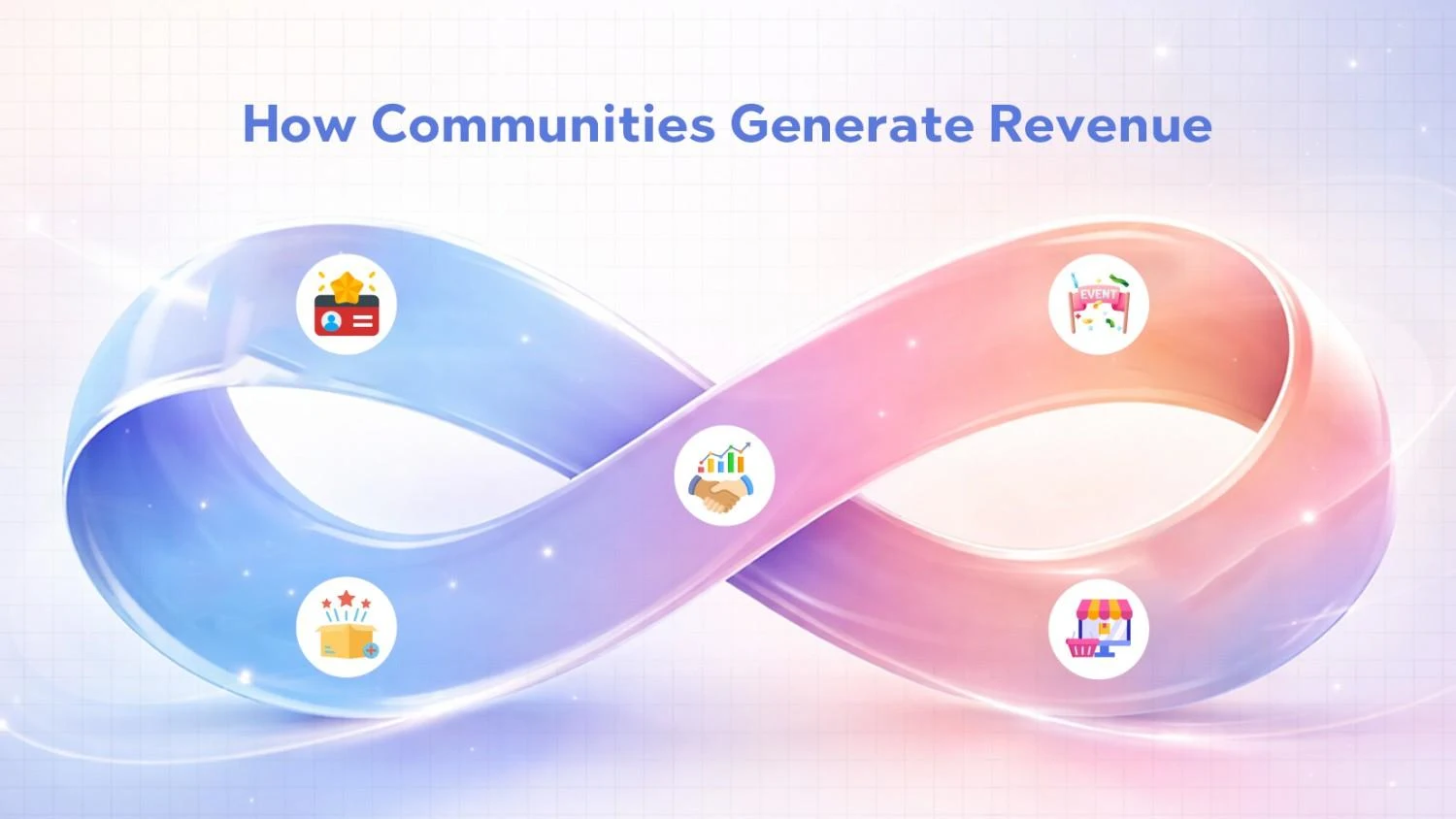
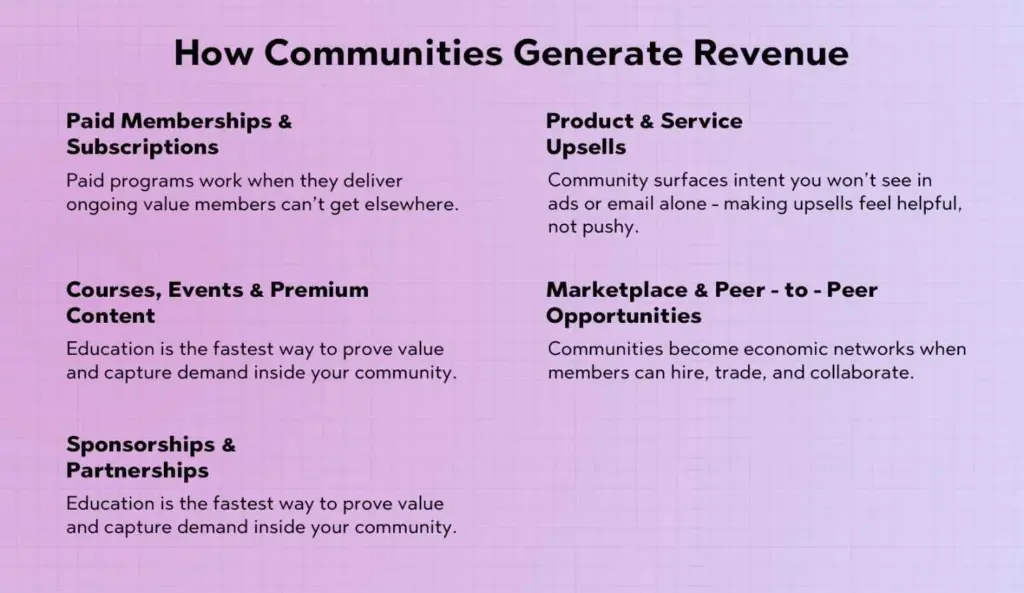
How Communities Generate Revenue
Healthy communities monetize by creating value first and then packaging access, service, or outcomes. Here are the most reliable levers.
1. Paid Memberships & Subscriptions
Paid programs work when they deliver ongoing value that members can’t get elsewhere.
●Tiered access. Offer Starter → Pro → Enterprise (or Student → Practitioner → Leader) with increasing privileges: private channels, office hours, templates, early access, or concierge support. Tiers let you match value to willingness‑to‑pay while keeping the public face accessible.
● Exclusive content & features. Ship research digests, benchmarks, cohort circles, or library access behind the paywall. For product‑led brands, consider feature flags or “members‑only” betas.
● Predictable recurring revenue. Subscriptions transform sporadic launches into steady cash flow. Use annual options for cash runway and monthly for accessibility; let members upgrade/downshift without friction.
Implementation notes
1. Align each tier with clear outcomes (e.g., “publish a portfolio,” “ship your first automation,” “master admin workflows”).
2. Bundle live touchpoints (AMAs, clinics) with a consistent cadence.
3. Show progress with badges, streaks, and milestone certificates—see Communities. Generate Revenue for gamified modules that keep motivation high.
2. Courses, Events & Premium Content
Education is the fastest way to prove value and capture demand inside your community.
● Workshops, masterclasses, webinars. Short, practical sessions drive spikes of engagement and act as conversion on‑ramps to memberships or higher‑touch programs.
● Certification programs. Role‑based tracks (Admin, Analyst, Coach, Creator) provide signaling power for members and a strong moat for brands. Certified members become advocates who lift your reputation.
● Community‑exclusive launches. Release templates, toolkits, or micro‑products to members first. The combination of scarcity + privilege lifts conversion and creates a hero experience for your core audience.
Packaging ideas
● Drip lessons to maintain momentum and reduce overwhelm.
● Offer cohort‑based versions of flagship courses to drive peer accountability.
● Bundle seat licenses for teams; price by cohort size or outcome (e.g., “deploy in 30 days”).
3. Product & Service Upsells
Community surfaces intent you won’t see in ads or email alone—making upsells feel helpful, not pushy.
● Early access to new products. Turn your members into a living beta group. They get perks and a voice; you get signal and velocity.
● Community‑only offers. Target bundles or upgrades at members who’ve hit milestones (e.g., 3 events attended; 10 helpful replies). Personalize the pitch using first‑party data.
● Feedback‑driven product improvements. Use “feature councils” and “design partner” programs inside your community. When people co‑create, they buy more, renew faster, and refer others.
Practical playbook
● Tag conversations by feature and segment: adoption risk, expansion interest, friction.
● Automate warm handoffs to sales or success when engagement crosses a threshold.
● Publish transparent changelogs and roadmap updates to close the loop.
4. Sponsorships & Partnerships
If your community has attention and trust, aligned partners will pay to access it—without polluting the experience.
● Brand collaborations. Co‑branded events, guides, or kits that genuinely help members can create net positive value (new expertise, discounts, reach). Vet partners for culture fit.
● Sponsored challenges or content. Run themed sprints, case‑study series, or AMAs with clear labeling. Keep editorial control and ensure sponsors contribute real know‑how.
● Value‑aligned partnerships. Think tools that integrate with your product, recruiters who understand the craft, or marketplaces your members already use. Take a revenue share while elevating outcomes for members.
Guardrails
● Cap frequency and maintain a strict code of conduct.
● Post a public sponsor policy and keep ads out of private support spaces.
● Measure member sentiment after sponsored moments and iterate.
5. Marketplace & Peer‑to‑Peer Opportunities
Communities become economic networks when members can hire, trade, and collaborate.
● Member services. Enable freelancers and agencies to list offers (implementation, audits, coaching). Take a small platform fee and highlight top‑rated providers.
● Job boards. Curate roles that match your craft. Charge employers, offer members early looks or referral bonuses, and measure placement rates as a community KPI.
● Creator monetization. Give power users a path to earn (premium threads, templates, office hours). Shared upside increases contribution quality and retention.
Operations tips
● Use verified profiles, reputation signals, and dispute guidelines.
● Provide template contracts and payment rails.
● Celebrate success stories prominently to boost flywheel momentum.
How Communities Build Long‑Term Brand Loyalty
Revenue follows trust. Here’s how community mechanics cultivate loyalty that lasts.
● Two‑way communication. Unlike broadcast channels, communities let members ask, challenge, and co‑create. Transparent roadmaps and open AMAs show that the brand listens—and acts.
● Peer‑to‑peer validation. People believe people. Reviews, case studies, and “show‑your‑work” threads reduce risk and nudge fence‑sitters to commit.
● Emotional investment through participation. When members teach, mentor, or ship projects together, identity forms around the brand’s mission. That emotional glue outlasts discounts.
● Recognition & belonging. Badges, shout‑outs, and “member spotlights” tap intrinsic motivation. Belonging turns passive customers into active advocates who recommend, defend, and build with you.
The Flywheel Effect: Engagement → Loyalty → Revenue
A well‑run community compounds because each stage feeds the next.
1. Engagement builds trust. Helpful content, quick support, and peer collaboration reduce uncertainty.
2. Trust increases loyalty. Members stick around, identify with the mission, and invest more time.
3. Loyalty drives repeat purchases. Renewals rise, upgrades feel natural, and word‑of‑mouth accelerates.
4. Revenue funds better community experiences. More moderators, better content, stronger events—fueling fresh engagement and restarting the loop at a higher level.
How to measure the flywheel
● Track activation (first post, first event), contribution rate, renewal/upgrade rate, and referral velocity.
● Compare LTV and NRR for community participants vs. non‑participants.
● Instrument cohorts by join month to visualize lift over time.
Community‑Led Growth vs Traditional Marketing
Community‑led growth doesn’t replace marketing; it re‑centers it around customer outcomes.
● Paid ads vs owned audiences. Ads rent attention; communities own it. Ads are still great for acquisition—but the compounding value lives where you control experience, data, and pacing.
● Short‑term conversions vs lifetime value. Launch spikes are exciting; LTV pays the bills. Communities turn one‑time buyers into multi‑year advocates whose feedback shapes the roadmap.
● Broadcast messaging vs conversations. Emails and posts shout; communities converse. Conversation is where objections surface and are resolved, making selling feel like helping.
Play nicely together
● Use paid to bring the right people to your welcome path.
● Nurture with community artifacts—member stories, template libraries, recorded clinics.
● Graduate qualified members to customer advocacy programs and case‑study pipelines.
What Types of Communities Monetize Best?
Some shapes of community are naturally closer to value—and therefore to revenue.
● Brand communities (D2C, SaaS). Home bases for customers and fans: product tips, launch previews, and peer support. Monetize with memberships, add‑ons, and certification programs.
● Professional & creator communities. Skills‑driven groups where members trade playbooks and gigs. Monetize with job boards, marketplaces, sponsor content, and cohort courses.
● Education & coaching communities. Cohorts, academies, and masterminds where progress is the product. Monetize with tiered curricula, office hours, and alumni networks.
● Enterprise & customer communities. Internal guilds, partner portals, and customer advisory boards. Monetize indirectly through expansion revenue, reduced churn, and lower support costs.
Fit check
● Can your audience benefit from repeat interactions?
● Does your product or expertise create ongoing, compounding value?
● Can members help each other in ways you can’t scale 1:1?
Best Practices for Monetizing Communities Without Losing Trust
Trust is the moat. Monetize with care and intention.
● Lead with value, not sales. Ship free, practical value before asking for payment: quick wins, templates, and relevant intros. Teach people how to succeed first.
● Transparent pricing. Publish what’s included, who it’s for, and how to cancel. Offer scholarships or regional pricing to maintain inclusivity.
● Member‑first monetization. Make offers that advance member goals. Avoid intrusive upsells in private help spaces and keep sponsored items clearly labeled.
● Long‑term focus over quick wins. Optimize for renewals, referrals, and outcomes—not just launch day revenue. Maintain healthy moderator ratios and community guidelines that protect safety and signal quality.
Governance checklist
● Codify a clear code of conduct and enforcement process.
● Create opt‑in notification bundles to prevent fatigue.
● Publish sponsor and affiliate policies.
● Establish data use/consent flows that members can understand at a glance.
Final Takeaway
When thoughtfully designed, a community is both a profit center and a loyalty engine. Engagement creates trust; trust unlocks loyalty; loyalty compounds into revenue that you can reinvest to create even more member value. Brands that operationalize this loop—supported by the right modules, governance, and measurement—win on both community revenue and brand loyalty.
FAQs
Through paid memberships, courses and events, product/service upsells, sponsorships, and peer‑to‑peer marketplaces. The most sustainable models package outcomes (skills, support, access) rather than just content.
Yes. Communities create ongoing dialogue, peer validation, and recognition mechanisms that turn customers into participants—and participants into advocates. Loyalty grows as members achieve results with your product or mission.
Start with value: consistent programming, strong onboarding, and member spotlights. Layer tiered memberships, cohort courses, and partner offerings once trust and cadence are established.
Often—but not always. Many brands use a freemium model: a large, open community for discovery and a paid inner circle for depth. Profitability depends on your audience, outcomes, and ability to deliver consistent value.
Protect member experience. Keep promotional slots scarce and clearly labeled, tie offers to member outcomes, and monitor sentiment. If engagement or satisfaction dips, recalibrate quickly.