Your community is one of your most valuable business assets—but if it’s hosted on Facebook, Discord, Slack, or another third-party platform, you don’t truly own it.
Social platforms make it easy to bring people together, but they also control your branding, your audience, your data, and often your visibility through changing algorithms. As your organization grows, these limitations can restrict engagement, customer relationships, and long-term community success.
A white-label community platform gives businesses, creators, educational institutions, and organizations complete control over their branding, member experience, and community data. Instead of building someone else’s platform, you’re creating a digital space that truly belongs to your brand.
In this guide, you’ll learn what white-label community platforms are, how they work, their benefits, the essential features to look for, and how to choose the right solution for your organization.
A white-label community platform is software that enables businesses and organizations to create a fully branded online community under their own name, domain, and visual identity. Unlike social media groups, white-label platforms provide complete control over branding, member data, engagement, and monetization while offering features such as discussions, events, networking, analytics, and member management.
What Is a White-Label Community Platform?
A white-label community platform is a customizable software solution that allows organizations to launch and manage an online community under their own brand identity.
The term “white-label” means the platform is rebranded as your own. Members interact with your logo, colors, domain, and mobile app—not the software provider’s branding.
Unlike traditional SaaS community tools that prominently display their own identity, white-label platforms create a seamless branded experience for your audience.
These platforms are widely used by:
Businesses
SaaS companies
Educational institutions
Creator communities
Professional associations
Membership organizations
Customer communities
Enterprises
Simple Workflow
Business → Custom Branding → Members → Engagement → Analytics → Growth
How Does a White-Label Community Platform Work?
Choose a Platform
Select a platform that aligns with your branding, engagement, and growth goals.
Customize Your Brand
Configure your community with:
Logo
Brand colors
Custom domain
Branded mobile app
Invite Members
Import existing members or invite new ones through email, social media, or website integrations.
Create Community Spaces
Organize conversations using:
Discussion groups
Interest-based communities
Private spaces
Learning hubs
Launch Events & Discussions
Keep members engaged through:
Social Feed
Events
Videos
Webinars
Polls
Q&A sessions
Discussion forums
Track Engagement
Gamify the whole community management platform and use analytics to monitor:
Leaderboards
Active members
Popular content
Event participation
Community growth
Retention trends
White-Label Community Platform vs Traditional Community Platforms
Feature
White-Label Platform
Traditional Platform
Branding
Fully customizable
Limited
Domain
Custom domain
Shared domain
Member Data
Fully owned
Limited access
Ads
No platform ads
Often includes ads
Analytics
Advanced insights
Basic reporting
Monetization
Flexible
Platform restrictions
Mobile App
Branded app
Generic app
Integrations
Extensive
Limited
White-Label Community Platform vs Facebook Groups vs Discord vs Slack
Feature
White-Label Platform
Facebook Groups
Discord
Slack
Ownership
Full
Limited
Limited
Limited
Branding
Complete
Minimal
Limited
Limited
Privacy
High
Platform-controlled
Moderate
Good
Member Experience
Personalized
Social-first
Chat-first
Workplace-first
Analytics
Advanced
Limited
Basic
Basic
Engagement
Comprehensive
Algorithm-dependent
Conversation-focused
Team collaboration
Monetization
Flexible
Limited
Limited
Not community-focused
Events
Built-in
Basic
Limited
Limited
Networking
Advanced
Basic
Moderate
Low
Benefits of Using a White-Label Community Platform
Brand Benefits
Professional branded experience
Consistent visual identity
Increased credibility and trust
Business Benefits
Own your audience and data
Improve customer retention
Reduce customer acquisition costs
Streamline customer support
Member Benefits
Personalized experience
Easier networking
Exclusive content and discussions
Better collaboration
Growth Benefits
Scalable infrastructure
Actionable analytics
Community-led growth
Stronger long-term engagement
Essential Features Every White-Label Community Platform Should Include
Community Feed
Keep members informed with a central activity feed.
Discussion Forums
Enable meaningful conversations organized by topics.
Member Directory
Help members discover and connect with one another.
Private Messaging
Support one-to-one and group communication.
Events Management
Host webinars, networking sessions, workshops, and virtual events.
Networking Tools
Encourage professional and peer-to-peer connections.
Gamification
Increase participation through points, badges, and challenges.
Rewards & Recognition
Celebrate active members and contributors.
Mentorship Programs
Connect mentors with mentees through structured programs.
Marketplace
Enable buying, selling, or exchanging products and services within the community.
Analytics Dashboard
Measure engagement, activity, and community growth.
Moderation Tools
Maintain a healthy and secure community environment.
Custom Branding
Create a seamless branded experience across every touchpoint.
Mobile Apps
Allow members to stay connected anytime, anywhere.
Who Should Use a White-Label Community Platform?
A white-label community platform is ideal for:
Businesses
SaaS companies
Creator communities
Educational institutions
Alumni networks
Professional associations
Membership organizations
Nonprofits
Customer communities
Employee communities
Startups
Enterprises
How to Choose the Right White-Label Community Platform
Before making a decision, evaluate the platform using this checklist:
✔ Branding options
✔ Ease of setup
✔ Security and privacy
✔ Scalability
✔ Engagement features
✔ Third-party integrations
✔ Mobile experience
✔ Analytics and reporting
✔ Customer support
✔ Transparent pricing
Choosing a scalable solution today helps avoid costly migrations as your community grows.
Common Mistakes to Avoid
Many organizations struggle because they:
Choose based on price alone
Ignore future scalability
Overlook analytics capabilities
Skip member onboarding
Use too many disconnected tools
Neglect engagement strategies
Forget mobile users
Avoiding these mistakes creates a stronger foundation for long-term community success.
Best Practices for Building a Successful Community
Successful communities don’t grow by accident.
Follow these best practices:
Define a clear community purpose
Welcome every new member
Encourage meaningful discussions
Host regular events
Reward active participation
Share valuable content consistently
Measure engagement regularly
Gather member feedback and improve continuously
The most successful communities prioritize value and relationships over member count.
Why Businesses Are Moving Away from Social Media Communities
Many organizations are transitioning from social media groups to dedicated community platforms because they want greater control and long-term sustainability.
Key reasons include:
Dependence on unpredictable algorithms
Lack of ownership over member relationships
Growing privacy concerns
Limited branding opportunities
Restricted access to member data
Unexpected platform policy changes
Declining organic reach
Owning your community means you’re no longer dependent on another company’s platform decisions.
Why Choose Thrico for Your White-Label Community?
Building a thriving community requires more than just a platform—it requires an experience that keeps members engaged and connected.
Thrico helps organizations create fully branded communities that strengthen relationships, improve engagement, and support long-term growth.
With Thrico, you can:
Deliver a fully branded community experience
Launch quickly with minimal complexity
Increase member engagement
Foster meaningful networking opportunities
Host engaging virtual and in-person events
Encourage participation through gamification
Run structured mentorship programs
Gain actionable insights through analytics
Scale confidently as your community grows
Manage everything from one centralized platform
Whether you’re building a customer community, professional network, alumni group, or membership organization, Thrico provides the tools to create lasting engagement while maintaining complete ownership of your community.
Ready to build a community that truly belongs to your brand? Explore Thrico or request a demo today to see how easy it is to launch a fully branded, scalable community platform.
Conclusion
A white-label community platform helps organizations move beyond rented social platforms and build a branded, secure, and scalable space where members can connect, collaborate, and grow.
By choosing the right platform, you invest in stronger relationships, better engagement, complete ownership of your audience, and long-term business growth.
If you’re ready to create a fully branded community with powerful engagement, networking, events, mentorship, and analytics, Thrico can help. Explore the platform or request a demo today to discover how easy it is to build a thriving community under your own brand.
Building a thriving online community starts with identifying a specific audience, choosing the right platform, creating valuable discussions, encouraging member participation, establishing clear community guidelines, and consistently engaging members. Successful communities grow through trust, meaningful conversations, and long-term value rather than rapid member acquisition.
What is an Online Community?
An online community is a digital space where people with shared interests, goals, or experiences interact, collaborate, and support one another. Unlike social media audiences, online communities encourage meaningful conversations and long-term relationships rather than one-way communication.
Definition
A group of individuals connected through a shared purpose, interacting via digital platforms.
How Online Communities Differ from Social Media Audiences
Social media audiences mainly consume content, while communities actively participate in discussions and contribute value.
Community vs Followers
Followers simply receive updates, whereas community members engage, share ideas, and build relationships.
Why Building an Online Community Matters
An engaged community helps businesses build trust, improve customer loyalty, generate user-generated content, collect valuable feedback, and drive sustainable organic growth.
Audience
Community
Passive
Active
One-way communication
Two-way engagement
Followers
Members
Short-term attention
Long-term relationships
Benefits of Building an Online Community
For Businesses
Build trust and customer loyalty
Reduce acquisition costs
Increase referrals
For Creators
Develop loyal fans
Receive direct feedback
Launch products successfully
For Startups
Validate ideas
Gain early adopters
Improve product-market fit
For SaaS Companies
Lower churn
Improve onboarding
Collect feature requests
For Coaches
Strengthen client relationships
Deliver ongoing support
Increase retention
For Nonprofits
Encourage volunteers
Raise awareness
Inspire advocacy
For Educational Platforms
Enable peer learning
Increase course completion
Improve engagement
Types of Online Communities
Interest-Based Communities: Built around hobbies or passions.
Brand Communities: Centered on products or services.
Learning Communities: Focused on education and skill development.
Support Communities: Provide peer assistance.
Gaming Communities: Connect gamers and creators.
Professional Communities: Networking and career growth.
Membership Communities: Exclusive paid groups.
Local Communities: Geographic-based engagement.
How to Build a Thriving Online Community from Scratch
Step 1 – Define Your Community Purpose
Identify why your community exists. Whether it’s customer support, education, networking, or brand advocacy, a clear mission attracts the right members.
Step 2 – Identify Your Target Audience
Understand:
Demographics
Interests
Pain points
Motivations
Creating audience personas helps tailor discussions and content.
Step 3 – Choose the Right Platform
Step 3 – Choose the Right Platform
Selecting the right platform depends on your community’s goals, audience, preferred communication style, and scalability requirements. Consider factors such as ease of use, customization, moderation features, integrations, and monetization options before making a decision.
Lower engagement compared to dedicated community platforms
WhatsApp
Small private groups
Simple and familiar messaging
Difficult to scale and organize conversation
Telegram
Large communities and announcements
Supports large groups and broadcast channels
Less structured discussions
Mighty Network
Courses and membership businesses
Community, courses, and events in one platform
Paid subscription required
If you’re building a branded, long-term community for your business, Thrico offers a dedicated platform designed to help organizations create engaging, customizable online communities while maintaining complete control over branding, member experience, and community growth.
Step 4 – Create Community Guidelines
Establish clear expectations covering:
Respectful communication
Spam policy
Self-promotion rules
Moderation process
Privacy standards
Step 5 – Invite Your First Members
Start with:
Existing customers
Email subscribers
Social media followers
Referral programs
Beta users
Step 6 – Publish Valuable Content
Keep conversations active through:
Tutorials
Polls
Live sessions
Ask Me Anything (AMA)
Videos
Weekly discussions
Challenges
User success stories
Step 7 – Encourage Member Participation
Boost engagement using:
Recognition
Badges
Leaderboards
Member spotlights
Contests
Polls
Community events
Step 8 – Moderate the Community
Effective moderation includes:
Removing spam
Resolving conflicts
Maintaining a positive culture
Being transparent and fair
Best Community Engagement Strategies
Weekly challenges
Member of the Month
Live Q&A sessions
Polls
Virtual events
Discussion prompts
Office hours
Exclusive content
Networking sessions
AMAs
Contests
Recognition programs
Expert interviews
Feedback surveys
Member introductions
Content Ideas for Community Managers
Daily
Weekly
Monthly
Poll
Tutorial
Challenge
Question
Case Study
Contest
Tip
Quiz
Interview
Discussion
AMA
Member Spotlight
Common Challenges and Solutions
Problem
Solution
Low engagement
Ask questions and run polls
Spam
Active moderation
Inactive members
Personalized onboarding
Negative comments
Clear policies
No discussions
Weekly prompts
Toxic users
Enforce community guidelines
Community Growth Strategies
Grow your community through:
SEO
Email marketing
Social media
Influencer partnerships
Referral programs
Webinars
Podcasts
Cross-promotions
Events
User-generated content
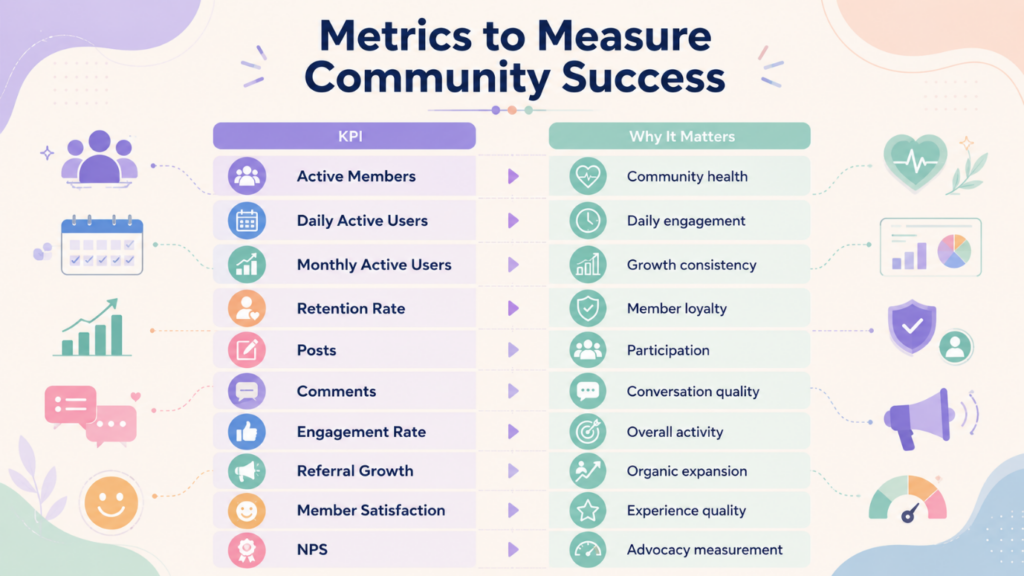
Metrics to Measure Community Success
KPI
Why It Matters
Active Members
Community health
Daily Active Users
Daily engagement
Monthly Active Users
Growth consistency
Retention Rate
Member loyalty
Posts
Participation
Comments
Conversation quality
Engagement Rate
Overall activity
Referral Growth
Organic expansion
Member Satisfaction
Experience quality
NPS
Advocacy measurement
Best Tools for Community Management
Tool
Purpose
Circle
Community platform
Discord
Real-time communication
Slack
Team collaboration
Notion
Knowledge base
Zapier
Automation
Typeform
Surveys
Google Analytics
Performance tracking
Buffer
Social scheduling
Canva
Content creation
Mailchimp
Email marketing
How to Monetize an Online Community
Communities can generate revenue through:
Membership subscriptions
Online courses
Virtual events
Premium content
Affiliate marketing
Sponsored partnerships
Digital products
Coaching
Paid newsletters
Common Mistakes to Avoid
Growing too fast
Ignoring members
Excessive promotion
Weak moderation
Inconsistent posting
Poor onboarding
Ignoring analytics
No engagement strategy
Future of Online Communities
The future includes AI-powered moderation, personalized member experiences, workflow automation, private communities, creator-led ecosystems, gamification, and, where relevant, emerging Web3 community models.
Expert Tips
Start with a niche audience.
Welcome every new member.
Reward active contributors.
Encourage user-generated content.
Stay consistent.
Measure engagement weekly.
Listen to feedback.
Focus on quality over quantity.
Build trust before monetizing.
Continuously evolve based on member needs.
Key Takeaways
Define a clear community purpose.
Understand your target audience.
Choose the right platform.
Create strong community guidelines.
Publish valuable content consistently.
Encourage active participation.
Moderate fairly and transparently.
Track engagement metrics.
Grow through referrals and SEO.
Build relationships before focusing on revenue.
Community-led growth is a business strategy where customers, users, advocates, and members actively contribute to brand growth through conversations, feedback, referrals, user-generated content, events, and peer-to-peer interactions. Instead of relying only on paid acquisition, brands build relationships within an owned community that can support engagement, retention, advocacy, and long-term growth.
As customer acquisition becomes increasingly competitive, businesses are looking for ways to build deeper relationships rather than depending entirely on one-way advertising. Community-led growth provides a complementary growth engine by turning customers and users into active participants in the brand ecosystem.
Brands looking to create a dedicated environment for conversations, engagement, events, and member relationships can explore Thrico’s community management platform.
What Is Community-Led Growth?
Community-led growth (CLG) is a growth strategy in which a business uses an active community of customers, users, prospects, creators, professionals, or advocates to support acquisition, engagement, retention, referrals, and customer loyalty.
Unlike traditional marketing, where the brand typically creates and distributes the majority of the message, community-led growth encourages members to participate in creating value.
A community-led growth strategy can involve:
Customer discussions
Peer-to-peer support
User-generated content
Product feedback
Events and networking
Member advocacy
Referrals
Reviews and recommendations
Knowledge sharing
Customer education
The goal is not simply to build a large community. The objective is to create a community where members receive meaningful value while their participation also contributes to business growth.
Community-led growth is becoming increasingly relevant as businesses face higher competition for customer attention and acquisition.
Several factors are contributing to this shift.
Rising Customer Acquisition Costs
Businesses across many industries compete for visibility through paid search, social advertising, influencer campaigns, and other acquisition channels. As competition increases, acquiring every new customer through paid channels can become more expensive.
Communities provide another way to create ongoing value among existing customers and prospects.
Declining Effectiveness of One-Way Marketing
Traditional advertising generally communicates from the brand to the audience. Modern customers, however, often want opportunities to ask questions, compare experiences, share opinions, and interact with other people.
Communities create a two-way environment where customers can participate rather than simply consume marketing messages.
Growing Demand for Authentic Interactions
Customers may trust experiences shared by peers differently from traditional promotional claims. Reviews, discussions, customer stories, recommendations, and peer-to-peer advice can provide context that conventional advertising often cannot.
Personalization Expectations
Customers increasingly expect brands to understand their interests and provide relevant experiences. Communities can help businesses understand member needs through conversations, participation patterns, questions, polls, and feedback.
Importance of Trust
Trust develops through repeated interactions. When customers see other members sharing genuine experiences, answering questions, and participating in discussions, the community can become a valuable source of social proof.
Members can create reviews, discussions, tutorials, recommendations, case studies, questions, and other content. This can reduce the pressure on brands to produce every piece of content themselves while creating authentic resources for other members.
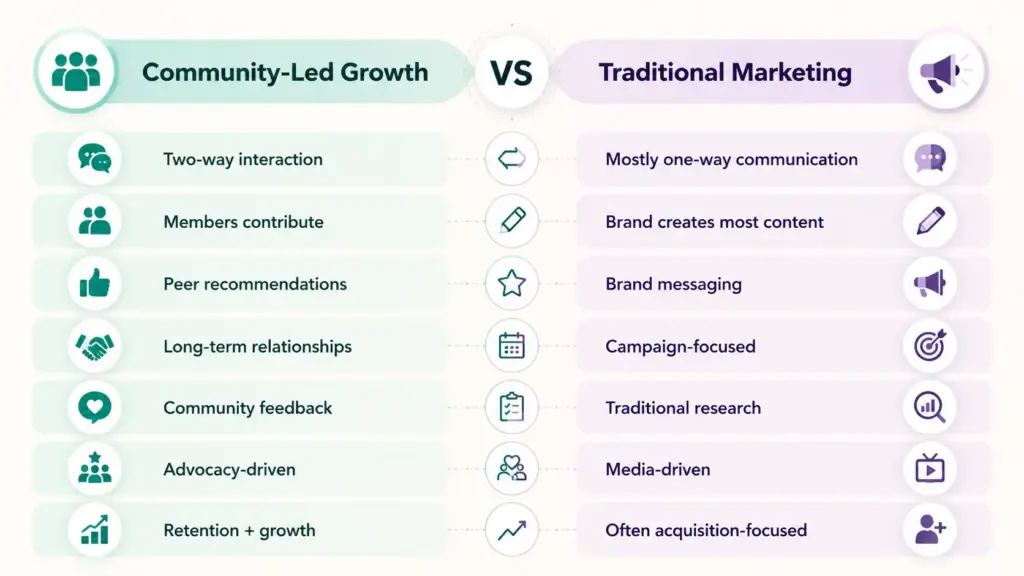
Community-Led Growth vs Traditional Marketing
Community-led growth and traditional marketing are not necessarily competing approaches. They can work together as part of an integrated growth strategy.
Community-Led Growth
Traditional Marketing
Two-way interaction
Mostly one-way communication
Members contribute
Brand creates most content
Peer recommendations
Brand messaging
Long-term relationships
Campaign-focused
Community feedback
Traditional research
Advocacy-driven
Media-driven
Focus on retention and growth
Often acquisition-focused
The key difference is participation.
Traditional marketing generally focuses on communicating a message to an audience, while community-led growth creates an environment where the audience can interact, contribute, and influence the broader customer experience.
Community-led growth works best when it complements existing acquisition, content, and performance marketing channels.
What Are the Core Elements of a Community-Led Growth Strategy?
A successful community-led growth strategy requires more than simply launching an online group. Businesses need to create a clear purpose, encourage participation, understand members, and connect community activity with measurable business outcomes.
1. Clear Community Purpose
People need a reason to join and remain active.
Before launching a community, ask:
Why should people join?
What problem does the community solve?
Who is the community for?
What value will members receive?
What makes the community different from existing channels?
A clear purpose helps prevent the community from becoming another inactive promotional channel.
2. The Right Member Profile
Community size is less important than member relevance and participation.
Potential members can include:
Existing customers
Prospects
Creators
Industry experts
Partners
Brand advocates
Alumni
Employees, where relevant
The ideal audience depends on the community’s business objective.
For example, a SaaS company may build a customer community around product education and peer support, while a professional association may focus on networking and knowledge sharing.
3. Meaningful Engagement
Engagement should provide value rather than simply increase activity numbers.
Useful engagement formats include:
Discussions
Q&A sessions
Polls
Events
Challenges
Knowledge sharing
Networking
Feedback sessions
Expert discussions
Member spotlights
Brands can use gamification strategies for community engagement to encourage useful participation through challenges, rewards, and recognition.
4. User-Generated Content
User-generated content (UGC) is one of the most valuable components of community-led growth.
Members can create:
Reviews
Tutorials
Discussions
Case studies
Questions
Recommendations
Product experiences
Educational resources
UGC can provide authentic social proof while giving other members useful information.
For example, a customer asking how another user solved a specific problem can receive a practical answer from someone with first-hand experience.
5. Recognition and Gamification
Recognition can encourage members to continue contributing.
Common approaches include:
Points
Badges
Levels
Leaderboards
Challenges
Rewards
Member recognition
The objective should not be to gamify every interaction. Instead, recognition should reinforce valuable community behaviors such as answering questions, sharing knowledge, attending events, or helping other members.
A community should not be treated only as a promotional channel.
An effective feedback loop looks like:
Member Feedback → Insight → Product or Content Improvement → Community Update → More Participation
For example, if members repeatedly request a particular product feature, educational resource, or event topic, the business can use that feedback to inform future decisions.
When members can see that their feedback leads to meaningful action, they have a stronger reason to participate.
7. Community Advocacy
Community members can gradually move through different stages:
Member → Active Contributor → Power User → Advocate → Brand Champion
Advocacy can include:
Referrals
Reviews
Recommendations
Social sharing
Testimonials
Event participation
Product advocacy
Peer support
As members become more engaged, they can contribute to revenue and brand loyalty through referrals, recommendations, advocacy, and deeper relationships with the brand.
How to Build a Community-Led Growth Strategy
Building community-led growth requires a structured approach. The following process can help businesses move from community creation to measurable business impact.
Step 1 — Define the Business Goal
Start with the outcome the community should support.
Possible goals include:
Customer retention
Brand awareness
Customer advocacy
Product feedback
Lead generation
Customer education
Referral growth
Revenue
Customer support
A community created primarily for customer support will require different activities and metrics from a community designed for lead generation or professional networking.
Step 2 — Identify Your Community Audience
Define the people who are most likely to receive and contribute value.
Consider:
Ideal member
Existing customers
Prospects
Advocates
Industry experts
Partners
Creators
Avoid trying to attract everyone. A focused community often creates more meaningful conversations than a large but loosely connected audience.
Step 3 — Choose the Right Community Model
Different businesses can use different community models.
Customer Community
Designed primarily for customer support, education, product discussions, and retention.
Brand Community
Focused on building customer relationships, loyalty, advocacy, and brand participation.
Professional Community
Built around networking, knowledge sharing, career development, and industry discussions.
Creator Community
Designed for creators, influencers, collaborators, and content professionals.
Micro-Community
Focused on a specific audience, interest, customer segment, or use case.
Attend an event → Connect with members → Participate in a discussion
The objective is to create recurring value rather than relying only on scheduled promotional posts.
Step 7 — Build a Community Content Strategy
A community content strategy can include:
Educational content
Discussions
Polls
Events
AMAs
Expert sessions
Member stories
Product updates
Challenges
User-generated content
The content mix should encourage participation instead of turning the community into another content distribution channel.
Step 8 — Turn Members Into Advocates
Not every member will become an advocate, and that is normal.
Businesses can encourage advocacy through:
Recognition
Referral programmes
Ambassador programmes
Exclusive access
Member spotlights
Rewards
Co-created content
The most effective advocacy usually develops after members have already experienced meaningful value from the community.
Step 9 — Measure and Optimise
Community success should not be measured only by member count.
Track:
Active members
Engagement rate
Contribution rate
Member retention
Member-generated content
Event participation
Referral rate
Advocacy
Conversion
Customer lifetime value
A community with 5,000 registered members but very little activity may provide less business value than a smaller community with highly engaged members.
Community-Led Growth Metrics to Track
Goal
Metrics
Community Growth
New Members, Growth Rate
Engagement
Posts, Comments, Reactions
Contribution
Active Contributors, UGC
Retention
Member Retention, Churn
Advocacy
Referrals, Reviews, Mentions
Business Impact
Leads, Conversions, Revenue
Community Health
Participation Rate, Sentiment
The most important community-led growth metrics include active members, engagement rate, contribution rate, retention, user-generated content, referrals, advocacy, and business conversions. The right metrics depend on the community’s primary business objective.
How Does Community-Led Growth Drive Business Growth?
Community-led growth can be understood as a growth flywheel:
More Members
↓
More Conversations
↓
More User-Generated Value
↓
More Trust
↓
More Engagement
↓
More Advocacy and Referrals
↓
More Members
As the community becomes more useful, members can contribute more knowledge, experiences, recommendations, and content. That value can make the community more attractive to prospective members.
Over time, the community can influence several stages of the customer journey, including discovery, education, engagement, retention, advocacy, and referrals.
However, the flywheel does not automatically work simply because a community exists. Businesses need active participation, effective moderation, relevant content, strong onboarding, and continuous measurement.
Community-Led Growth Examples
The following examples are hypothetical and illustrate how different businesses could apply community-led growth.
SaaS Example
A software company creates a customer community where users share workflows, troubleshooting tips, integrations, and best practices.
Existing customers receive peer support, while new users can discover practical solutions. As participation increases, the community can support product education, engagement, retention, and advocacy.
D2C Example
A consumer brand creates a community where customers share product experiences, usage ideas, reviews, and recommendations.
Member-generated content can provide social proof for prospective customers, while discussions help existing customers get more value from the product.
Education Example
An education business creates a community where students, instructors, alumni, and industry experts share knowledge.
Students receive access to peer discussions and networking opportunities, while experts can contribute through sessions, AMAs, and educational content.
Professional Association Example
A professional association creates a digital community where members participate in discussions, attend events, exchange industry knowledge, and build professional relationships.
The community strengthens the value of membership by providing ongoing interaction beyond individual events.
Community-Led Growth Challenges
Community-led growth can deliver significant value, but it also requires ongoing effort.
Common challenges include:
1. Low Initial Participation
New communities often struggle to generate conversations because there are not enough active members initially.
2. Community Becoming Inactive
A community can lose momentum when discussions become repetitive or members do not see enough value in returning.
3. Poor Onboarding
Members may leave if they do not understand what to do after joining.
4. Lack of Clear Purpose
A community without a clear reason to exist can quickly become another promotional channel.
5. Excessive Promotional Content
Constant product promotion can reduce trust and discourage genuine participation.
6. Difficult Moderation
As activity increases, businesses may need clear guidelines and moderation processes to maintain quality.
7. Vanity Metrics
Large member numbers do not necessarily indicate a healthy community.
8. Lack of Executive Support
Community-led initiatives often require long-term investment in people, content, technology, and measurement.
9. Poor Member Experience
Slow communication, confusing navigation, irrelevant notifications, or difficult participation can reduce engagement.
10. Failure to Connect Community Activity to Business Outcomes
Community activity should eventually be connected to relevant outcomes such as retention, referrals, customer satisfaction, conversions, or revenue.
How to Keep a Community Engaged Over Time
Launching a community is only the beginning. Long-term engagement requires consistent value.
Businesses can maintain participation through:
A consistent content calendar
Regular events
Member recognition
Polls
Challenges
Expert sessions
Personalized communication
Sub-groups
Member feedback
Community milestones
Member-generated content
Exclusive resources
Avoid depending on one engagement tactic. A combination of discussions, events, educational content, recognition, networking, and member participation can create a more sustainable experience.
Is Community-Led Growth Right for Every Business?
Community-led growth is not universally suitable for every business.
It can be particularly valuable for:
SaaS companies
Consumer brands
Education businesses
Creator businesses
Professional associations
Membership organisations
Startups
Customer-centric businesses
It may require more effort for businesses where customers have:
Highly transactional purchasing behavior
Very low repeat interaction
Extremely short customer journeys
No clear shared interest
Limited motivation to interact with other customers
The key question is not whether a business should have a community. Instead, businesses should ask whether customers can receive meaningful value from interacting with each other and with the brand.
Community-Led Growth vs Community-Led Marketing
Community-led marketing and community-led growth are related but not identical.
Community-led marketing generally means using a community as a marketing channel to distribute content, engage audiences, promote products, or generate awareness.
Community-led growth is broader. It uses community participation and relationships to influence multiple parts of the growth journey, including:
Acquisition
Engagement
Education
Product feedback
Retention
Advocacy
Referrals
Customer loyalty
Business growth
In simple terms:
Community-led marketing = community as a marketing channel.
Community-led growth = community as a growth ecosystem.
Community-Led Growth Checklist
Use this checklist when developing a community-led growth strategy:
Define the community purpose
Identify ideal members
Choose the appropriate community model
Select a suitable platform
Create a structured onboarding process
Establish community guidelines
Build engagement loops
Create a content strategy
Encourage user-generated content
Recognise valuable contributors
Use gamification where appropriate
Create feedback loops
Develop advocacy programmes
Track community health
Measure retention and engagement
Track referrals and conversions
Connect community activity to business outcomes
Continuously optimise the member experience
Social media is a powerful way for brands to reach new audiences, start conversations, and build awareness. But relying entirely on social platforms can leave organizations with limited control over their audience relationships. Algorithms change, organic reach fluctuates, platform policies evolve, and access to audience insights can be restricted.
That is why more organizations are investing in branded communities and first-party community data.
Owning your community data is not about having unlimited access to members’ personal information. It is about creating a direct, trusted environment where organizations can responsibly collect relevant insights, understand member needs, and use those insights to improve the community experience.
What Does “Owning Your Community Data” Actually Mean?
Community data includes the information and insights generated through legitimate interactions within a community. This can include member profiles, interests, discussions, comments, content interactions, event participation, poll responses, surveys, feedback, engagement patterns, and contribution history.
However, data ownership comes with responsibility. Member consent, privacy, data minimization, security, and applicable regulations must remain central to any community data strategy.
For organizations, the real value lies in turning these first-party insights into meaningful decisions. Community engagement analytics can help teams understand how members interact, what they value, and where engagement opportunities exist.
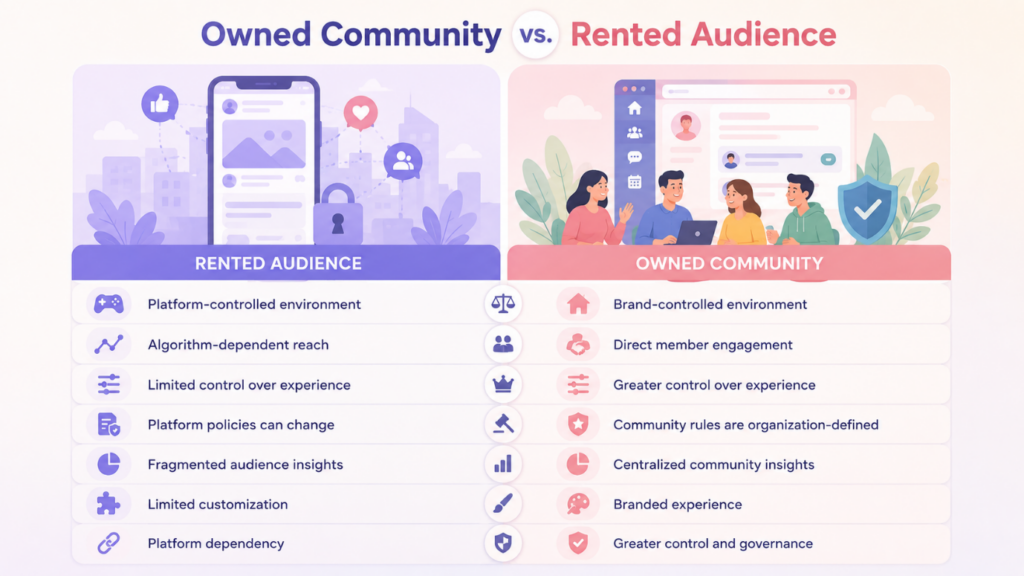
Owned Community vs. Rented Audience
The difference between a social media audience and an owned community can be thought of as the difference between renting and building.
Rented Audience
Owned Community
Platform-controlled environment
Brand-controlled environment
Algorithm-dependent reach
Direct member engagement
Limited control over experience
Greater control over experience
Platform policies can change
Community rules are organization-defined
Fragmented audience insights
Centralized community insights
Limited customization
Branded experience
Platform dependency
Greater control and governance
“Owned” does not mean unrestricted ownership of personal data. Instead, it means having greater control over the community environment, member relationship, and legitimately collected first-party insights.
A branded community platform can give organizations greater control over branding, member experience, content, and community governance.
Why Does Community Data Matter More Than Ever?
1. Reduce Dependence on Third-Party Platforms
Social platforms can be excellent discovery channels, but organizations do not control their algorithms, policies, or product roadmaps. A branded community creates an environment where organizations have more influence over how members interact and how engagement is managed.
2. Build Stronger First-Party Relationships
A dedicated community provides a direct space for members to interact with a brand and with one another. Over time, these repeated interactions create valuable first-party insights that can strengthen relationships beyond individual transactions.
3. Understand What Members Actually Need
Community conversations can reveal common questions, pain points, feature requests, content preferences, and emerging interests. Instead of relying solely on assumptions or occasional surveys, organizations can learn from ongoing member interactions.
4. Create More Relevant Experiences
Responsible use of community insights can help organizations improve content, events, discussions, resources, notifications, and member journeys.
What Are the Business Benefits of Owning Community Data?
The value of community data becomes clearer when it is connected to business outcomes.
Better retention: Declining engagement can help identify members who may need better onboarding, relevant content, or additional support.
Better relationships: Communities create opportunities for ongoing conversations instead of limiting interactions to individual purchases or support requests.
Better product feedback: Discussions, polls, and surveys can reveal what customers want and where products or services could improve.
More relevant content: Engagement data can show which subjects and formats members find useful.
Stronger advocacy: Highly engaged contributors can become valuable advocates, mentors, or community champions.
Better ROI measurement: Community activity can be connected to participation, retention, referrals, customer success, and product adoption.
This is especially important for customer success communities, where ongoing engagement can contribute directly to customer relationships and long-term success.
What Types of Community Data Should Organizations Track?
Organizations should focus on data that supports clear community objectives.
Member data: Profile information, membership status, interests, and community roles.
Engagement data: Posts, comments, reactions, discussions, and content interactions.
Event data: Registrations, attendance, participation, and post-event engagement.
Feedback data: Poll responses, surveys, suggestions, and product feedback.
Community health data: Active members, retention, inactivity, engagement trends, and contributor growth.
Tools such as community engagement features can help organizations turn discussions, feedback, and polls into useful community signals.
How Community Data Creates a Feedback Loop
Community data becomes most valuable when it creates a continuous improvement cycle:
Member Activity → Data & Insights → Better Experience → Higher Engagement → More Member Activity
The objective is not simply to collect more information. The objective is to transform legitimate community signals into better decisions and better experiences for members.
Organizations can identify high-value topics, recognize at-risk members, find community champions, improve events, develop more useful content, and close the feedback loop by showing members how their input influences improvements.
Why a Branded Community Gives Organizations More Control
A branded community can provide greater control over brand identity, member experience, moderation, content organization, engagement, analytics, member journeys, customization, and data governance.
This is where awhite-label community platform for enterprises can become valuable. Rather than building community engagement entirely around a third-party social network, organizations can create a dedicated environment aligned with their brand and governance requirements.
Community Data and Privacy: Ownership Comes With Responsibility
Greater control over community data also means greater responsibility.
Organizations should establish clear consent practices, transparent privacy policies, secure storage, access controls, appropriate retention periods, deletion processes, and responsible analytics. They should also comply with privacy regulations that apply to their members and operations.
Community data ownership should never be presented as unlimited access to members’ personal information. The goal should be responsible collection, transparent use, and secure management of relevant first-party data.
Common Community Data Mistakes to Avoid
Several mistakes can reduce the value of a community data strategy:
Collecting data without a clear purpose
Focusing only on vanity metrics such as member count
Ignoring qualitative feedback
Keeping important insights in disconnected systems
Failing to act on member feedback
Over-personalizing experiences
Ignoring privacy and consent
Measuring community size instead of community health
A large community is not necessarily a healthy community. Meaningful participation, contribution, retention, and member satisfaction are often better indicators of community success.
How to Build a Community Data Strategy
A practical approach can be built around seven steps:
Step 1: Define the objective. Determine what the community should achieve.
Step 2: Identify the data you need. Collect information because it serves a purpose, not simply because it is available.
Step 3: Establish privacy practices. Clearly define how data will be collected, stored, accessed, and used.
Step 4: Choose the right platform. Look for analytics, member management, engagement tools, integrations, security, scalability, and data controls.
Step 5: Track meaningful metrics. Focus on engagement, retention, contribution, and outcomes.
Step 6: Turn insights into action. Use findings to improve onboarding, content, events, and member experiences.
Step 7: Continuously improve. Community data should feed an ongoing cycle of measurement, learning, and optimization.
Key Community Data Metrics to Track
Metric
What It Measures
Active Members
Community health
Activation Rate
New-member onboarding
Engagement Rate
Member participation
Posts & Comments
Contribution
Event Participation
Event effectiveness
Retention Rate
Long-term engagement
Inactivity Rate
Engagement risk
Content Performance
Member interests
Response Time
Community support
Sentiment
Member experience
Organizations can also explore how to measure community success by connecting these metrics to broader objectives.
Owned Community Data vs. Social Media Data
Social media audiences are largely mediated by the platform, while an owned community provides a more direct environment for member relationships. Social platforms also impose branding, experience, analytics, and governance constraints, whereas a branded community can provide significantly more flexibility.
The goal is not necessarily to replace social media. Social platforms can remain valuable for discovery and awareness while an owned community becomes the deeper environment for engagement, relationships, and first-party insights
Conclusion
The future of community building is not simply about collecting more members. It is about developing direct, trusted relationships and using responsible first-party insights to create better experiences.
The strongest community data strategy follows a simple progression:
Organizations that treat community data as a responsibility as well as an asset can build communities that are not only more measurable, but also more useful, trusted, and valuable for their members.
When users see content aligned with their interests, they naturally click, react, and comment more. A Smart Feed reduces the guesswork—surfacing posts that are both timely and meaningful. Engagement climbs across the board: likes, replies, saves, and shares.
2) More Time Spent on Platform
Relevance propels retention. If each scroll yields something personally useful, members linger. Over weeks, this compounds into significantly more time spent per session, per day, and per month—fueling stronger creator economies and healthier network effects.
3) Better Content Discovery
Chronological feeds bury gems almost immediately. Smart Feeds elevate high-quality and trending content for each user—keeping long-tail posts alive longer and helping new members discover must-follow creators, topics, and conversations.
4) Stronger Community Connection
Seeing the “right” posts at the “right” moments nurtures a connection between creators and members. It amplifies shared interests while ensuring diverse points of view still surface—strengthening the social fabric.
5) Personalized Experience
Personalization makes your platform feel tailored to each member. The personalized feed adapts in real time to learning styles, professional needs, and leisure interests—creating an experience that feels uniquely “theirs.”
6) Reduction in Irrelevant Content
Low-relevance or repetitive posts move down the feed automatically. That reduces content overload and frustration, keeping the stream clean, focused, and rewarding.
7) Boost in Return Visits (Retention)
Habit loops form when users repeatedly find value quickly. A smart community feed algorithm builds those loops by reliably delivering posts users care about—leading to more return visits and stronger daily/weekly active usage.
Need for personalized delivery: Relevance drives satisfaction, which drives growth. Personalization is no longer “nice to have.”
Shrinking attention spans: Members decide in seconds whether to stay. Smart ranking makes those seconds count.
Shift toward algorithmic discovery: Algorithms help uncover niche content and new voices—beyond what follows alone can surface.
Better user satisfaction & stickiness: When users feel understood, they’re more likely to contribute and keep coming back.
Key Features of a Smart Feed
Below are table-stakes elements for a modern AI feed feature—and the building blocks we recommend prioritizing:
Personalized content stream: Post ordering that adapts per-user based on interests, history, and real-time context.
Trending community highlights: Snapshots of what’s buzzing—topics, threads, or creators gaining momentum.
Recommended posts: Suggestions that connect users to high-value content outside their current bubble.
Topic-based suggestions: Curated lanes (e.g., “Design,” “Growth,” “DevOps”) that help members dive into specific interests.
Creator highlights: Spotlights on rising and relevant creators to widen discovery and build creator-member bonds.
Real-time updates: The feed refreshes as new posts land or as members interact—keeping it lively and current.
Engagement triggers: Gentle prompts to like, comment, or share; inline replies; quick reactions; and follow suggestions.
Want to equip your community with first-class personalization and discovery? Explore Thrico’scommunity-building tools to see how smart feeds fit into a modern growth stack.
How a Smart Feed Boosts Engagement
Shows users exactly what they care about: Smart ranking prioritizes posts aligned to interests, recent activity, and session context—making relevance the default.
Encourages users to interact more: When content resonates, users reply more often, react more freely, and join threads earlier.
Reduces content overload: Filtering and diversification prevent the “wall of noise,” encouraging deeper, focused engagement.
Makes the platform feel active and relevant: Real-time refresh and trending highlights keep the community feeling alive—especially during peak hours.
Enhances connection between creators and members: More relevant exposure leads to more meaningful interactions and loyal follow relationships.
Drives discussions around trending topics: Timely surfacing of hot conversations increases participation and cross-pollination between sub-groups.
Online community platforms: Private networks, member clubs, hobby groups, and niche forums.
Social media apps: Consumer or prosumer apps that need sticky, daily engagement.
Creators & influencers: Personalized reach to the right audience at the right moment.
Brands with active communities: Owned communities that support product education, advocacy, and loyalty.
Educational & professional networks: Cohorts, alumni groups, guilds, and peer-learning spaces.
Customer forums: Support hubs and product communities where timely, relevant answers matter.
Tips to Optimize Your Community Feed for Maximum Engagement
Use AI-driven content ranking: Start with a baseline ranking model (e.g., logistic regression or gradient boosting) and iterate toward deep learning as data grows.
Use re-ranking to apply diversity constraints, safety filters, and community policies.
5) Feedback & Learning
Continuous retraining: Periodically update models with fresh data to reduce staleness.
Human-in-the-loop: Allow moderators or community managers to pin highlights, feature creators, and correct drift.
Transparency cues: “Because you follow X” or “Popular near you” increases trust and comprehension.
Practical Playbook: Rolling Out a Smart Feed Without Overwhelm
Metrics That Prove It’s Working
Track these KPIs to validate impact:
Engagement rate: Likes + comments + shares per impression.
Dwell time: Average time per post and per session.
Reply depth: Median comments per thread, ratio of multi-turn conversations.
Retention: D1 / D7 / D30 return rates, weekly active to monthly active (WAU/MAU).
Discovery: % of impressions from recommended or trending posts; new creators followed per user.
Quality signals: Hide/mute rates, spam reports, sentiment of replies.
Tie metrics to your business goals—education completion, product adoption, or support deflection.
Ethical and Design Considerations
Smart Feeds are powerful. Use them responsibly:
User control: Offer toggles (e.g., “Latest” vs. “For You”), mutes, and topic management.
Transparency: Provide short “why” labels for recommendations.
Well-being: Avoid purely maximizing time-on-site; optimize for healthy engagement.
Fairness: Ensure diversity in exposure; don’t let large accounts dominate by default.
Privacy: Collect only necessary data; honor user preferences and applicable regulations.
Example Smart Feed Layout (UX Sketch-in-Words)
Top bar: “For You” (default) and “Latest” tabs.
Composer strip: Lightweight prompt with attachment options and draft-saving.
Priority card: A single “Must-See Today” item (e.g., AMA announcement, milestone).
Mainstream: Personalized posts with inline actions, skim-friendly previews, and “Why am I seeing this?” tags.
Right rail: Trending topics, creator highlights, and quick-follow suggestions.
Footer: Infinite scroll with “You’re all caught up” moments and backfill recommendations.
This structure merges personalization with clarity and control—maximizing satisfaction and discoverability.
Implementation Roadmap
Phase 1 — Instrumentation & Data Model
Define events and schemas: impressions, clicks, dwell, replies, hides, and follows.
Create content embeddings and topic taxonomies.
Phase 2 — Candidate Generation
Build follow-based, topic-based, and trending-based candidate pools.
Add diversity sampling and safety filtering.
Phase 3 — First Ranking Model
Train a baseline model to predict CTR or reply probability.
Launch a simple personalized feed with transparency tags.
Phase 4 — Multi-Objective Re-Ranking
Add freshness, diversity, creator fairness, and safety constraints.
Introduce session-aware features (time of day, recency).
Phase 5 — Feedback Loops & A/B Testing
Set up continuous retraining on rolling windows.
Test variants: different weights, decay functions, and exploration policies.
Phase 6 — Growth & Creator Tools
Add creator analytics, recommended posting times, and highlight slots.
Integrate with onboarding flows to map users to interests faster.
Conclusion
Modern communities thrive on relevance. A Smart Feed—powered by an adaptive community feed algorithm—delivers the right content to the right member at the right time, creating a virtuous cycle of discovery, conversation, and return visits. It reduces content overload, elevates creators, and accelerates engagement while giving users control and clarity. If you want a living, breathing community that compounds value daily, a Smart Feed isn’t optional—it’s foundational.
Ready to upgrade your platform? Explore Thrico’scommunity-building tools to see how smart feed capabilities fit into your engagement strategy.