Community platforms, including forums, social groups, and brand communities, are digital destinations where people connect, share, and build relationships around an interest. Users engaging with your community contribute to a lively and engaged community. When users feel positive about being valued participants in the community and feel connected to the community, they thrive in the social arena. This blog focuses on practical user interaction strategies for community engagement and user retention. We have discussed user interaction strategies for the community platform and provided examples that enhance the member experience.
Why User Interaction & Retention Matter?
User engagement and retention are critical for any community platform’s success. High engagement encourages growth, trust, and loyalty since people who are involved on a platform are more likely to be loyal to it and refer new members. Engaging with users and retaining them makes more financial sense than acquiring new users because acquisition costs usually outweigh actual retention costs. Keeping users regularly engaged in activities that link them and keep them connected makes them more likely to stick around, keep talking or posting about the community, or recommend it to others. Engaged community members are the main catalyst for an online community’s success.
User Interaction Strategies to Boost Engagement
If your goal is to increase user engagement, these experiences must have a personal, fun, and interactive feel. Here are some ideas:
Welcome and Onboarding Experiences:
An onboarding process is crucial, especially with the amount of time it takes to network or join new communities. As an onboarding experience, use auto-welcome messages, starter guides, onboarding tours, etc., to ensure that the new user feels connected and has a good understanding of how to use the network.
Gamification and Rewards:
Incorporating points/badges/leaderboard features in your network would help increase users’ motivation to remain active and engaged. In addition to increasing engagement, certain aspects of gamification promote a sense of competition and achievement.
Ask Questions & Start Discussions:
Prompt interactions – use polls, Q&As, AMAs, etc., generate conversation and allow for two-way dialogue. Users will appreciate being involved and being able to voice their opinion.
Highlighting top contributors:
Recognising the top contributors on your network is a great everyday practice, not only to bring more faith to daily, weekly, and monthly appearances in the network but also to simply recognise, celebrate, and highlight those who are extremely active.
Interactive Content:
Contests, user-generated content prompts, quizzes, etc, were all very effective in encouraging participation and engagement within a fun setting.
Each of these strategies helps to foster a sense of belonging and ownership, driving users to interact more often.
Tools & Features That Help Improve User Engagement
There are many tools to increase user engagement. Notifications, mentions, reactions, and live chat help create communication opportunities in real-time while guiding users back to the platform. Adopting a mobile-first approach ensures users can interact with the community no matter what device they are on. Consider the following tools: in-app messaging, push notifications, and personalised support for a more use-case-specific interaction with real users in the community.
Community Retention Tips
Maintaining a community’s engagement over time is crucial to its success. Here are some suggestions for keeping your users engaged:
Regular Content/Events Calendar:
Keep a calendar that will add structure; for example, you can have weekly themes and monthly contests or hold sessions with experts and quickly build an engaged community.
Personalised Communication:
Continue personal communication with your users by using emails, notifications, push messages, and direct messages. Users need to feel valued.
Sub-Groups or Channels of Niche Focus:
Encourage the users to find their niche groups within the community. This type of organisation can be predicated on shared interest, goals, or expertise.
Moderation & Safety:
You need to create a positive space, and while that is as simple as just allowing discussions, it can be just as simple to moderate it for toxicity and deal with such things immediately.
Feedback Loops:
Consistently gather feedback through idea boards or surveys, and importantly, act on these ideas to demonstrate to users that their opinion matters.
Using these strategies should generate a community of users that feel valued and will ideally retain long-term.
Track and Optimize Engagement Metrics
To effectively enhance user engagement over time, it is essential to monitor key performance indicators (KPIs), such as daily active users (DAUs), post/comment ratio, and churn rate. These metrics define user experience and behavior, as well as what needs to be improved or brought to light. You can then use that metric and behavioral data as your foundation to begin testing with different evaluation tools, such as Google Analytics, if you have the capability. Then you can begin rolling out iterative re-evaluations of the business plans, procedures, or processes so they adapt to the changing user molds and the movement of consumer/commercial engagement along that line. You should analyse them regularly each day, or if you do it once a month, then you could have a much better ability to sequence the data and adapt to what will bring with it better successes along your engagement objectives over time.
Gamification in communities has bloomed as an effective way to increase user engagement and motivation. By using game design elements like points, badges, leaderboards, and quests in contexts other than games, community platforms have an opportunity to make interactions more fun and rewarding. Gamification capitalises on our human faculties for achievement and recognition to encourage active participation. Community managers are constantly searching for new ways to encourage more interaction and loyalty among members, and gamification has become an increasingly appealing approach.
At Thrico, we help organisations use gamification to unlock the potential of their communities and transform passive audiences into engaged members. In this blog, we will highlight the benefits of gamification on community platforms with examples of how it can drive engagement, loyalty, collaboration, learning, positive behaviors, and brand equity.
What is gamification in community platforms?
Points:
Gamification is the purposeful use of game design elements in non-game settings to improve engagement levels. In community platforms, these typically consist of:
Points are earned by taking part in activities such as posting, commenting, or completing tasks.
Badges:
Badges represent levels of achievement, serving as visual tokens for milestone accomplishments or specific actions.
Leaderboards:
Leaderboard ranks drive healthy competition among users.
Challenges:
Challenges are fun, time-bound activities that engage users to try different activities.
Rewards:
Rewards are tangible or digital rewards that reinforce participation.
Thrico implements these elements into our platform to build active, value-led ecosystems.
How Gamification Enhances Engagement
Gamification turns typical community engagement into fun and rewarding:
Encouraging Engagement:
Points and badges incentivise users to post regularly.
Keeping Users Engaged:
Leaderboards and streaks help bring users back.
Driving Engagement:
Contributing or working together on a challenge can facilitate greater conversation.
Thrico’s gamification module for community engagement helps brands and associations create spaces where members are genuinely excited to engage with each other and share and move forward together.
Boosts User Retention and Loyalty
Gamification builds the “stickiness” of platforms by
Using Achievements:
Rewards and recognitions keep users coming back over time.
Creating Connections:
Shared milestones and friendly competition encourage a mutually beneficial relationship.
Personal Engagement:
Custom reward systems recognise individual journeys.
At Thrico, you will not only attract users, but you will also keep them coming back. Through gamification, we assist communities in retaining their top contributors by obtaining long-term loyalty.
Fosters Healthy Competition and Collaboration
Gamification rewards both individual performance and group collaboration.
Leaderboards:
Users receive motivation to increase their contributions.
Peer Recognition:
Badges and mentions enable members to express acknowledgement to each other.
Group Challenges:
Users engage in team-based activities together with other functions.
Thrico’s platform engages clients enjoyably, incorporating competition with collaboration to foster community positively and productively.
Promotes Learning and Skill Development
Gamified communities cultivate peer learning.
Knowledge sharing:
Users earn rewards based on the helpfulness of answers and insights.
Level-up paths:
Visual progress systems provide a look at growth and expertise.
Mentorship support:
Acknowledge and reward users who mentor other users.
Thrico supports communities that foster learning by embedding gamification tools that recognise expertise and allow users to continually grow.
Encourages Positive Behavior and Community Guidelines
Gamification is the systematic process of building incentives into an online community to support super-nice behavior
Reputation Scores:
Recognition of civility and helpfulness.
Description:
An aggregate of civic behaviors and positive interactions around the site.
Behavioral Rewards:
Recognition of respectful constructive interaction.
Spam Control:
A disincentive for trolls via automated moderation.
Thrico’s gamified reputation systems contribute to the creation of safe and inclusive high-value online environments.
Business and Brand Benefits
Beyond engagement, gamification delivers major value to brands:
Brand Advocacy:
Engaged users frequently become organic advocates.
Monetization Opportunities:
Increased time on the platform drives revenue.
Customer Support:
Self-service help forums can reduce operational costs.
Thrico turns organizations’ community platforms into brand amplifiers and revenue drivers through gamification.
Conclusion
The advantages of gamification in community platforms range from increasing user engagement and loyalty to fostering collaboration and enhancing learning. How we can help you at Thrico is to turn community participation into a fun experience for users and a real growth opportunity for your brand.
Community engagement continues to evolve. It has transitioned from a focus on grassroots activism and local advocacy to a data-powered, technology-enabled, and connected world. We see community engagement in social media, online forums, and platforms owned by brands, where most communities can exist independently of place or space. However, in a digital world, keeping abreast of community engagement trends is no longer optional, as it poses a threat to all businesses, creators, and associations that no longer evolve to be more relevant. Understanding the future of community platforms will help you foster loyalty through awareness, become more innovative through co-creation, and ultimately create lasting digital relationships.
Understanding Online Community Engagement
What it’s going to mean in 2026 and beyond:
Online community engagement now moves beyond mere likes and comments and into a space of belonging where we do things together, share, cultivate, and make it matter. An online community is like a digital neighbourhood: welcoming, active, and responsive.
The role of platforms/social media/forums:
Engagement today depends on community platforms, brand-owned forums, branded social media groups, etc. These online spaces give each user a voice and life to ongoing conversations, leading them to form profound relationships amongst themselves and with the brand.
Engaged communities become passionate brand advocates, emphasising the importance of their products for others.
These communities offer helpful advice by creating a feedback loop that allows brands to evolve based on real user needs.
Why the Future of Community Platforms Matters
From passive observers to active participants:
Modern platforms are built to give users the ability to post their own content, ideas, and opinions, making them feel like active co-creators.
Platforms as ecosystems, not just content vending machines:
Community platforms are going through a metamorphosis to become ecosystems that provide everything, from learning to collaborative spaces and commerce outlets. They are no longer a place to dump content – they are an interactive environment of continued engagement.
The business case for investing in communities:
Strong communities drive longer customer lifetime value and lower customer churn. Observation of an already high user lifetime value being overlaid through community-building techniques, investing in community-based tech can privilege an ROI higher than traditional marketing if users differentiate into grand brand evangelists.
Top Community Engagement Trends to Watch
AI-Powered Customisation:
Artificial intelligence (AI) is transforming communities – recommending, introducing and moderating content on social media and other platforms. AI is powering communities, alongside chatbots, smart assistant applications, and more. User communities leverage the enhanced intelligence that AI brings to facilitate conversations, engagement and answering questions without the need for constant oversight and input from humans.
Community-Generated Content:
People prefer community-generated content because it is more authentic and engaging than branded content. User communities are realising they will gain more authenticity and trust through community-generated content that leverages polls, blogs, and discussions led by members.
Gamification Before Engagement:
Badges, leaderboards, points systems, etc., are the best tools to help convert potential users into active users. They promote active participation and engagement above passive participation and engagement due to the elements of competitive spirit and rewards for active participants.
Hybrid and Virtual Spaces:
The lines that separate virtual and real communities are disappearing fast. Brands are taking real-world events, mixing them with virtual meetups while employing virtual reality (VR) and augmented reality (AR) to engage members and further facilitate and immerse conversations and relationships as well as deepen satisfaction or activity between members.
Mobile-First and Application-Based Communities:
Mobile-first applications offer opportunities based on notifications so that members have easy access to their communities wherever they are. In-app notification alerts and content threads can stimulate conversations when members choose to partake!
Analytics-Powered Engagement Strategies:
Data is the new community compass. Current platforms do this by employing behavior-based segmentation, predictive analytics, etc., so they can engage users with a nudge or drop personalised content sooner! We can hopefully improve engagement together.
Preparing for the Future of Community Engagement
Audit your current platforms and engagement levels
Start by reviewing what’s working and what isn’t. Identify areas where engagement drops and analyse which features or formats users gravitate toward.
Adopt modular, scalable community tools
Choose tools that can grow with your community – adding features like real-time chat, member badges, or analytics dashboards as needed. Scalability ensures long-term sustainability.
Encourage member ownership and collaboration
When members feel a true sense of ownership, collaboration naturally follows. They don’t just participate- they invest, contribute ideas, and work together to build something meaningful. Empower them with clear roles, shared goals, and the freedom to make decisions. When everyone has a stake in the outcome, the collective energy fuels innovation and trust.
User-generated content (UGC)-like reviews, photos, videos, and forum posts-is any authentic content created by users rather than brands. In our digital age, online communities serve as vibrant hubs where customers, creators, and brands converge. Finding relevant voices in these communities matters more than ever. UGC sparks meaningful connections by showcasing real-life experiences, making your audience feel heard and valued. This authenticity acts as rocket fuel for community growth strategies, pushing engagement, loyalty, and brand evangelism to new heights. When harnessed effectively, UGC for community growth can transform passive users into passionate advocates, laying the foundation for an ever-expanding community ecosystem.
What is User-Generated Content (UGC)?
UGC is content created by users-customers, members, and fans, rather than by the brand itself. It takes various forms, including:
Social media posts featuring your product or service
Reviews and testimonials shared on forums or e-commerce sites
Blogs and forum posts providing insights or experiences
Photos/videos made and shared by users
These diverse inputs from real people bring authenticity, trust, and relatability elements no brand-crafted marketing campaign alone can match.
Key Benefits of Using a Community Management Platform
Community-building tools (like the ones on Thrico’s features page) empower brands to harness UGC effectively while managing and scaling community growth strategies. Here are four core advantages:
1. Builds Trust and Credibility
Real voices from real users: Seeing content from genuine users bridges the gap between marketing and reality. Hearing actual experiences establishes trust that brand messages can’t replicate.
Acts as social proof: Potential members look at UGC as validation-it shows others are already benefiting. That kind of social proof plays a huge role in community growth and conversion.
2. Increases Engagement
Encourages participation and interaction: When users see their peers creating content, they’re inspired to engage, respond, and contribute-and that builds momentum.
Makes users feel valued: Featuring someone’s photo or review publicly shows that their voice matters. Recognition breeds further engagement and community connection.
3. Enhances Content Volume and Reach
Cost-effective content creation: Instead of allocating budget to marketing, brands can let users generate content organically-UGC becomes a resource-efficient form of content marketing.
Organic sharing on social platforms: Once a user shares content, it extends beyond your platform. One post can spark conversations, be re-shared, and ripple outwards-amplifying community reach.
4. Boosts Brand Loyalty
Gives users a sense of ownership: When their content is embraced, users see themselves as integral to the community-not just as passive observers.
Turns customers into brand advocates: Member-generated content often resonates more authentically. That trust propels them into promoters who willingly advocate on your behalf.
How UGC Helps Grow Online Communities
UGC isn’t just a buzzword-it actively builds stronger, more vibrant communities by:
Creates a Feedback Loop
When users share their thoughts and experiences, it starts conversations. These discussions provide valuable insights to shape your community and offerings. As users see their contributions matter, they share more, reinforcing the cycle and strengthening UGC for community growth.
Strengthens Community Identity
UGC allows individuals to express their personal narratives-stories, values, and interests. Shared content helps people recognize “this is my tribe,” reinforcing identity and connection. That shared identity is critical for retention and sustained growth.
Improves Visibility on Search Engines
Fresh, authentic, keyword-rich content elevates your SEO. Google prioritizes user content because it’s real. Every post, testimonial, or comment increases visibility-helping new users discover your community through search and driving organic growth.
Best Practices for Leveraging UGC
Use these strategies to amplify user-generated content effectively:
Ask and Encourage Contributions
Run contests or giveaways to spark creativity.
Promote branded hashtags to streamline participation.
Use community-building tools to request testimonials and feedback.
Feature and Credit Your Users
Showcase standout UGC in newsletters, social channels, or your website.
Tag creators and credit them-it shows appreciation and motivates continued sharing.
Moderate and Maintain Quality
Establish guidelines to protect your brand image.
Use moderation tools to filter out harmful or irrelevant content.
Use UGC Strategically Across Channels
Embed UGC on your website, in email campaigns, social media, and even in paid ads.
Consistency across channels grows trust and visibility.
Challenges in Using UGC (and How to Overcome Them)
UGC offers massive rewards-but there are hurdles. Here’s how to handle them:
Copyright & Permission
Always secure explicit consent before resharing user content. A simple ask builds trust and keeps you legally safe.
Negative or Off-Brand Content
Clear community guidelines help members understand what’s acceptable. A moderation process ensures you can filter or respond to content that doesn’t align with brand values.
Conclusion
UGC isn’t just another content type-it’s the engine driving community growth strategies. By encouraging authentic contributions, engaging creators, and promoting user voices, you spark trust, belonging, and meaningful connections. The rule of thumb? Encourage, engage, elevate. Fuel your community with valuable voices-your platform will be more vibrant and your community more enduring.
In today’s world, where digital technology drives consumerism, having a robust online community is not merely desirable but essential. A community creates brand loyalty among different user types (from brands to consumers and/or creators). It allows brands to drive engagement from different types of users and audiences, transforming customers into advocates (and brand ambassadors no less!). Community benefit means you have a win-win-win… but to realise these rewards, the right community management platform is key. Your platform choice influences how members interact, how your brand is experienced, and how you’re going to scale it. Using the right platform empowers your community to grow and flourish; using the wrong platform will stifle growth and frustrate your users! This guide will help you work through the community management landscape so you can find the tools you need to be most successful and best align with your business goals.
What Is a Community Management Platform?
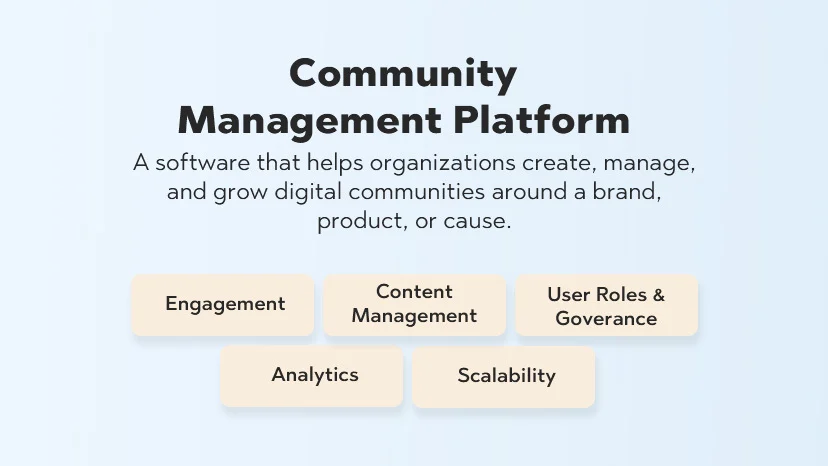
A community management platform is software that helps organizations create, manage, and grow digital communities around a brand, product, or cause. It is a central hub for communication, content, and member engagement.
Purpose and Growth Impact:
It enables real-time conversations, structured forums, and event management.
User Roles & Governance: Admin tools and permission settings.
Analytics: Member behavior and sentiment tracking.
Scalability: Support for growing member bases and subgroups.
Popular platforms include Discourse, Khoros, Open Social, Sprout Social, and others like Slack and Discord for informal setups.
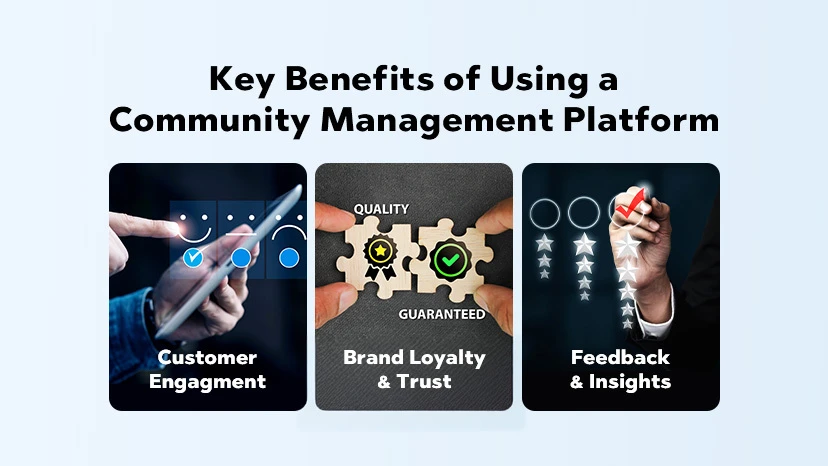
Key Benefits of Using a Community Management Platform
By choosing your community platform wisely, you can reap many benefits:
1. Customer Engagement
A fantastic platform will drive engagement. Polls, live events, Q&As, threaded discussions, and other tools keep your users engaged.
2. Brand Loyalty & Trust
Communities foster belonging. The more value members find, the more likely they will develop loyalty to your brand.
3. Feedback & Insights
Feedback loops allow you to continuously improve your products and services. Feedback from engaged users is very often more authentic and valuable than standard surveys.
4. Support & Knowledge Sharing
Peer-to-peer support lessens your burden on customer service. Knowledge bases and FAQs driven by community content become more efficient over time as a result of community use.
Find social rules that support these benefits all in one place.
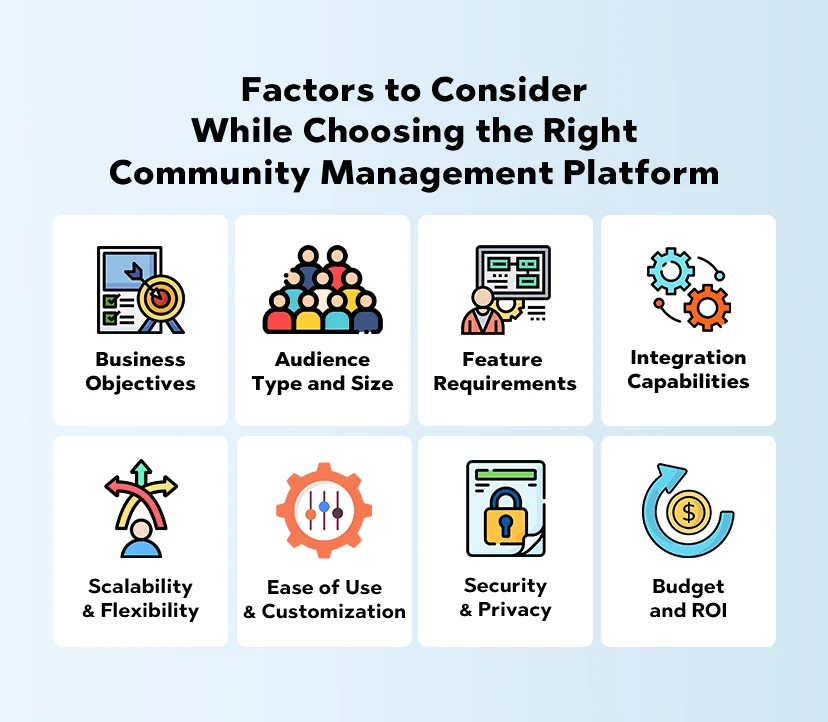
Factors to Consider While Choosing the Right Community Management Platform
Before you commit to any community platform, you need more than just a feature list—you need clarity. What’s your goal? Who’s your audience? Will it scale as you grow? The ideal platform should fulfill all requirements, from integration to security, while staying within your budget. Here’s a smart breakdown of what matters when choosing a community management platform.
1. Business Objectives
Are you aiming to improve support, increase engagement, or boost brand presence? Define your primary goal.
2. Audience Type and Size
Know your members: B2B or B2C, small niche or large public group? Different audiences require different features.
3. Feature Requirements
Do you need forums, gamification, analytics, or moderation tools? List must-haves versus nice-to-haves.
4. Integration Capabilities
Check how well the platform integrates with CRMs, marketing tools, and social media platforms.
5. Scalability & Flexibility
Will the platform grow with you? Look for modular structures, group controls, and performance under scale.
6. Ease of Use & Customization
An intuitive admin dashboard and customisable branding options are crucial.
7. Security & Privacy
Look for robust data protection, user permission controls, and compliance features.
8. Budget and ROI
Balance between free tools and premium platforms. Compare open source vs subscriptions.
How to Compare and Test Community Management Platforms Before Buying
1. Free Trials and Demos
Most platforms offer demos. Use these to understand the UI, features, and limitations.
2. Pilot Projects or Internal Testing
Test within your team or with a small group to identify usability challenges.
3. Team Feedback & Stakeholder Involvement
Include cross-functional stakeholders. Their perspectives can reveal overlooked needs.
Common Mistakes to Avoid When Choosing a Community Management Platform
1. Ignoring Future Scalability
What works for 100 users might not work for 10,000 users. Growth plan.
2. Overpaying for Unused Features
Avoid flashy platforms with bloated features. Stick to your essentials list.
3. Poor Integration with Existing System
If it doesn’t sync with your CRM, marketing tools, or analytics, you’ll create data silos.
Final Community Management Platform Checklist Before You Decide
Business Goals Alignment: Is the platform helping you achieve your core objectives?
Feature Checklist: Does it meet your technical and engagement needs?
Usability Test Results: Have admins and members found it intuitive?
Budget Match: Can you sustain this platform long-term?
Team Consensus: Is everyone on board?
Conclusion
Choosing the right community management platform isn’t about jumping on the trendiest option – it’s about aligning tech with your strategy. With the right choice, you’ll build a vibrant space that grows with your business, deepens connections, and fuels brand loyalty.
Healthy online communities foster belonging, support, and collaboration—elements that boost engagement, trust, and even user well-being. At the heart of this lies the moderator’s role: shaping community culture, ensuring respectful discourse, and steering conversations toward positivity. By enforcing fair rules and modeling constructive behavior, moderators act as custodians of connection and inclusivity. They make sure conversations stay healthy, discourage negativity like trolling or harassment, and encourage welcoming interactions. Clear community moderation best practices, powerful online community management tips, and unwavering commitment to building positive community norms create spaces where users feel valued, safe, and eager to take part. That foundation is what allows communities—and brands—to truly thrive.
Moderation protects users from harmful content—hate speech, explicit material, and misinformation—and cultivates a respectful environment.
2. Encourages Constructive Participation
By guiding discussions, moderators ensure conversations stay relevant and valuable—boosting engagement and reducing noise.
3. Prevents Toxic Behavior and Misinformation
Swiftly addressing trolling, spam, or false claims stops negativity from spreading and reinforces trust in the community and brand.
These community moderation best practices aren’t optional—they’re essential for fostering a trustworthy, engaging space where users want to stay and contribute.
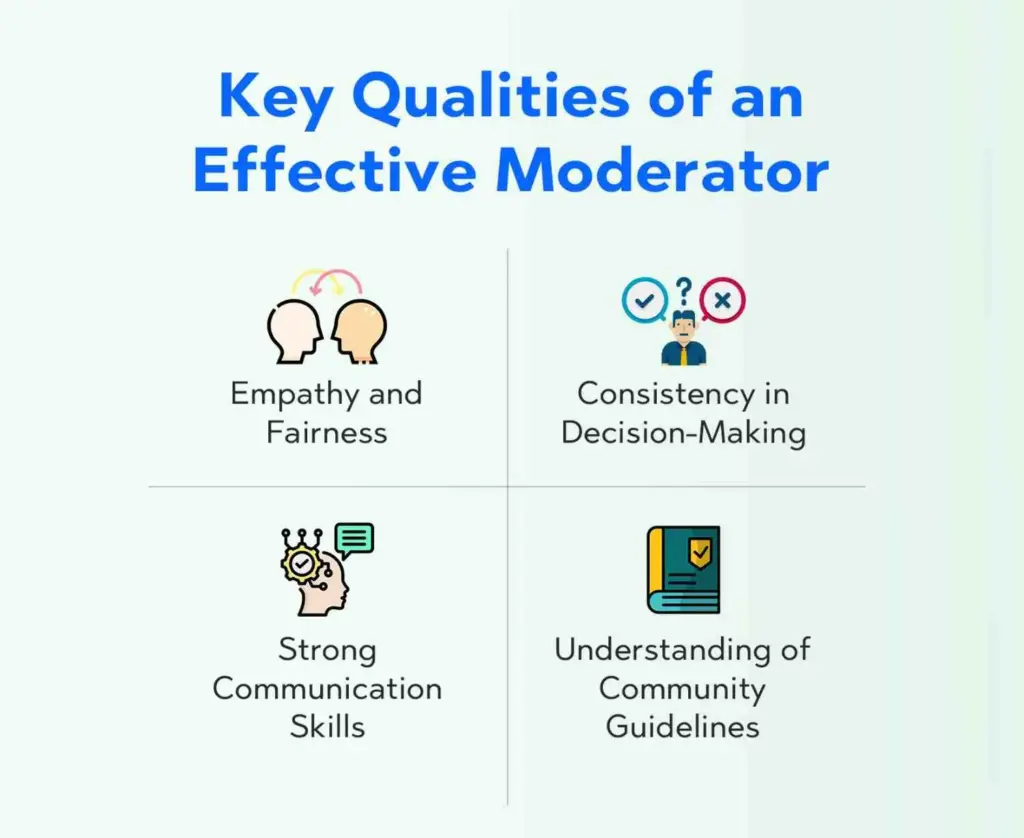
Key Qualities of an Effective Moderator
To deliver online community management tips, moderators should bring more than just patience. Here’s what every great moderator should embody:
1. Empathy and Fairness
Understanding different viewpoints helps moderators act with compassion and impartiality—earning members’ respect.
2. Consistency in Decision‑Making
Applying rules evenly and transparently builds trust. Consistent moderation prevents confusion and backlash.
3. Strong Communication Skills
Clear guidelines, polite warnings, and concise explanations reinforce boundaries without alienating members.
4. Understanding of Community Guidelines
Deep familiarity with the rules—why they exist and how to enforce them—empowers moderators to act confidently and correctly.
With these traits, moderators can apply community moderation best practices while pushing forward and building positive community objectives.
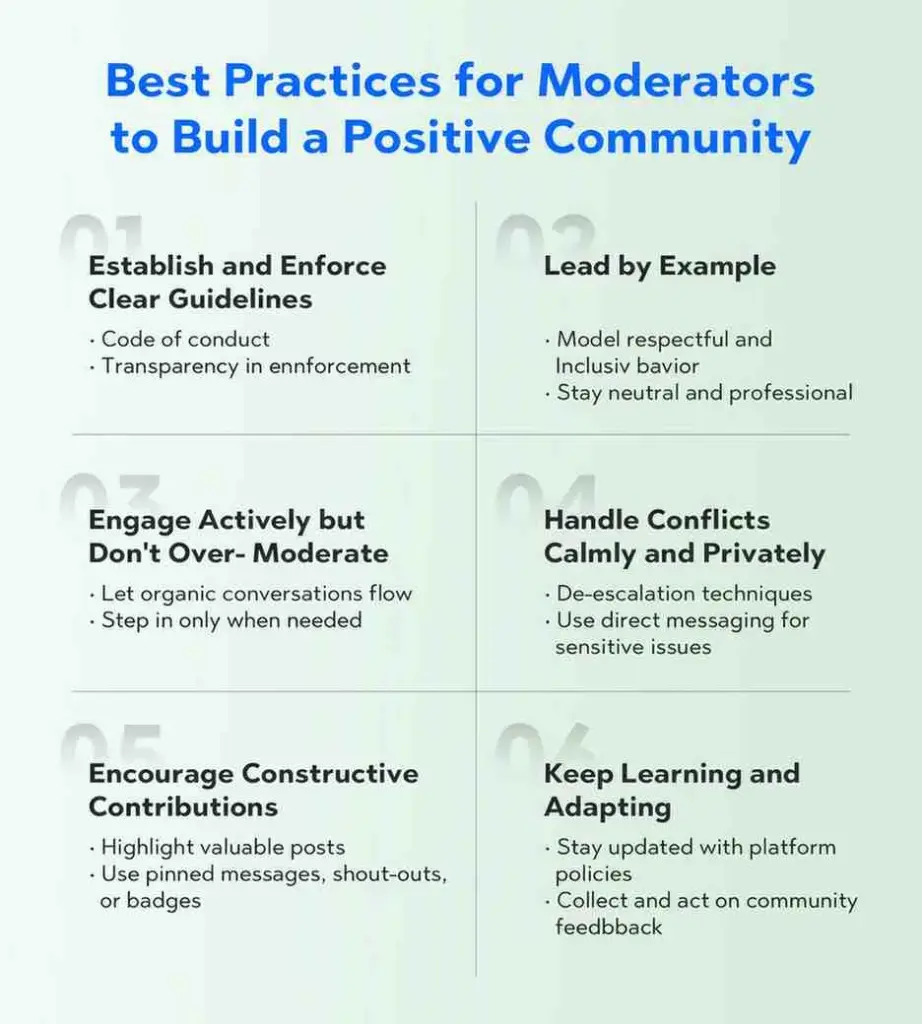
Best Practices for Moderators to Build a Positive Community
Here are the top community moderation best practices and online community management tips to help moderators foster positivity:
Transparency in enforcement: Explain why actions happen—public warnings or private messages—keeping trust intact.
2. Lead by Example
Use respectful, inclusive language—even when moderating.
Remain neutral in disputes, acting as an impartial guide rather than a judge.
3. Foster Inclusivity and Belonging
Encourage diverse voices: Invite different perspectives and experiences.
Address bias quickly: Step in against discrimination or microaggressions.
4. Engage Actively but Don’t Over‑Moderate
Let conversations flow—only intervene when necessary.
Identify hotspots early to reduce friction before it escalates.
5. Handle Conflicts Calmly and Privately
Use de-escalation: Take a neutral, empathetic tone to reduce tension.
Flag intense or personal issues to private channels, keeping them out of public view.
6. Encourage Constructive Contributions
Highlight thoughtful posts using pinned messages or badges.
Recognize members in newsletters or chat shout-outs to reinforce positive behavior.
7. Keep Learning and Adapting
Stay current—monitor updates to policies and best practices.
Solicit community feedback and tweak moderation methods based on real experiences.
Applying these community moderation best practices ensures your community stays respectful, welcoming, and aligned with your brand’s core values.
Tools and Techniques to Support Effective Moderation
Effective moderation hinges not just on people but also on tools. Leverage the following online community management tips and community moderation best practices:
1. Automated Moderation Tools
AI filters for spam, hate speech, or profanity.
Rule-based triggers that flag potential violations.
Real-time alerts for moderators to respond swiftly.
2. Reporting and Escalation Systems
User flagging to spotlight issues.
Escalation paths to senior moderators or admins.
Clear workflows ensure timely resolution.
3. Analytics to Track Engagement and Issues
Dashboards showing flagged posts, moderator response times, and conversation health
Metrics to identify toxicity trends or friction points.
Data-driven decisions improve transparency and moderation quality.
Pairing human moderation with smart tools makes your approach scalable, fair, and reliable.
Common Challenges Moderators Face and How to Overcome Them
Even seasoned moderators face hurdles. Here are typical issues and how to address them using community moderation best practices:
1. Trolls and Spam
Challenge: Low-effort or disruptive posts clutter conversations
Solution: Use automated spam filters and fast-response moderation routines.
2. Biased or Emotional Responses
Challenge: Emotional bias may skew moderation.
Solution: Train moderators to use emotion‑check protocols and get peer reviews on tough decisions.
3. Burnout and Mental Fatigue
Challenge: Constant exposure to negativity impacts mental health.
Solution: Rotate shifts, offer peer support, monitor stress levels, and provide mental health resources.
By incorporating online community management tips to support moderator well-being, you preserve both community health and moderator morale.
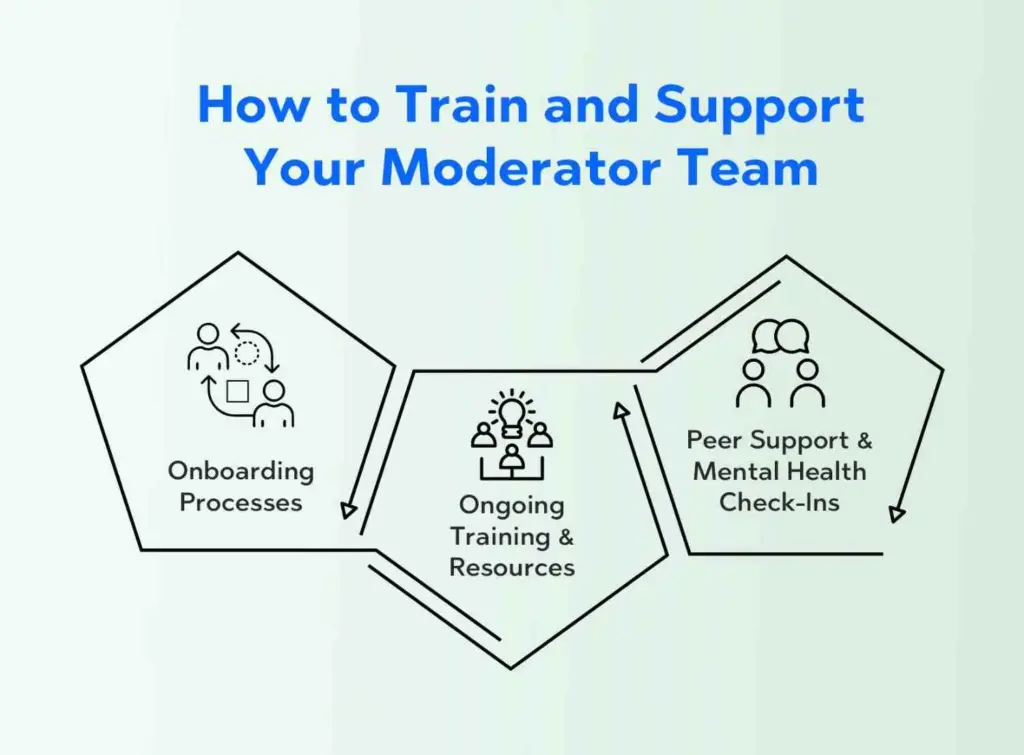
How to Train and Support Your Moderator Team
A strong moderation team must be well-prepared, supported, and continuously growing. Here’s how to make that happen:
1. Onboarding Processes
● Provide clear orientation on rules, tools, and escalation paths. ● Pair new moderators with experienced mentors for hands-on support.
2. Ongoing Training & Resources
● Conduct regular workshops, policy updates, and tool training. ● Maintain a shared knowledge base with guidelines and best practices.
3. Peer Support & Mental Health Check‑ins
● Schedule routine wellness discussions and feedback sessions. ● Encourage open dialogue about challenges and coping strategies.
With proactive training and support, moderators become confident, resilient ambassadors of building positive community values.
Conclusion
Moderators are the guardians who turn online spaces into thriving, inclusive communities. By mastering community moderation best practices and deploying effective online community management tips, they safeguard positivity, foster connection, and uphold brand integrity. Their success lies in empathy, consistency, and ongoing growth. A well-moderated space invites engagement and trust—and that’s what makes a truly building positive community shine.
In today’s digital-first world, an online community in a business context is more than just a forum-it’s a vibrant space where customers, fans, and brand advocates gather around shared interests, products, or services. These branded ecosystems, powered by technology, enable companies to engage directly with their audience, solicit feedback, and cultivate long-term relationships. But without clear measures, you can’t gauge whether your community is delivering real value-be it ROI, engagement spikes, or steady growth. In this blog, we’ll dive into the key metrics and methods you need-from community engagement strategies to loyalty-building tactics-to accurately track your online community’s health and impact.
Why Measuring Community Success Matters
Tracking the success of your online community isn’t just about numbers. It’s about understanding what’s working, what’s not, and where you should steer your focus next. When you measure effectively:
You evaluate the health and effectiveness of your online space.
You gather insights to support content planning and strategic decisions.
You justify community investments to stakeholders with solid data.
Set Online Community Clear Goals Before You Measure
Before diving into metrics, ask yourself, What does success look like for my community?
Engagement: Are members actively posting, commenting, and interacting?
Customer Support: Is your community reducing the load on your customer service team?
Brand Advocacy: Are members promoting your brand organically?
Next, align these goals with your business objectives:
Lead Generation: Use community interactions to feed your sales funnel.
Loyalty and Retention: Harness community loyalty building to increase customer loyalty.
Support Deflection: Save time and cost by answering customer questions within the community.
Clear goals lay the foundation for relevant community engagement strategies and better ROI.
Online Community Key Metrics to Track
a. Engagement Metrics
These reveal how vibrant and interactive your community is:
Active Members: How many unique users engage weekly or monthly?
Post Frequency and Comments: Is content being created and responded to regularly?
Likes, shares, and reactions: quick but meaningful indicators of interest.
Event Participation: Who’s showing up to webinars, AMAs, or live chats?
b. Growth Metrics
Monitor how well your community is scaling:
New Member Sign-ups: Track weekly or monthly additions.
Retention Rate: Are members sticking around or dropping off?
Invite and Referral Stats: A healthy community grows organically through advocacy.
c. Sentiment & Satisfaction
It’s not just about quantity-it’s about quality:
Surveys and Feedback: Regular pulse checks help understand satisfaction.
Net Promoter Score (NPS): A proven way to measure loyalty.
Conversation Quality: Monitor the depth and tone of discussions.
d. Conversion & Business Impact
Community isn’t fluff-it’s a business driver:
Leads and Sales: Track conversions directly from community activity.
Support Ticket Reduction: A thriving community should lighten support loads.
User-Generated Content: Look for testimonials, case studies, or customer-driven answers.
Strategy 3: Gamify the Engagement Experience
Gamification injects fun and motivation into your community engagement strategies.
Points, Badges, and Rewards: Give recognition for posts, replies, and contributions.
Loyalty Programs: Reward active members with perks-discounts, early access, or exclusives.
Referrals and Reviews: Motivate users to share and invite peers with tangible rewards.
These tactics do more than entertain-they deeply increase customer loyalty and turn users into ambassadors.
Tools and Platforms to Measure Community Performance
The right tools make measuring easier and more insightful.
1. Built-in Analytics
Facebook Groups, Discord, and Slack offer native insights like post reach and member activity.
2. Third-party Tools
Google Analytics: Track traffic, session duration, and bounce rates.
Orbit, Common Room: Tailored tools for community health and member lifecycle tracking.
Sprout Social: Ideal for social engagement, sentiment, and reach.
3. CRM & Marketing Automation
HubSpot: Integrate community insights into broader marketing and sales analytics.
Whether you’re using native dashboards or full-suite CRMs, these tools enable smarter decisions and showcase ROI to your team.
Tips for Ongoing Community Evaluation
Think of evaluation as a routine, not a one-off event.
Monthly/Quarterly Reviews: Set a regular cadence to assess progress.
Dashboards: Visual tools help you spot trends at a glance.
Member Feedback: Involve your community by polling them, asking open-ended questions, and acting on their responses.
Likes and followers may look good, but they don’t guarantee meaningful engagement or business results.
2. Ignoring Qualitative Insights
Don’t skip reading the room-track the tone and context of member conversations.
3. Not Linking Metrics to Business Goals
Metrics are only useful if they drive business impact. Make sure your numbers connect to outcomes like customer retention, revenue, or satisfaction.
4. Skipping Feedback Loops
Listening without acting is worse than not listening at all. Show members their voices matter.
5. Neglecting Accessibility and Mobile Users
A huge chunk of users browse communities via mobile. Make the experience seamless across devices.
6. Trying to Do Too Much Too Soon
Focus on foundational wins, first-community engagement strategies that work. Scale features later.
Conclusion
Measuring your online community’s success is essential-not optional. It helps you understand what’s working, what needs fine-tuning, and where to invest your time and budget. But more than that, it shows your members you care.
Let data guide, but let people stay at the center. When you focus on building genuine relationships through proven community engagement strategies, you’ll not only increase customer loyalty, but you’ll also create advocates who stick around and spread the word.
In the digital world, accessibility and inclusion are more than technical checkboxes-they’re the foundation of vibrant, sustainable communities. Online community accessibility means designing spaces that everyone can use, including individuals with visual, auditory, cognitive, or physical disabilities. Meanwhile, inclusion ensures that all voices are welcomed, respected, and empowered to participate. Together, these principles build platforms that aren’t just functional but deeply human. Communities that prioritize these values see higher engagement, broader reach, and stronger loyalty. In this blog, we’ll explore what these terms mean, why they matter, and how to embed them into your platform design, community engagement strategies, and everyday culture.
Why Accessibility and Inclusion Matter in Online Communities
1. Promotes Equal Participation:
Everyone, regardless of ability or background, deserves a seat at the digital table.
2. Builds Trust and Culture:
Inclusive community platforms feel safer, warmer, and more trustworthy.
3. Boosts Brand Reputation:
Accessible platforms are not only good, they’re good business.
4. Meets Legal/Ethical Standards:
From WCAG to ADA, accessible design is both a legal mandate and a moral imperative. A platform that embraces accessibility in community building isn’t just inclusive-it’s forward-thinking.
Understanding Accessibility in Community Platforms
1. What is Accessibility?
Accessibility ensures your community platform is usable for all, including those with:
Visual impairments (blindness, color blindness, low vision)
Auditory impairments (deafness, hard of hearing)
Mobility limitations (difficulty using a mouse or keyboard)
Cognitive challenges (dyslexia, ADHD, etc.)
2. Common Barriers
Tiny fonts or poor contrast
Missing alt text on images
Complex navigation
Media without captions
3. Tips for Better Accessibility
Use Alt Text: Every image should include descriptive tags.
Prioritize Contrast: Make text legible on all backgrounds.
Add Captions and Transcripts: Videos must include alternatives for the hearing impaired.
Keyboard-Friendly Navigation: Ensure users can move through your site without a mouse.
Creating inclusive experiences from the ground up is essential to meaningful online community accessibility.
Understanding Inclusion in Online Communities
1. What is inclusion?
Inclusion is about more than access-it’s about belonging. It ensures all members feel:
Valued
Heard
Represented
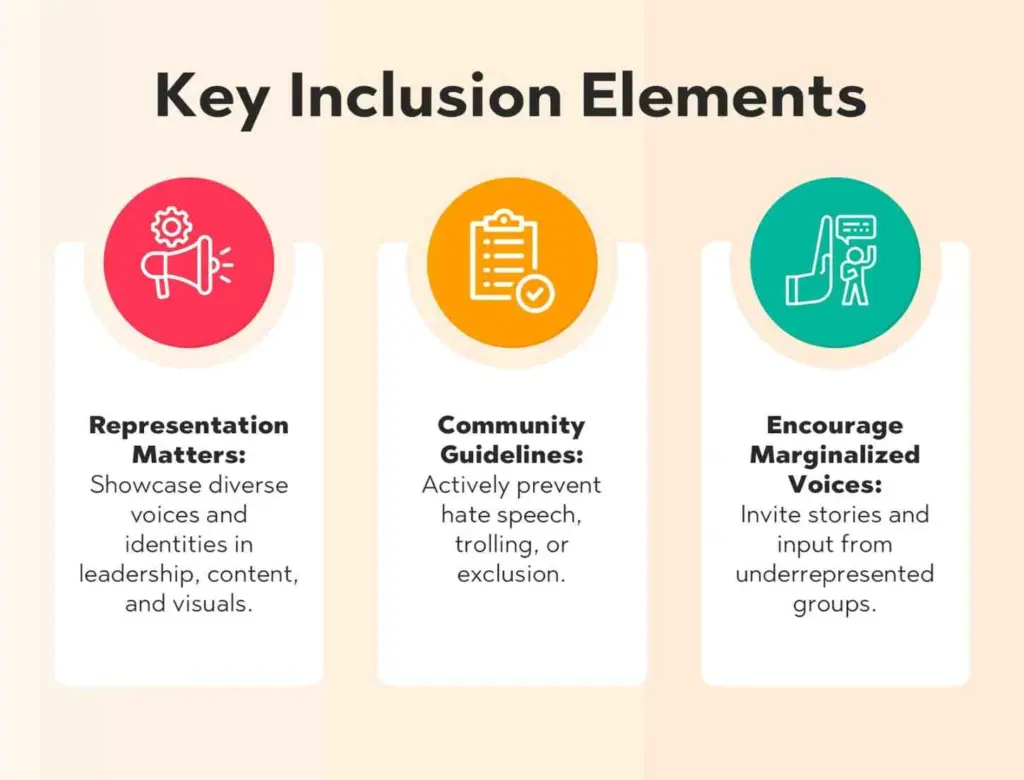
2. Key Inclusion Elements
Representation Matters: Showcase diverse voices and identities in leadership, content, and visuals.
Community Guidelines: Actively prevent hate speech, trolling, or exclusion.
Encourage Marginalized Voices: Invite stories and input from underrepresented groups.
In short, inclusive community platforms intentionally center diversity, not just as a feature, but as a culture.
Practical Strategies to Build a Welcoming Online Space
a. Use Inclusive Language
Ditch the jargon, stereotypes, and assumptions.
Adopt gender-neutral and culturally sensitive language.
b. Design for All Devices and Abilities
Optimize for mobile—it’s not optional anymore.
Test with screen readers, voice assistants, and magnifiers.
c. Moderate Respectfully
Clear rules keep discussions safe.
Train moderators to spot and address harmful behavior.
d. Create Safe Spaces for Dialogue
Subgroups for shared interests build micro-communities.
Anonymous options empower those afraid to speak out.
e. Invite Feedback and Improve Constantly
Run regular surveys and listen.
Publicly show how feedback shapes your platform.
These strategies lay the groundwork for real accessibility in community building.
Tools and Platforms to Measure Community Performance
1. Key Tools for Accessibility
WAVE & Axe: Identify common website accessibility issues.
Google Lighthouse: Performance and accessibility audit.
Grammarly: Offers inclusive writing suggestions.
2. Guidelines
WCAG (Web Content Accessibility Guidelines): The gold standard.
Building accessible and inclusive community platforms isn’t just about doing the right thing—it’s about building something that lasts. When everyone can participate and feel like they belong, your platform becomes magnetic. You not onlyenhance community engagement strategies but also increase customer loyalty and trust.
Start small if you need to, but start. Because every improvement makes your space more welcoming for someone new.
FAQs
What is the difference between accessibility and inclusion in online communities?
Accessibility is about technical usability; inclusion is about emotional and cultural belonging.
Why is accessibility important for online platforms?
It ensures everyone, including people with disabilities, can participate and benefit from your community.
How can I make my community platform more accessible?
Use tools like WAVE, provide alt text, and ensure keyboard and screen reader compatibility.
What are some examples of inclusive practices in online communities?
Diverse leadership, safe space policies, inclusive language, and anti-bias moderation.
How does inclusive language impact community engagement?
It makes members feel safe and valued and more likely to participate.
Which tools can help check my platform’s accessibility?
WAVE, Axe, Google Lighthouse, and Microsoft’s Accessibility Checker.
Can small businesses implement accessibility and inclusion easily?
Yes! Start with small steps—like captions or alt text-and grow over time
What are common accessibility barriers in online communities?
Tiny text, poor contrast, no captions, inaccessible forms, and mouse-only navigation.
How do I handle discrimination or exclusion within my community?
Have clear rules, act swiftly, and foster open dialogue with those affected.
How often should I review my community for accessibility and inclusion updates?
At least quarterly. Regular audits ensure you’re evolving with your audience’s needs.
In today’s digital economy, community engagement has evolved into a cornerstone of brand loyalty. In a business context, it refers to the consistent, value-driven interaction between a company and its customers in meaningful online spaces. Why does it matter? Because consumers today aren’t just buying products-they’re investing in relationships, shared values, and experiences. A strong community deepens that bond, turning passive customers into active advocates. With platforms like Thrico, brands can power up their community engagement strategies, foster rich conversations, and build the kind of community loyalty that fuels long-term growth. In this blog, we’ll walk through five proven strategies that drive both engagement and retention.
Why Community Engagement Matters for Customer Loyalty
Emotional bonds make customers stick around.
Engaged communities are fertile ground for brand advocacy.
Retention is cheaper than acquisition and more profitable.
86% of loyal customers will recommend a brand to friends (source: Zendesk).
If you want to increase customer loyalty, build a community they want to be part of.
Strategy 1: Create Exclusive Online Communities
The heart of any engagement plan? A private digital hub where your audience feels seen, heard, and valued.
Platforms: Thrico, Facebook Groups, WhatsApp, Discord, and Slack.
What to Offer: Early product access, exclusive content, and behind-the-scenes updates.
How to Engage: Spark two-way conversations, not one-way announcements.
Real-Life Example: Brands like Glossier and Peloton have built cult-like followings through private groups where users share experiences and amplify each other’s voices.
Using Thrico, businesses can launch such groups effortlessly, tailor user journeys, and build engagement into every touchpoint.
Gamification isn’t fluff-it’s neuroscience. And when embedded into community loyalty building, it creates a sticky user experience. Thrico allows seamless integration of these gamified layers to ensure your members keep coming back.
Strategy 4: Feature Your Community Members
Shine the spotlight on your people-they’ll never forget it.
Tactics:
Highlight user-generated content (photos, reviews, and stories).
Run challenges where users get featured in your newsletter or social channels.
Share testimonials with rich visuals and personal anecdotes.
Benefits:
Builds identity and pride.
Converts passive followers into vocal promoters.
Signals that your brand genuinely values its community.
Use Thrico’s in-built user analytics and content features to identify and spotlight your most active or creative contributors.
Strategy 5: Consistent & Personalized Communication
Talk with your audience, not at them.
Tools to Leverage:
Personalized newsletters tailored to user behavior.
DMs and welcome email sequences for new members.
Interest-based content segmentation.
Why It Works: People engage more when the message feels like it was crafted just for them.
Example: Send “Happy Anniversary” messages on customer join dates, or customised tips based on past activity.
With Thrico’s automation and segmentation capabilities, brands can craft meaningful, humanised outreach that resonates and scales.
Conclusion
Let’s recap the five key community engagement strategies:
Create exclusive online communities to build belonging.
Host interactive events that inspire and inform.
Gamify engagement to make participation rewarding.
Feature community members to foster pride and identity.
Communicate personally and consistently to deepen relationships.
When you implement even one of these tactics with intention and heart, you start to increase customer loyalty in powerful, lasting ways. Whether you’re a startup or an established brand, platforms like Thrico make this easy, scalable, and authentic.
Engaged communities are the lifeblood of any organization. They promote collaboration, build trust, and empower people to participate in meaningful decisions. When you harness community engagement analytics through Thrico’s intelligent tools, you gain clarity on what drives activity and what causes members to fall silent. This blog explores the essential tools, strategies, and community performance metrics that help you track user behavior, measure impact, and adapt your approach to cultivate a vibrant, sustainable community.
What is Community Engagement Analytics?
Community engagement analytics involves collecting, analyzing, and interpreting data about how people interact within a community. This goes beyond just tracking visits. It focuses on understanding member interactions, identifying key influencers, and evaluating the success of community efforts.
Unlike general website analytics, which focuses on visits, bounce rates, and session lengths, community engagement analytics measures the quality and depth of participation. It considers how often users post, comment, join events, or react to content.
Platforms such as forums, social media groups, membership portals, or event communities can be integrated with Thrico to provide these insights. Each platform provides unique data points that contribute to a full picture of community health.
Why Analytics Matter for Community Growth
Analytics are essential for scaling and sustaining a thriving community. Here’s why:
1. Understanding Member Behavior and Preferences
Thrico’s dashboard helps reveal which topics, formats, and discussions attract attention. When you understand what members care about, you can personalize content and experiences that foster deeper engagement.
2. Optimizing Content, Events, and Interactions
You can track how content performs, identify which events are most popular, and see how members interact. This information allows you to fine-tune your community strategy to boost participation.
3. Data-Driven Decisions Improve Engagement and Retention
By making informed decisions based on data, you increase member satisfaction. Early detection of engagement drops or churn helps you take action quickly, such as re-engaging members or refining content delivery.
Using data this way creates a feedback loop that strengthens your community over time.
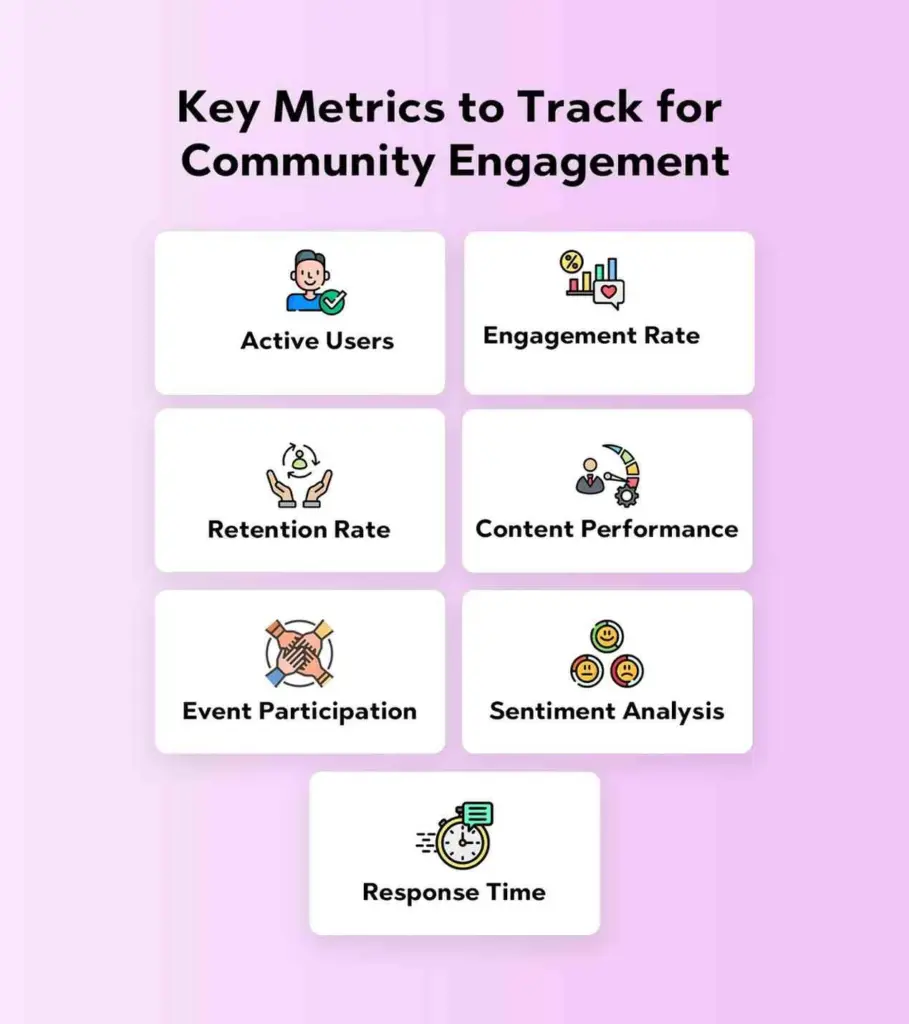
Key Metrics to Track for Community Engagement
To effectively measure community engagement, focus on the following metrics:
1. Active Users
Track daily, weekly, and monthly active users to understand participation trends. Thrico helps you monitor how many new members join to gauge growth.
2. Engagement Rate
Measure how members interact with posts, comments, likes, shares, and other activities. Also, consider the amount of user-generated content and average session duration.
3. Retention Rate
Evaluate how many members return regularly. Track churn and growth rates to identify potential issues or successes.
4. Content Performance
Determine which types of posts generate the most responses. Measure downloads, video views, and link clicks to understand what content resonates most.
5. Event Participation
Compare RSVPs to actual attendance. Use these numbers to refine event planning and communication.
6. Sentiment Analysis
Assess member sentiment by tracking reactions and comments. Use tools like Net Promoter Score or customer satisfaction surveys to gain quantitative insight.
7. Response Time
Track how quickly community managers or moderators respond to inquiries. Prompt responses enhance trust and maintain momentum.
These community performance metrics offer a comprehensive view of how engaged and satisfied your members are. Thrico simplifies the tracking process by consolidating key insights into one unified platform.
Tools to Track Community Analytics
A variety of tools help track and understand community engagement:
1. Thrico
Thrico brings together multiple analytics capabilities into a single, intuitive platform purpose-built for community engagement. It streamlines the process of tracking all your performance metrics while offering deep insights into what makes your community tick.
2. Google Analytics
Use it to monitor traffic, user behavior, and conversion paths on your community website.
3. Facebook and LinkedIn Group Insights
Gain information about group growth, post performance, and member demographics.
4. Specialized Tools: Bevy, Hivebrite, Common Room
These platforms offer in-depth dashboards for tracking member engagement, content impact, and event participation.
5. CRM and Behavior Analytics:
HubSpot, Mixpanel Track member journeys, onboarding, and feature usage to understand how people interact with your platform.
6. Social Media Tools: Sprout Social, Hootsuite
Manage and analyze engagement across multiple social channels.
7. Forum and Chat Platforms: Discourse, Slack, Discord Analytics
Use built-in tools to track participation, activity levels, and user sentiment.
8. Other Options
Mailchimp helps track email campaign effectiveness. Brandwatch and Keyhole analyze sentiment and track social mentions and hashtags.
When choosing tools, consider platform compatibility, detail of insights, integration options, and your available budget and resources.
How to Use Analytics Insights to Improve Engagement
Here are ways to turn analytics into action:
1. Identify and repeat successful content. Thrico’s content analysis tools highlight top-performing posts so you can build on them.
2. Re-engage inactive members through personalized email campaigns or special invitations.
3. Segment your audience and tailor content for different user groups
4. Adjust your posting schedule based on when your audience is most active.
5. Test variations of announcements or newsletters through A/B testing to see which gets better results.
Set clear goals, use Thrico’s analytics tools to gather data, and segment your audience to deliver personalized experiences. Then analyze, test, and refine your approach continuously.
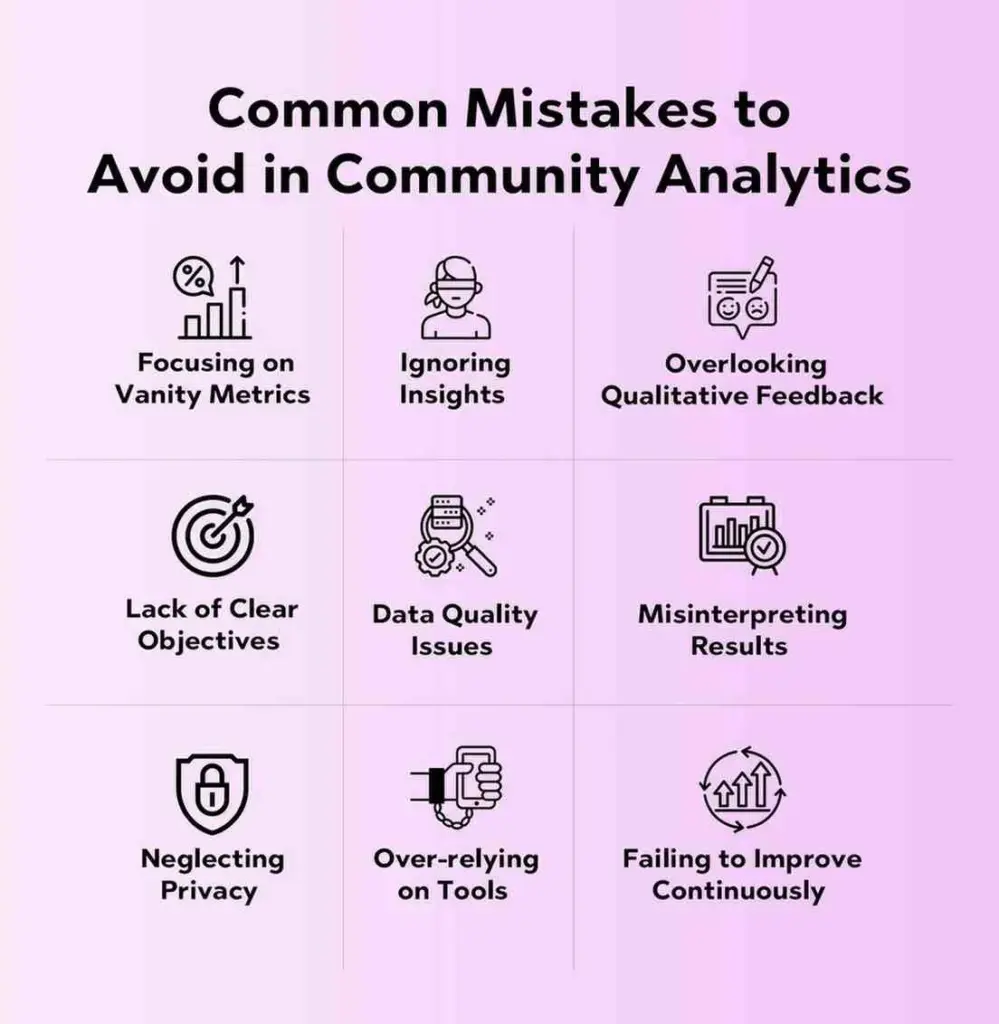
Common Mistakes to Avoid in Community Analytics
Avoid these common pitfalls:
1. Focusing on Vanity Metrics
Likes and views are not enough. Focus on metrics that reflect meaningful engagement and behavior changes.
2. Ignoring Insights
Data without action has no value. Use insights to adjust your strategy.
3. Overlooking Qualitative Feedback
Member comments and reviews offer valuable context. Combine them with quantitative data.
4. Overcomplicating Dashboards
Too many metrics can dilute focus. Prioritize the ones that align with your goals.
5. Lack of Clear Objectives
Without defined goals, data lacks direction. Establish what success looks like first.
6. Data Quality Issues
Ensure data is accurate and up to date. Poor data leads to flawed conclusions.
7. Misinterpreting Results
Understand the difference between correlation and causation. Avoid jumping to conclusions without proper analysis.
8. Neglecting Privacy
Respect member data and stay compliant with privacy laws like GDPR.
9. Over-relying on Tools
Use human judgment along with automated tools. Combine both to get a complete picture.
10. Failing to Improve Continuously
Analytics is not a one-time activity. Keep reviewing, refining, and evolving your strategy.
Future Trends in Community Analytics
Community analytics continues to evolve with technology. Here are some future trends:
1. Predictive Analytics and AI
AI can forecast member behaviour, identify potential churn, and recommend content automatically. These insights will help managers act before problems arise.
2. Sentiment Analysis and Natural Language Processing (NLP)
Advanced NLP tools can detect emotional tone in comments and posts, helping you assess community mood in real time.
3. Privacy-Aware Tracking
With increased focus on privacy, communities must rely more on first-party data and ensure all tracking methods are transparent and ethical.
4. Real-Time and Augmented Analytics
Expect more real-time dashboards with AI-powered recommendations. These tools will make it easier to adapt quickly and improve engagement on the fly.
5. Data Democratization
More platforms are making analytics accessible to non-technical users. This shift helps more team members contribute to strategy and improvement.
Conclusion
Analytics are a powerful tool for building strong communities. They help you understand member behavior, refine your content, and improve satisfaction. Start small by tracking a few key metrics and gradually expand your approach. Over time, a data-informed strategy will help your community thrive.