
Why Owning Your Community Data Matters More Than Ever
Social media is a powerful way for brands to reach new audiences, start conversations, and build awareness. But relying entirely on social platforms can leave organizations with limited control over their audience relationships. Algorithms change, organic reach fluctuates, platform policies evolve, and access to audience insights can be restricted.
That is why more organizations are investing in branded communities and first-party community data.
Owning your community data is not about having unlimited access to members’ personal information. It is about creating a direct, trusted environment where organizations can responsibly collect relevant insights, understand member needs, and use those insights to improve the community experience.
What Does “Owning Your Community Data” Actually Mean?
Community data includes the information and insights generated through legitimate interactions within a community. This can include member profiles, interests, discussions, comments, content interactions, event participation, poll responses, surveys, feedback, engagement patterns, and contribution history.
However, data ownership comes with responsibility. Member consent, privacy, data minimization, security, and applicable regulations must remain central to any community data strategy.
For organizations, the real value lies in turning these first-party insights into meaningful decisions. Community engagement analytics can help teams understand how members interact, what they value, and where engagement opportunities exist.
Owned Community vs. Rented Audience
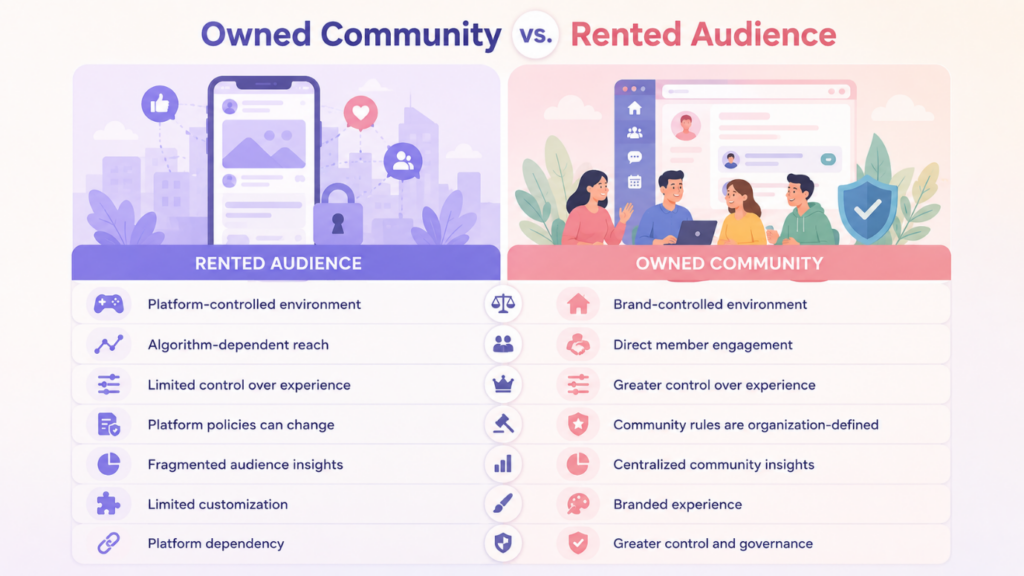
The difference between a social media audience and an owned community can be thought of as the difference between renting and building.
| Rented Audience | Owned Community |
| Platform-controlled environment | Brand-controlled environment |
| Algorithm-dependent reach | Direct member engagement |
| Limited control over experience | Greater control over experience |
| Platform policies can change | Community rules are organization-defined |
| Fragmented audience insights | Centralized community insights |
| Limited customization | Branded experience |
| Platform dependency | Greater control and governance |
“Owned” does not mean unrestricted ownership of personal data. Instead, it means having greater control over the community environment, member relationship, and legitimately collected first-party insights.
A branded community platform can give organizations greater control over branding, member experience, content, and community governance.
Why Does Community Data Matter More Than Ever?
1. Reduce Dependence on Third-Party Platforms
Social platforms can be excellent discovery channels, but organizations do not control their algorithms, policies, or product roadmaps. A branded community creates an environment where organizations have more influence over how members interact and how engagement is managed.
2. Build Stronger First-Party Relationships
A dedicated community provides a direct space for members to interact with a brand and with one another. Over time, these repeated interactions create valuable first-party insights that can strengthen relationships beyond individual transactions.
3. Understand What Members Actually Need
Community conversations can reveal common questions, pain points, feature requests, content preferences, and emerging interests. Instead of relying solely on assumptions or occasional surveys, organizations can learn from ongoing member interactions.
4. Create More Relevant Experiences
Responsible use of community insights can help organizations improve content, events, discussions, resources, notifications, and member journeys.
What Are the Business Benefits of Owning Community Data?
The value of community data becomes clearer when it is connected to business outcomes.
Better retention: Declining engagement can help identify members who may need better onboarding, relevant content, or additional support.
Better relationships: Communities create opportunities for ongoing conversations instead of limiting interactions to individual purchases or support requests.
Better product feedback: Discussions, polls, and surveys can reveal what customers want and where products or services could improve.
More relevant content: Engagement data can show which subjects and formats members find useful.
Stronger advocacy: Highly engaged contributors can become valuable advocates, mentors, or community champions.
Better ROI measurement: Community activity can be connected to participation, retention, referrals, customer success, and product adoption.
This is especially important for customer success communities, where ongoing engagement can contribute directly to customer relationships and long-term success.
What Types of Community Data Should Organizations Track?
Organizations should focus on data that supports clear community objectives.
Member data: Profile information, membership status, interests, and community roles.
Engagement data: Posts, comments, reactions, discussions, and content interactions.
Event data: Registrations, attendance, participation, and post-event engagement.
Feedback data: Poll responses, surveys, suggestions, and product feedback.
Community health data: Active members, retention, inactivity, engagement trends, and contributor growth.
Tools such as community engagement features can help organizations turn discussions, feedback, and polls into useful community signals.
How Community Data Creates a Feedback Loop
Community data becomes most valuable when it creates a continuous improvement cycle:
Member Activity → Data & Insights → Better Experience → Higher Engagement → More Member Activity
The objective is not simply to collect more information. The objective is to transform legitimate community signals into better decisions and better experiences for members.
Organizations can identify high-value topics, recognize at-risk members, find community champions, improve events, develop more useful content, and close the feedback loop by showing members how their input influences improvements.
Why a Branded Community Gives Organizations More Control
A branded community can provide greater control over brand identity, member experience, moderation, content organization, engagement, analytics, member journeys, customization, and data governance.
This is where a white-label community platform for enterprises can become valuable. Rather than building community engagement entirely around a third-party social network, organizations can create a dedicated environment aligned with their brand and governance requirements.
Community Data and Privacy: Ownership Comes With Responsibility
Greater control over community data also means greater responsibility.
Organizations should establish clear consent practices, transparent privacy policies, secure storage, access controls, appropriate retention periods, deletion processes, and responsible analytics. They should also comply with privacy regulations that apply to their members and operations.
Community data ownership should never be presented as unlimited access to members’ personal information. The goal should be responsible collection, transparent use, and secure management of relevant first-party data.
Common Community Data Mistakes to Avoid
Several mistakes can reduce the value of a community data strategy:
- Collecting data without a clear purpose
- Focusing only on vanity metrics such as member count
- Ignoring qualitative feedback
- Keeping important insights in disconnected systems
- Failing to act on member feedback
- Over-personalizing experiences
- Ignoring privacy and consent
- Measuring community size instead of community health
A large community is not necessarily a healthy community. Meaningful participation, contribution, retention, and member satisfaction are often better indicators of community success.
How to Build a Community Data Strategy
A practical approach can be built around seven steps:
Step 1: Define the objective. Determine what the community should achieve.
Step 2: Identify the data you need. Collect information because it serves a purpose, not simply because it is available.
Step 3: Establish privacy practices. Clearly define how data will be collected, stored, accessed, and used.
Step 4: Choose the right platform. Look for analytics, member management, engagement tools, integrations, security, scalability, and data controls.
Step 5: Track meaningful metrics. Focus on engagement, retention, contribution, and outcomes.
Step 6: Turn insights into action. Use findings to improve onboarding, content, events, and member experiences.
Step 7: Continuously improve. Community data should feed an ongoing cycle of measurement, learning, and optimization.
Key Community Data Metrics to Track
| Metric | What It Measures |
| Active Members | Community health |
| Activation Rate | New-member onboarding |
| Engagement Rate | Member participation |
| Posts & Comments | Contribution |
| Event Participation | Event effectiveness |
| Retention Rate | Long-term engagement |
| Inactivity Rate | Engagement risk |
| Content Performance | Member interests |
| Response Time | Community support |
| Sentiment | Member experience |
Organizations can also explore how to measure community success by connecting these metrics to broader objectives.
Owned Community Data vs. Social Media Data
Social media audiences are largely mediated by the platform, while an owned community provides a more direct environment for member relationships. Social platforms also impose branding, experience, analytics, and governance constraints, whereas a branded community can provide significantly more flexibility.
The goal is not necessarily to replace social media. Social platforms can remain valuable for discovery and awareness while an owned community becomes the deeper environment for engagement, relationships, and first-party insights
Conclusion
The future of community building is not simply about collecting more members. It is about developing direct, trusted relationships and using responsible first-party insights to create better experiences.
The strongest community data strategy follows a simple progression:
Owned Community → First-Party Insights → Better Understanding → Better Experiences → Stronger Engagement → Long-Term Growth
Organizations that treat community data as a responsibility as well as an asset can build communities that are not only more measurable, but also more useful, trusted, and valuable for their members.
FAQs About Owning Community Data
It means having greater control over the community environment and responsibly collected first-party insights rather than depending entirely on a third-party platform.
It helps organizations understand member needs through direct interactions and use those insights to improve engagement, content, products, and experiences.
No. Organizations must respect consent, privacy rights, applicable regulations, and appropriate data-use principles.
It can reveal what members care about, where they encounter friction, which content they value, and when engagement begins to decline.
Yes. Engagement patterns, feedback, and participation trends can help organizations identify opportunities to strengthen relationships and support members.
Important metrics can include activation, engagement, contribution, event participation, retention, inactivity, content performance, response time, and sentiment.