What is a Branded Community Platform and Why Your Business Needs One
Building meaningful relationships with customers has become more important than simply acquiring new ones. Businesses today are increasingly investing in branded community platforms to create spaces where customers, partners, employees, and members can connect, collaborate, and grow together.
Unlike social media groups, a branded community platform gives businesses complete ownership over their audience, content, and data. It provides a dedicated digital space that reflects your brand identity while encouraging engagement, knowledge sharing, and long-term loyalty.
In this guide, you’ll learn what a branded community platform is, how it works, its essential features, business benefits, common use cases, and how to choose the right platform for your organization.
Branded Community Platform at a Glance
| Feature | Details |
| Best For | SaaS, E-commerce, Education, Enterprises, Creators |
| Primary Purpose | Build and own an online community |
| Community Type | Public, Private, Paid |
| Popular Features | Forums, Events, Courses, Chat, Analytics |
| Benefits | Customer Engagement, Retention, Loyalty |
What is a Branded Community Platform?
Definition
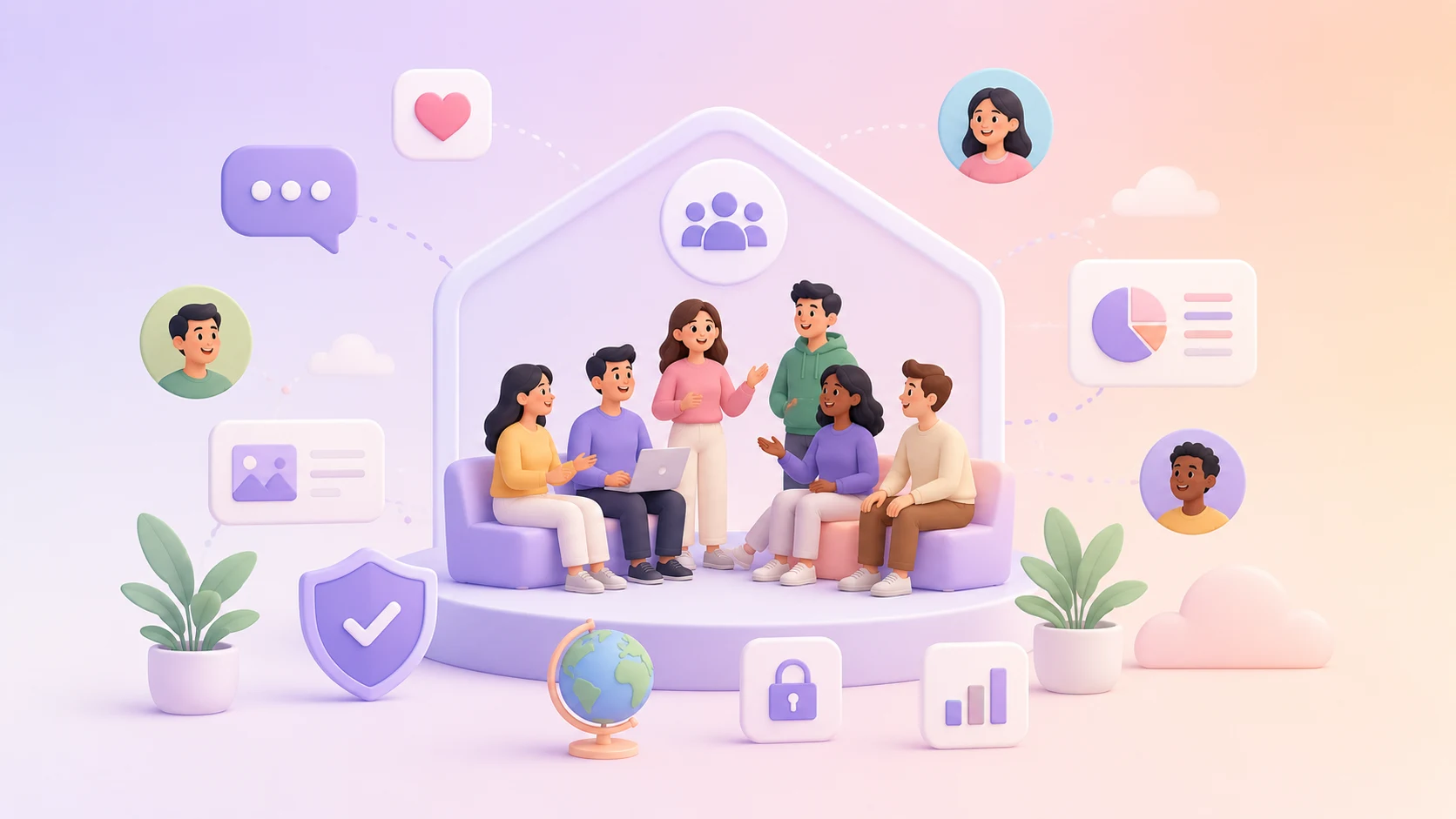
A branded community platform is an online space owned and managed by a business where members can interact, share ideas, ask questions, access resources, and build relationships around a common interest or brand.
What Makes It “Branded”?
Unlike generic social platforms, every aspect of the experience—from domain name and design to user journey and communication—is customized to reflect your brand identity.
How It Differs from Traditional Online Communities
Traditional communities on Facebook or LinkedIn operate under third-party rules and algorithms. Branded communities provide complete control over branding, member experience, data ownership, and monetization opportunities.
Why Businesses Are Investing
Organizations recognize that engaged communities improve customer retention, reduce support costs, increase product adoption, and strengthen long-term brand loyalty.
How Does a Branded Community Platform Work?
A modern community platform brings together several engagement tools in one centralized location.
Member Registration & Onboarding
New members register, create profiles, and receive guided onboarding experiences.
User Profiles & Permissions
Role-based access ensures administrators, moderators, and members have appropriate permissions.
Discussion Forums & Groups
Members participate in topic-based discussions, ask questions, and share experiences.
Content Sharing & Knowledge Base
Businesses publish articles, guides, FAQs, videos, and downloadable resources.
Community Moderation
Moderators maintain healthy discussions by removing spam, enforcing guidelines, and resolving conflicts.
Notifications & Engagement
Smart notifications encourage members to participate without overwhelming them.
Community Analytics & Reporting
Detailed dashboards help administrators track engagement, growth, retention, and content performance.
Key Features of a Branded Community Platform
A robust platform should include:
- Community feed
- Discussion forums
- Public and private groups
- Chat
- Events
- Member profiles
- Gamification features including badges, leaderboards, rewards, and points
- Content library
- Advanced search and discovery
- Mobile app support
- Analytics dashboard
- Role-based access control
These features create an engaging environment that encourages participation while simplifying community management.
Why Your Business Needs a Branded Community Platform
A dedicated community can generate measurable business value.
Increase Customer Engagement
Interactive discussions and valuable content keep members actively involved.
Build Long-Term Relationships
Communities foster trust by enabling ongoing conversations rather than one-time transactions.
Improve Customer Retention
Engaged customers are more likely to remain loyal and continue purchasing.
Reduce Customer Support Costs
Peer-to-peer support and searchable knowledge bases reduce repetitive support tickets.
Increase Product Adoption
Educational resources, tutorials, and discussions help users maximize product value.
Collect Customer Feedback Faster
Communities provide direct access to customer opinions, feature requests, and pain points.
Encourage User-Generated Content
Members naturally contribute reviews, tutorials, discussions, and success stories.
Turn Customers into Brand Advocates
Satisfied community members often become your strongest promoters.
Increase Organic Referrals
Active communities generate word-of-mouth marketing and referral opportunities.
Benefits for Different Types of Businesses
| Business Type | Primary Benefits |
| SaaS | Product adoption, customer success |
| E-commerce | Loyalty and repeat purchases |
| Education | Student collaboration |
| Healthcare | Patient communities |
| Enterprise | Employee collaboration |
| Nonprofit | Volunteer engagement |
| Coaches & Creators | Paid memberships |
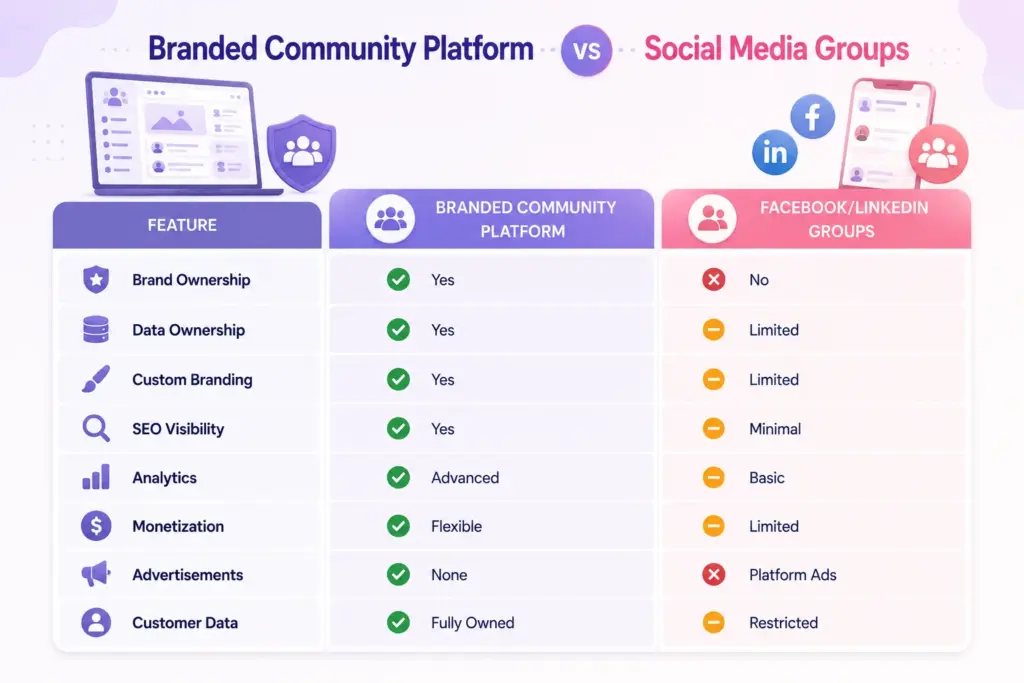
Branded Community Platform vs Social Media Group
| Feature | Branded Community Platform | Facebook/LinkedIn Groups |
| Brand Ownership | ✔ | ✖ |
| Data Ownership | ✔ | Limited |
| Custom Branding | ✔ | Limited |
| SEO Visibility | ✔ | Minimal |
| Analytics | Advanced | Basic |
| Monetization | Flexible | Limited |
| Advertisements | None | Platform Ads |
| Customer Data | Fully Owned | Restricted |
Common Use Cases
Branded community platforms support various business needs, including:
- Startups
- Enterprise
- Academia
- Creators
- Associations
Essential Features to Look for Before Choosing a Community Platform
Before selecting a solution, evaluate whether it offers:
- Easy user management
- Enterprise-grade security and compliance
- Mobile-friendly experience
- Complete brand customization
- API integrations
- Community moderation tools
- SEO-friendly pages
- Analytics and reporting
- Automation capabilities
- Scalability for future growth
How to Choose the Right Branded Community Platform
Selecting the right platform starts with understanding your business needs.
- Define your business objectives.
- Understand your audience’s expectations.
- Compare available features.
- Evaluate pricing and long-term costs.
- Review security standards.
- Test the user experience.
- Request a live demo before making a decision.
Common Challenges and Their Solutions
| Challenge | Solution |
| Low Member Engagement | Gamification and live events |
| Member Retention | Personalized content |
| Spam & Fake Accounts | Strong moderation |
| Low Community Growth | Referral programs |
| Content Overload | Categories and advanced search |
Best Practices for Building a Successful Community
To keep your community active:
- Welcome every new member.
- Publish valuable content consistently.
- Encourage discussions instead of one-way communication.
- Host regular live events.
- Reward active contributors.
- Collect member feedback frequently.
- Monitor analytics to optimize engagement.
- Keep community guidelines updated.
Common Mistakes to Avoid
Avoid these common pitfalls:
- Launching without a clear strategy
- Ignoring member feedback
- Excessive product promotion
- Weak moderation practices
- Poor onboarding experiences
- Inconsistent content publishing
Successful communities focus on creating value before promoting products.
Metrics to Measure Community Success
| KPI | Why It Matters |
| Active Members | Community health |
| Daily Active Users (DAU) | Engagement |
| Monthly Active Users (MAU) | Growth |
| Retention Rate | Loyalty |
| User-Generated Content | Participation |
| Event Attendance | Engagement |
| Customer Satisfaction (CSAT) | User experience |
| Net Promoter Score (NPS) | Brand advocacy |
Future Trends in Branded Community Platforms
The future of online communities is increasingly powered by AI and personalization.
Emerging trends include:
- AI-powered community management
- Personalized member experiences
- Community commerce
- Creator-led communities
- Hybrid online and offline events
- Advanced analytics
- AI-driven content recommendations
These innovations will help businesses deliver more engaging and scalable community experiences.
Signs Your Business Needs a Branded Community Platform
You may be ready to launch a community if you have:
- A rapidly growing customer base
- High customer support volume
- Increasing customer churn
- A need for stronger customer engagement
- Frequent product updates
- A long-term vision for customer loyalty
Before You Invest in a Community Platform
Before implementation, consider the following:
- Set clear business objectives.
- Estimate expected community size.
- Plan community management resources.
- Define measurable success metrics.
- Evaluate integration requirements.
- Review security and compliance needs.
Proper planning significantly increases the chances of long-term community success.
Branded Community Platform Decision Checklist
Before making your final decision, ensure the platform can:
- Support complete brand customization
- Scale with community growth
- Deliver a mobile-responsive experience
- Integrate with your CRM
- Connect with email marketing tools
- Provide detailed analytics
- Include moderation features
- Offer reliable customer support
- Fit your budget
Conclusion
A branded community platform is far more than a discussion forum—it’s a strategic business asset that strengthens customer relationships, improves engagement, increases retention, and creates long-term brand loyalty.
Unlike social media groups, a branded platform gives you complete ownership of your audience, data, and brand experience while enabling sustainable growth through meaningful interactions. Whether you’re a SaaS company, educational institution, enterprise, creator, or e-commerce business, investing in your own community helps build a loyal ecosystem that continues delivering value over time.
Before choosing a platform, clearly define your goals, understand your audience, and prioritize features that support scalability, security, engagement, and seamless integrations. With the right strategy and technology, a branded community can become one of your most valuable channels for customer success and business growth.
A branded community platform is an online space owned by a business where customers, employees, partners, or members interact under the company’s branding.
Owned communities provide greater control over branding, customer data, analytics, SEO, and monetization without relying on changing social media algorithms.
SaaS, e-commerce, education, healthcare, nonprofits, enterprises, coaching businesses, and creator-led brands all benefit from dedicated communities
Yes. Strong communities increase engagement, foster trust, encourage peer support, and create lasting customer relationships.
Common methods include paid memberships, premium content, online courses, events, certifications, sponsorships, and exclusive subscriptions.
Discussion forums, member profiles, groups, events, gamification, analytics, mobile support, moderation tools, and third-party integrations.
Absolutely. Small businesses can strengthen customer relationships and build loyal audiences without requiring large marketing budgets.
While every community is different, most businesses begin seeing meaningful engagement within three to six months with consistent management and valuable content.