
Community Management vs Social Media Marketing: Key Differences
Many businesses use the terms community management and social media marketing interchangeably. While both focus on engaging audiences online, they serve different purposes and contribute to business growth in unique ways.
Social media marketing is primarily about attracting attention, increasing brand awareness, and generating leads. Community management, on the other hand, focuses on building lasting relationships, encouraging conversations, and creating loyal brand advocates.
Understanding the difference between these two strategies helps businesses allocate resources effectively, improve customer experiences, and achieve sustainable growth. In this guide, we’ll compare community management and social media marketing, explore their benefits, discuss when to use each approach, and explain why combining both often delivers the best results.
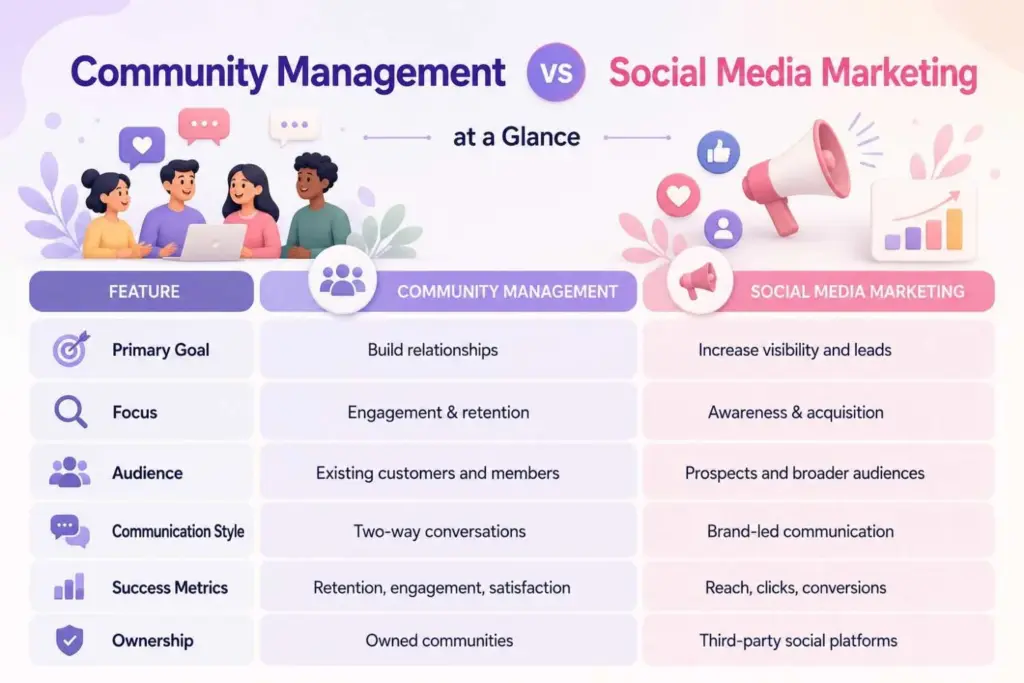
Community Management vs Social Media Marketing at a Glance
| Feature | Community Management | Social Media Marketing |
| Primary Goal | Build relationships | Increase visibility and leads |
| Focus | Engagement & retention | Awareness & acquisition |
| Audience | Existing customers and members | Prospects and broader audiences |
| Communication Style | Two-way conversations | Brand-led communication |
| Success Metrics | Retention, engagement, satisfaction | Reach, clicks, conversions |
| Ownership | Owned communities | Third-party social platforms |
What is Community Management?
Definition
Community management is the process of building, nurturing, and managing relationships with customers, members, employees, or partners within an online or offline community.
Primary Objectives
The main objective is to create meaningful engagement that strengthens trust, loyalty, and long-term customer relationships.
Key Responsibilities
Community managers welcome members, moderate discussions, answer questions, encourage participation, gather feedback, and maintain a positive environment.
What is Social Media Marketing?
Definition
Social media marketing involves using platforms like Facebook, Instagram, LinkedIn, X, and TikTok to promote a brand, engage audiences, and drive business goals.
Primary Objectives
The primary focus is increasing brand awareness, driving traffic, generating leads, and supporting sales campaigns.
Key Responsibilities
Social media marketers create content, schedule posts, run paid advertising campaigns, monitor analytics, and optimize campaign performance.
Examples of Social Media Marketing
- Product launch campaigns
- Influencer collaborations
- Paid social advertising
- Promotional videos
- Seasonal marketing campaigns
Community Management vs Social Media Marketing: Key Differences
Purpose
Community management focuses on nurturing relationships, while social media marketing aims to attract and convert audiences.
Communication Style
Community management encourages ongoing, two-way conversations. Social media marketing is often centered on broadcasting content and promotional messaging.
Audience Relationship
Community managers engage with existing customers and members, whereas marketers primarily target new audiences and potential customers.
Content Strategy
Community content emphasizes discussions, knowledge sharing, and member contributions. Social media content prioritizes campaigns, promotions, and storytelling.
Customer Support
Community platforms often become self-service support hubs where members help one another. Social media mainly provides quick responses and directs users to support channels.
Brand Building
Both strengthen brands, but community management builds trust over time, while social media marketing expands brand visibility.
Customer Retention
Community management plays a significant role in improving customer retention through continuous engagement.
Lead Generation
Social media marketing is generally more effective for attracting new prospects and generating qualified leads.
Sales Focus
Marketing campaigns directly support revenue generation, while community management influences sales indirectly through loyalty and advocacy.
Success Metrics
Community managers track engagement, retention, and member satisfaction, whereas marketers focus on impressions, traffic, leads, and conversions.
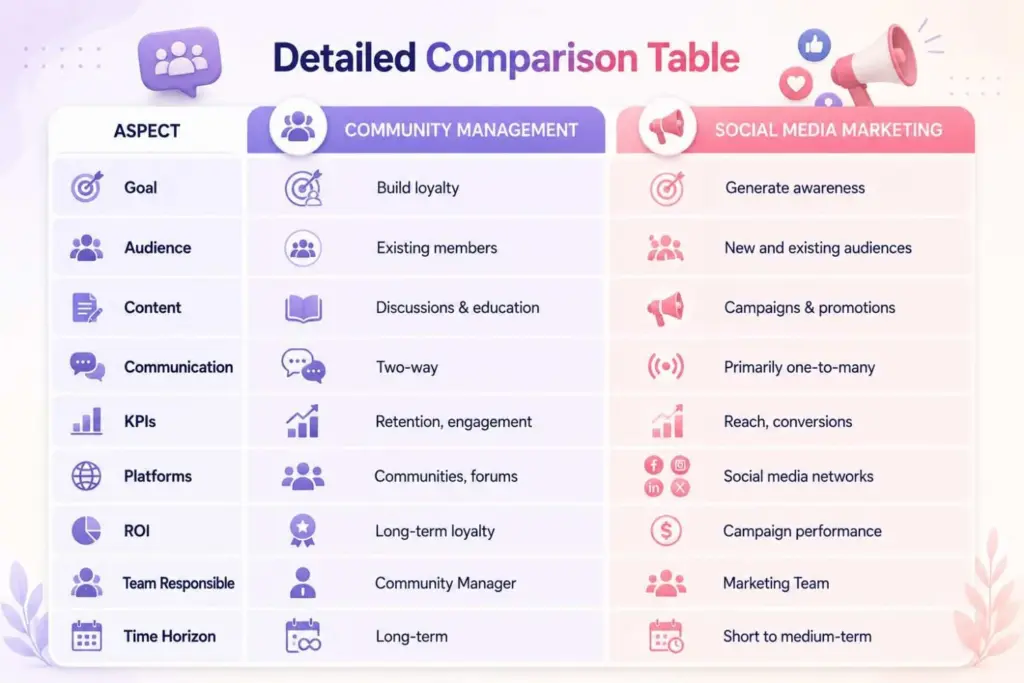
Detailed Comparison Table
| Aspect | Community Management | Social Media Marketing |
| Goal | Build loyalty | Generate awareness |
| Audience | Existing members | New and existing audiences |
| Content | Discussions & education | Campaigns & promotions |
| Communication | Two-way | Primarily one-to-many |
| KPIs | Retention, engagement | Reach, conversions |
| Platforms | Communities, forums | Social media networks |
| ROI | Long-term loyalty | Campaign performance |
| Team Responsible | Community Manager | Marketing Team |
| Time Horizon | Long-term | Short to medium-term |
Why Community Management Matters
Builds Long-Term Relationships
Consistent engagement creates stronger emotional connections with customers.
Improves Customer Retention
Active communities increase customer satisfaction and reduce churn.
Creates Brand Advocates
Engaged members naturally recommend brands to friends and colleagues.
Encourages User-Generated Content
Communities inspire reviews, discussions, tutorials, and customer success stories.
Reduces Customer Support Costs
Members often answer each other’s questions, reducing the burden on support teams.
Why Social Media Marketing Matters
Increases Brand Awareness
Social media introduces brands to wider audiences through organic and paid content.
Generates Leads
Targeted campaigns help attract qualified prospects.
Drives Website Traffic
Social channels become important traffic sources for websites and landing pages.
Supports Product Launches
Social campaigns create excitement before and after product releases.
Increases Sales Opportunities
Promotions, retargeting, and paid advertising help move prospects through the buying journey.
Can Community Management and Social Media Marketing Work Together?
How They Complement Each Other
Social media attracts new audiences, while communities convert those audiences into loyal members.
Example Workflow
A user discovers your brand through Instagram, downloads a resource, joins your branded community, participates in discussions, attends events, and eventually becomes a long-term customer.
Benefits of Combining Both Strategies
Using both approaches creates a complete customer journey—from discovery to advocacy—resulting in stronger engagement and higher customer lifetime value.
Which Strategy is Right for Your Business?
Choose Community Management If…
- Customer retention is a priority.
- You need ongoing product feedback.
- You want to build loyal customer relationships.
Choose Social Media Marketing If…
- You need greater brand awareness.
- Lead generation is your main objective.
- You’re launching new products or entering new markets.
Invest in Both If…
You want sustainable growth by attracting new customers while strengthening relationships with existing ones.
Industries That Benefit Most
| Industry | Community Management | Social Media Marketing |
| Startups | Customer success | Lead generation |
| Enterprise | Loyalty programs | Promotions |
| Academia | Student engagement | Course marketing |
| Associations | Member engagement & networking | Membership growth & event promotion |
| Creators | Audience loyalty & paid communities | Audience growth & content promotion |
Essential Skills Required
Community Manager Skills
- Relationship building
- Conflict resolution
- Customer support
- Communication
- Community moderation
Social Media Marketer Skills
- Content creation
- Copywriting
- Paid advertising
- Analytics
- Campaign management
Popular Tools
Community Management Tools
- Thrico
- Circle
- Discord
- Slack
- Discourse
- Hivebrite
- Bettermode
Social Media Marketing Tools
- Buffer
- Hootsuite
- Sprout Social
- Meta Business Suite
- Canva
- Google Analytics
Common Mistakes to Avoid
Avoid these common pitfalls:
- Treating community members like social media followers
- Focusing only on promotional content
- Ignoring customer feedback
- Measuring the wrong KPIs
- Engaging inconsistently
Successful brands prioritize conversations over constant promotions.
Best Practices
Build stronger engagement by:
- Developing genuine relationships
- Encouraging member participation
- Publishing valuable content consistently
- Responding quickly to questions
- Measuring engagement regularly
Future Trends
Businesses are increasingly investing in:
- AI-powered community management
- Private branded communities
- Social commerce
- Community-led growth (CLG)
- Personalized customer experiences
These trends combine technology with relationship-building to create more engaging customer experiences.
Community Management vs Social Media Marketing at a Glance
- Primary Purpose: Relationships vs. promotion
- Main Audience: Existing members vs. prospective customers
- Best Use Cases: Retention vs. acquisition
- Key Benefits: Loyalty vs. awareness
- Common Platforms: Communities vs. social networks
- Typical KPIs: Engagement vs. conversions
- Business Impact: Long-term growth through combined strategies
Signs Your Business Needs Community Management
You should consider investing in community management if you have:
- A growing customer base
- Increasing support requests
- A need to improve customer loyalty
- Active user discussions
- Frequent product feedback
- Plans for a customer advocacy program
Signs Your Business Needs Social Media Marketing
Social media marketing is essential if you’re aiming for:
- Greater brand awareness
- More website traffic
- Successful product launches
- Higher lead generation
- Effective paid advertising campaigns
- Expansion into new markets
Before Choosing a Strategy
Before investing, ask yourself:
- What are your business goals?
- Who is your target audience?
- What resources does your team have?
- Which KPIs will define success?
- Which tools best fit your needs?
Conclusion
Community management and social media marketing are not competing strategies—they serve different but complementary purposes. Social media marketing helps businesses reach new audiences, increase visibility, generate leads, and support sales initiatives. Community management focuses on nurturing those relationships, improving customer satisfaction, encouraging advocacy, and increasing retention.
Businesses that combine both approaches create a stronger customer journey—from initial discovery to long-term loyalty. By investing in social media to attract audiences and community management to engage and retain them, organizations can build sustainable growth, stronger customer relationships, and higher lifetime value.
Community management focuses on building long-term relationships with existing customers and members, while social media marketing aims to attract new audiences, increase brand awareness, and generate leads.
Yes, especially in small businesses. However, as a company grows, these roles often become specialized due to their different objectives and responsibilities.
Small businesses benefit from both. Social media marketing helps attract customers, while community management builds loyalty and encourages repeat business.
Yes. Active communities generate fresh user-generated content, discussions, and long-tail keywords that can contribute to improved search visibility when hosted on your own platform.
Yes. Community management complements digital marketing by strengthening customer relationships, improving retention, and supporting brand advocacy.
Community management KPIs include active members, engagement rate, retention, and customer satisfaction. Social media marketing KPIs include reach, impressions, click-through rate, website traffic, leads, and conversions.
It can initiate engagement, but long-term loyalty is typically strengthened through consistent community management and meaningful customer interactions.
Private communities give brands greater control over customer relationships, data ownership, personalized experiences, feedback collection, and long-term engagement without relying solely on third-party social media platforms.