7 Ways to Increase Member Retention in Online Communities
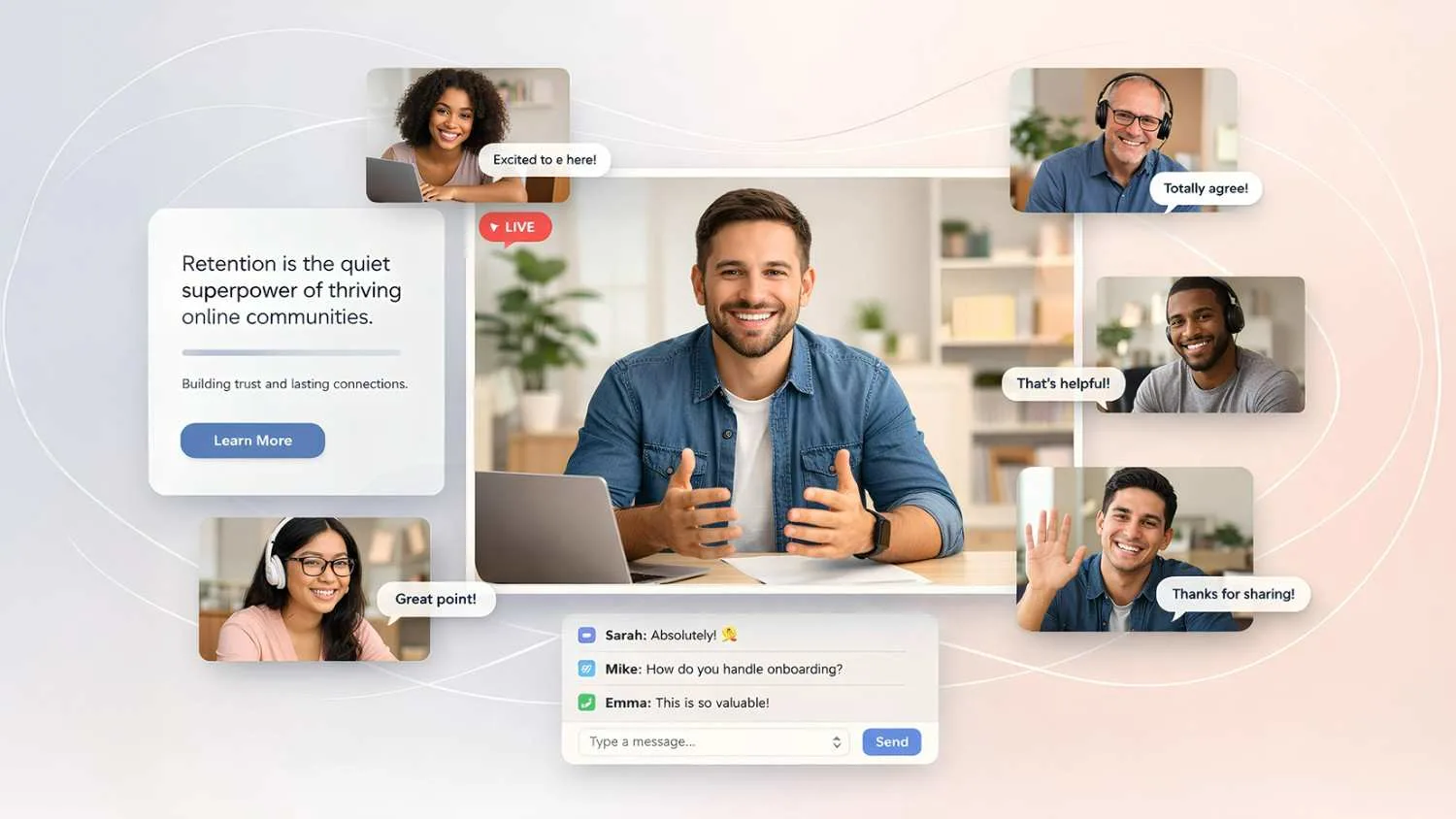
Keeping people around is the quiet superpower of any thriving online community. New member acquisition can look flashy—spikes in sign-ups, big launch posts, impressive top-line numbers—but retention is where the compounding happens. When your existing members keep showing up, they build relationships, create content, answer questions, and welcome newcomers. That flywheel lowers your costs, raises your impact, and makes every new join more valuable than the last.
This guide distils seven evidence-backed, battle-tested plays to boost retention. You’ll get practical checklists, copy templates, cadence examples, and a simple measurement model you can implement today.
What “Retention” Actually Means (and How to Measure It Fast)
Retention is the percentage of members who remain active after a period of time. “Active” should be defined by your community’s core actions (e.g., posts, comments, attending events, completing lessons, logging in, or opening emails).
A quick, practical way to start:
● Define an activation action: the minimum signal that a member has found value (e.g., “posted or replied at least once,” “attended one live session,” “completed one onboarding task”).
● Choose your time windows: Day-7, Day-30, Day-90 are standard. For communities tied to courses or cohorts, use milestones like “during week 1,” “during the project window,” and “after graduation.”
● Use cohort tracking: group members by join week or month and measure what percentage hits the activation action and returns in later windows.
Simple retention formula:
Retention Rate (Day X) =
Members from cohort who were active on or after Day X
————————————————— x 100
Total members in that cohort
If you’re new to this, start with 30-day retention, then layer in 7- and 90-day views. The seven plays below map to those windows.
Nail the First 7 Days with a Deliberate Onboarding Arc
Most members decide whether to stay within their first few sessions. Treat onboarding like a product feature, not an afterthought.
The First-Week Arc
1. Minute 0–10: Zero Friction Welcome
○ Auto-send a short, human welcome that points to one simple action.
○ Surface the community’s “what to do first” checklist immediately.
2. Hour 1–24: Warm Introduction
○ Get them to say “hello” in a safe, low-stakes space.
○ Offer a “choose your lane” prompt (interests, goals, skill level).
3. Day 2–3: Tiny Win
○ Deliver a pre-curated resource or micro-challenge that produces value in <30 minutes.
4. Day 4–7: Belonging Cue
○ Match them with people or spaces aligned to their profile.
○ Invite to one live touchpoint (office hours, casual huddle, welcome call).
Copy you can steal
Welcome DM / Email
Subject: Quick win inside (takes 5 minutes)
Hey {FirstName} — welcome aboard!
Start here: {link to “First 5 Minutes” checklist}.
Then pop into {#introductions} and say hello using this prompt:
“I’m working on {project/goal} and I’m here to {desired outcome}.”
If you want a quick win today, try {resource link} — it takes 10 minutes.
See you inside,
{Your Name}
First Win Prompt
What’s one blocker you want to remove this week?
Reply with: BLOCKER → WHY IT MATTERS → 1 NEXT STEP
Onboarding Checklist (paste into your community)
● Automated welcome message with one action
● “Start here” checklist pinned where new members land
● Intro template with 2–3 prompts
● Micro-challenge or quick win resource
● Calendar invite to a weekly live session
● Staff/volunteer nudge to comment on 1 intro within 24 hours
Retention impact: Improves Day-7 retention by giving members a reason to return and a path to a tiny win. People return to places where they experienced progress.
Build Habit Loops with Clear Cadence and Rituals
Humans are rhythmic. Communities that retain well run on predictable beats—recurring prompts, events, and cycles that create anticipation and habit.
Design your weekly rhythm
● Mon – Goal setting thread (“What’s your one thing?”)
● Wed – Show-your-work check-in (post drafts, WIP screenshots)
● Thu – Peer feedback circle or live coworking
● Fri – Wins roundup + gratitude thread
● Sat/Sun – Light social prompt (icebreaker, book/photo club)
Pick 2–3 anchors and run them every week for at least a quarter. The consistency matters more than the cleverness.
Name your rituals
Give recurring moments a brand: “Monday Momentum,” “Workshop Wednesday,” “Friday High-Fives.” Names stick, and stickiness helps retention.
Automate the nudge
Schedule posts and reminders in advance. Stagger time zones when possible, and keep prompts short, specific, and answerable in <2 minutes.
Retention impact: Cadence combats “out of sight, out of mind.” Members who know what happens when are more likely to drop in and participate.
Offer a Clear Value Ladder (So Members Always Know the Next Step)
Retention drops when members plateau. The antidote is a value ladder—a sequence of increasingly valuable experiences.
Example ladder
1. Lurker-friendly value: curated resources, read-only guides, event replays.
2. Low-effort participation: polls, emoji reactions, short replies.
3. Guided contribution: templates to share progress, peer reviews.
4. Active collaboration: small groups, projects, mastermind pods.
5. Leadership & mastery: mentorship, hosting, content creation, teaching.
Design content and prompts that pull members up the ladder over time. For example:
● Week 1: consume → react → introduce yourself
● Week 2: share a small win → comment on 1 post
● Week 3: join a pod → attend one live event
● Week 4: volunteer to facilitate a 10-minute segment
Retention impact: People stay when they see a path to growth. The value ladder makes that path explicit.
Recognize, Rank, and Reward the Behaviors That Matter
Recognition fuels belonging and motivation—if it’s tied to meaningful behaviors.
Define your “north-star behaviors.”
Choose 3–5 actions that correlate with healthy engagement. Examples:
● Commenting with substance (not just “nice!”)
● Posting progress updates
● Giving peer feedback
● Showing up to live sessions
● Completing a community challenge
Recognition system ideas
● Badges & roles: visible markers for contributors, helpers, mentors.
● Spotlight posts: “Member of the Week” with a mini-interview.
● Progress streaks: gentle tracking that celebrates consistency (not just volume).
● Thank-you rituals: a weekly gratitude thread, or a “shout-out” segment in live calls.
● Points → perks: points that unlock real benefits (see below).
Reward ideas that actually help retention
● Early access to new resources
● Priority support or feedback
● Private Q&A with hosts
● Small group invites (pods, masterminds)
● Swag with meaning (stickers, digital certificates)
● Opportunities to lead (hosting, writing, teaching)
Caution: Rewards should amplify intrinsic motivation, not replace it. Tie them to community values and make the path to earning them transparent.
Retention impact: When members feel seen and rewarded for the right things, they repeat those behaviors and stick around.
Program for Participation: A Calendar That Serves Different Member Modes
Members move through modes—learn, make, share, connect. An effective program calendar covers each.
The monthly mix
● Teach (learn): workshops, deep dives, expert AMAs
● Build (make): coworking, sprints, challenges
● how (share): demo days, gallery threads, critique circles
● Bond (connect): mixers, interest clubs, casual hangs
Capacity-friendly formats
● 30/30 workshops: 30 minutes of teaching, 30 minutes of doing in breakout rooms.
● Coworking blocks: 50 minutes focus, 10 minutes social check-in.
● Lightning rounds: 5 members, 5 minutes each, timed and facilitated.
● Asynchronous challenges: weekly prompt, submit anytime, vote/react on entries.
The “3-2-1” programming rule
Per month, aim for:
● 3 small events (low prep, recurring)
● 2 medium events (guest sessions or guided workshops)
● 1 marquee event (challenge, summit, demo day)
Publish the calendar a month in advance. Post reminders a week, a day, and an hour before each event.
Retention impact: Programming gives members a reason to return now, not “someday.” A variety of formats meets people where they are.
Close the Loop: Feedback, Co-Creation, and Member Ownership
Communities are not content feeds; they’re social systems. Members stay when they feel ownership.
Lightweight, continuous feedback
● Monthly pulse (1–2 questions): “What should we start/stop/continue next month?”
● Exit survey for churned members: short and honest—“What pulled you away? What would bring you back?”
● Idea upvote board: visible backlog of suggestions with status labels (planned, in progress, shipped).
Co-create, don’t just consult
● Recruit working groups (3–6 members) to shape programs, guides, or challenges.
● Run beta pilots with volunteer testers; ship changelogs that name contributors.
● Invite member-led sessions and equip hosts with a one-page run-of-show template.
One-pager for member hosts
Session Title:
Outcome (what people leave with):
Outline (timed):
– 0–5: Welcome + why it matters
– 5–15: Demo or framing
– 15–35: Activity or breakout
– 35–45: Shareback
– 45–50: Wrap + next step
Links/Materials:
Accessibility notes:
Retention impact: Ownership turns participants into stewards. Stewards are the backbone of durable retention.
Treat Retention Like a Product: Instrument, Analyze, Iterate
You can’t fix what you don’t see. Build a simple retention operating system.
Instrument the basics
Track these five metrics by cohort (join week/month):
- Activation rate (Day-7) – % who complete your activation action
- 30-day retention – % active on or after Day-30
- 90-day retention – longer-term stickiness
- Participation rate – % posting, commenting, attending, or submitting
- Contributor rate – % generating content others engage with
Layer in qualitative tags for posts and events (e.g., “how-to,” “celebration,” “stuck,” “win,” “feedback”) to spot what drives activity.
Build simple dashboards
● A cohort table showing activation → D30 → D90
● A weekly rhythm chart: # posts, comments, attendees, unique contributors
● Top content/events by engagement last 30 days
● “Silent churn” list: members who were active 30 days ago but not in the last 14 days
Run monthly experiments
Adopt a one-experiment-per-month cadence:
● Define a hypothesis (“If we add a Monday goal thread, 30-day retention will rise 3 points for new members.”)
● Ship it for one month
● Compare cohorts exposed vs. not
● Keep, fix, or scrap
Retention impact: Regular, data-informed iteration compounds small wins into durable gains.
Bonus: Lifecycle Segmentation and Reactivation Playbook
Retention is easier when messages match member moments. Segment by lifecycle and tailor your touchpoints.
Lifecycle segments
● New (0–7 days): onboarding and tiny wins
● Warm (8–30 days): exploration + gentle push up the value ladder
● Core (31–90 days): deeper collaboration, leadership invites
● Alumni (90+ days or post-program): periodic updates, mentor/host paths
● At-risk (no activity in 14–30 days): personalized check-ins
Reactivation templates
Personalized nudge
Subject: Quick idea for {FirstName}
Saw your {last activity} from {date} — how did that go?
We’re running {upcoming event} this {day}.
If {topic} is still on your radar, I’ll save you a seat. Want me to register you?
— {Your Name}
“What changed?” check-in
Totally okay if your priorities shifted.
If you have 30 seconds, reply with a number:
1) Busy season
2) Topic pivot
3) Platform fatigue
4) Didn’t find what I expected
5) Other (tell me)
Win-back bundle
Offer a single link that:
● Recaps what they missed (top 3 threads, 1 replay)
● Invites them to this week’s easiest touchpoint (coworking or intro)
● Provides one fresh resource aligned to their past interest
Retention impact: Meeting members where they are—and giving them a light, specific way back—saves relationships without nagging.
Guardrails: Reduce Friction, Burnout, and Noise
Retention isn’t only about adding; it’s also about subtracting.
● Moderate for psychological safety: clear rules, consistent enforcement, fast escalation.
● Kill zombie spaces: too many channels = cognitive load. Archive or merge.
● Set realistic cadences: protect hosts from burnout with rotations and off-weeks.
● Optimize notifications: default to digest or key alerts; show people how to tune their settings.
● Accessibility matters: captions on replays, time-zone friendly scheduling, summaries for async members.
A 90-Day Retention Plan You Can Run This Quarter
Week 1–2: Foundation
● Define activation action and set up Day-7, Day-30 tracking by cohort.
● Ship “Start Here” and quick win resource.
● Launch a warm welcome flow and an intro template.
● Pick your weekly rituals (two anchors) and name them.
Week 3–4: Programming & Recognition
● Publish a 30-day event calendar with at least one teach, one build, and one bond touchpoint.
● Define your north-star behaviors; create one visible badge and one weekly recognition ritual.
● Recruit 3 volunteer hosts for member-led segments (equip them with the one-pager).
Week 5–8: Value Ladder & Feedback
● Roll out a low-effort → guided → collaboration ladder with prompts and templates.
● Launch a monthly pulse survey (2 questions) and an idea board.
● Run your first cohort-level experiment (e.g., Monday goals thread).
Week 9–12: Reactivation & Iteration
● Build an at-risk segment and send a personalized nudge to each member in it.
● Host a marquee event (demo day/challenge) with clear on-ramps for new and returning members.
● Review metrics: activation, D30, participation, contributor rate. Keep what worked, scrap what didn’t.
● Publish a changelog post thanking contributors by name.
Templates & Snippets You Can Copy-Paste
“Start Here” Checklist
✅ Read the Community Guidelines (2 min)
✅ Post your intro using the template (5 min)
✅ Grab the Quick Win resource (10 min)
✅ React to 2 posts with helpful comments (5 min)
✅ Add the next live session to your calendar (1 min)
Weekly Ritual Post (example)
# Friday High-Fives
Share one win from this week. It can be tiny. Use this format:
WIN:
HOW YOU GOT IT:
WHAT’S NEXT:
Tag one person who helped you this week and say thanks.
Peer Feedback Prompt
Looking for: Specific critique on {area}
Context: {goal, audience}
Link or screenshot: {attached}
2 questions I want answered:
1)
2)
Event Reminder (1 hour before)
Happening soon: {Event Name} — bring {one thing}.
If you can’t make it, RSVP anyway for the replay link.
Join here: {link}
Changelog Post
Shipped this month:
– New “Start Here” + Quick Win pack
– Monday Momentum + Friday High-Fives rituals
– Member-led session pilot (thank you @names)
– Idea board with voting
Coming next:
– February challenge (theme: {theme})
– Mentor program beta (apply by {date})
Common Retention Pitfalls (and Fast Fixes)
●Pitfall: Too many spaces, not enough activity
Fix: Archive anything underused; consolidate around your weekly rhythm.
● Pitfall: Hosts doing all the talking
Fix: Seed posts with prompts that require member input; assign responder roles to volunteers.
● Pitfall: One-off big events with no follow-up
Fix: Always attach a next step: thread, challenge, or sign-up for small groups.
● Pitfall: Vague calls to action (“engage more”)
Fix: Micro-clear asks (“Leave one comment with advice for the post above yours.”)
● Pitfall: Rewarding volume over value
Fix: Recognize helpfulness, specificity, and follow-through.
Frequently Asked Questions (FAQs)
Member retention refers to the ability of an online community to keep members active and engaged over time rather than losing them after initial sign-up. High retention means members consistently participate in discussions, events, and activities because they find ongoing value and a sense of belonging.
Retention is often measured across time periods such as 7-day, 30-day, or 90-day activity, depending on the community’s goals.
While growth brings visibility, retention drives sustainability. A community with strong retention:
● Creates richer conversations and peer learning
● Requires less effort and cost to maintain engagement
● Builds trust, relationships, and social proof
● Converts more members into contributors, leaders, and advocates
Without retention, growth becomes a leaky bucket—new members join, but value never compounds.
Common reasons include:
● Poor or confusing onboarding
● Lack of clear value after joining
● Too many inactive or irrelevant channels
● No regular programming or engagement rhythm
● Members not feeling seen, welcomed, or acknowledged
● Over-reliance on content instead of connection
Fixing retention often means simplifying the experience, not adding more features.
Some improvements—like better onboarding or weekly rituals—can improve 7-day retention almost immediately. However, meaningful gains in 30-day and 90-day retention typically take 1–3 months of consistent effort, testing, and iteration.
Retention is cumulative. Small improvements compound over time.
There is no universal benchmark, but general guidelines are:
● Day-7 retention: 40–60%
● Day-30 retention: 20–40%
●Day-90 retention: 10–25%
Healthy communities focus less on hitting a specific number and more on month-over-month improvement and increasing meaningful participation.
Small communities actually have an advantage. You can:
● Personally welcome new members
● Respond to introductions quickly
● Run low-effort rituals (weekly threads, check-ins)
● Encourage member-led discussions
● Host simple events like coworking or office hours
Retention is more about human connection than scale or technology.
Events give members a reason to return now, not later. Regular events:
● Strengthen relationships
● Create shared experiences
● Increase perceived value
● Encourage accountability
Even simple formats like coworking sessions or open Q&A calls can significantly improve retention when run consistently.
Not necessarily. Healthy communities support different engagement styles:
● Some members learn quietly
● Others engage socially
● A smaller group contributes consistently
The goal is not forcing participation, but making participation easy, safe, and rewarding when members are ready.
Effective re-engagement focuses on personalization and relevance, not volume. Best practices include:
● Referencing a member’s past activity or interests
● Inviting them to a specific, low-effort event
● Sharing a short recap of what they missed
● Asking for feedback instead of pushing participation
A respectful, human tone works better than automated reminders.
Community managers are the connective tissue of a community. Their role includes:
● Welcoming and onboarding members
● Modeling desired behavior
● Encouraging participation
● Recognizing contributions
● Maintaining psychological safety
Even in product-led or creator-led communities, active stewardship dramatically improves retention
Recognition reinforces behaviors that keep communities alive. When members feel seen for contributing—whether through shout-outs, badges, or leadership opportunities—they’re more likely to stay engaged.
The key is recognizing helpfulness and consistency, not just loud or frequent posting.
You don’t need complex tools to start. Helpful options include:
● Platform analytics (active users, posts, comments)
● Cohort tracking spreadsheets
● Simple surveys and feedback forms
● CRM or community management tools
● Calendar-based engagement tracking
What matters most is using the data to make decisions, not just collecting it.
Yes. Retention tactics vary for:
● Learning communities
● Creator or fan communities
● Professional or career-focused groups
● Brand or customer communities
However, the fundamentals—onboarding, value clarity, belonging, and consistency—apply to all.
The biggest mistake is assuming retention will “just happen” if the content is good.
Communities retain members through intentional design, not passive consumption. Without structure, rituals, and human connection, even high-quality content fails to hold attention.
Thrco is built to help communities activate, engage, and retain members by supporting:
● Structured onboarding flows
● Engagement analytics
● Community-led experiences
● Member recognition and interaction
● Scalable community operations
Retention becomes easier when the platform supports human connection instead of fighting it.