How Marketplace Features Help Community Monetization
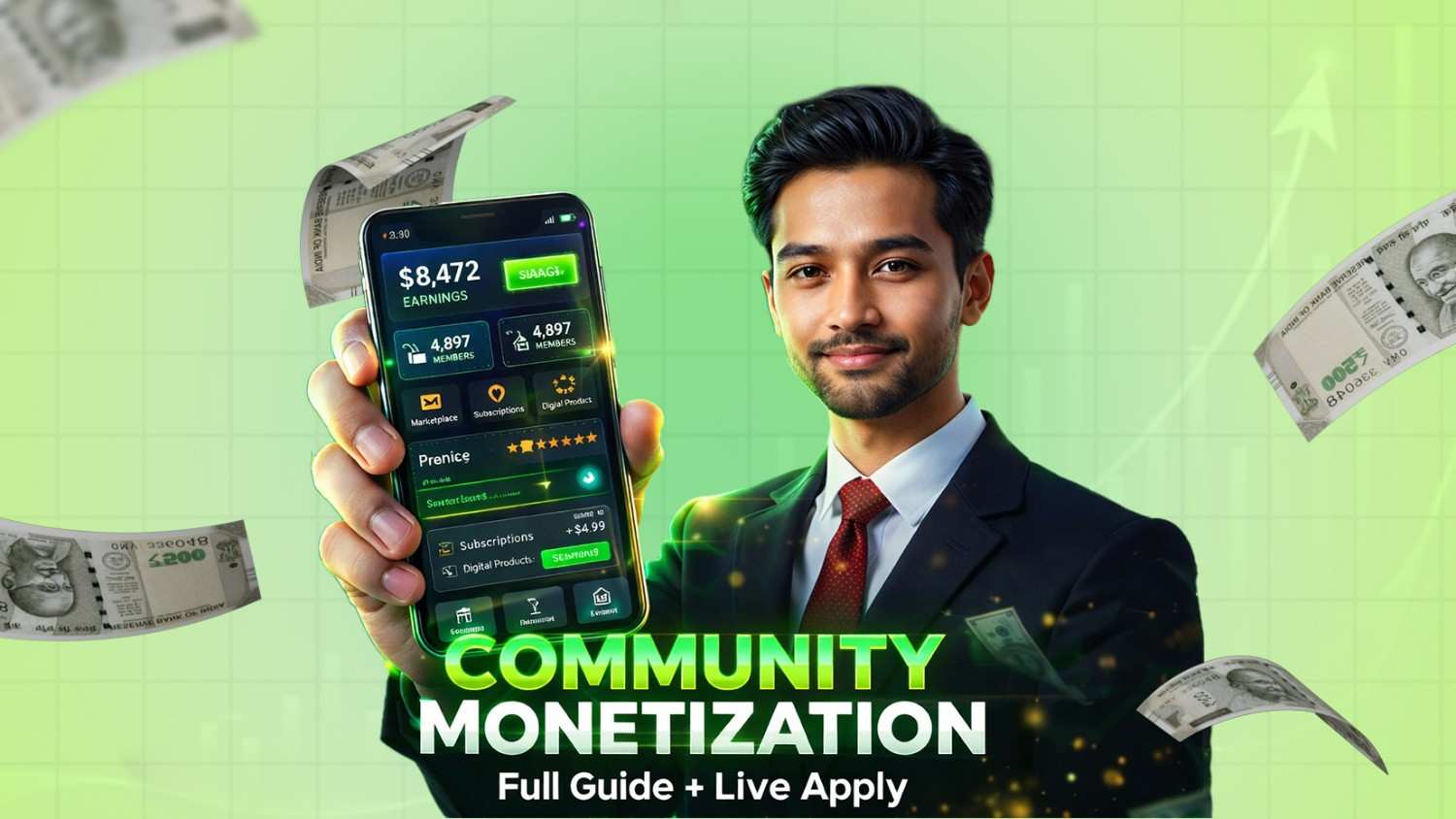
Community monetization is the practice of earning revenue from an engaged audience through structured value exchanges. Marketplace features—like listings, integrated payments, memberships, and digital downloads—give creators, brands, and community owners the tools to sell directly, reward participation, and scale income without leaving the platform.
What Is Community Monetization?
Community monetization means generating revenue from an engaged audience by matching valuable offerings—content, access, products, or services—to member needs. It’s not “paywall everything”; it’s designing mutually beneficial value exchanges where members willingly pay for deeper outcomes: learning, credibility, convenience, or status.
You’ll find monetization in:
● Creator communities: photographers selling presets, musicians offering sample packs, writers hosting paid salons, streamers selling exclusive drops.
● Learning platforms: cohort-based programs, private study groups, templates, and tutoring.
● Niche groups: professional associations, hobbyist clubs, and local groups trading skills, equipment, and collectibles.
At its core, monetization only works when the value is real and felt. Members pay because they gain clarity, time, results, belonging, or recognition. That’s the engine of sustainable community economics.
What Are Marketplace Features in Community Platforms?
Marketplace features are native commerce tools built into a community platform. Instead of bolting on scattered apps, a marketplace consolidates the member journey—from discovery to payment to delivery—inside one trusted environment. Typical components include:
● Product & service listings: Catalog items (digital or physical), services (coaching, design, audits), bundles, and limited-time offers. Rich listings show media, descriptions, inventory, and policies.
● Integrated payment systems: Secure checkout, saved payment methods, tax/VAT handling, refunds, and receipts. Less friction means higher conversion.
● Subscription & membership tools: Tiered access, recurring billing, trials, coupons, and upgrade/downgrade paths. Great for predictable cash flow.
● Digital downloads and gated access: Files, templates, courses, libraries, and posts that unlock after purchase or membership.
● Seller and buyer profiles: Ratings, reviews, verification, and portfolios that signal quality and build trust.
Because the marketplace lives where conversation happens, members move from discussion → discovery → purchase without context switching—one of the biggest killers of conversion.
How Marketplace Features Help Community Monetization
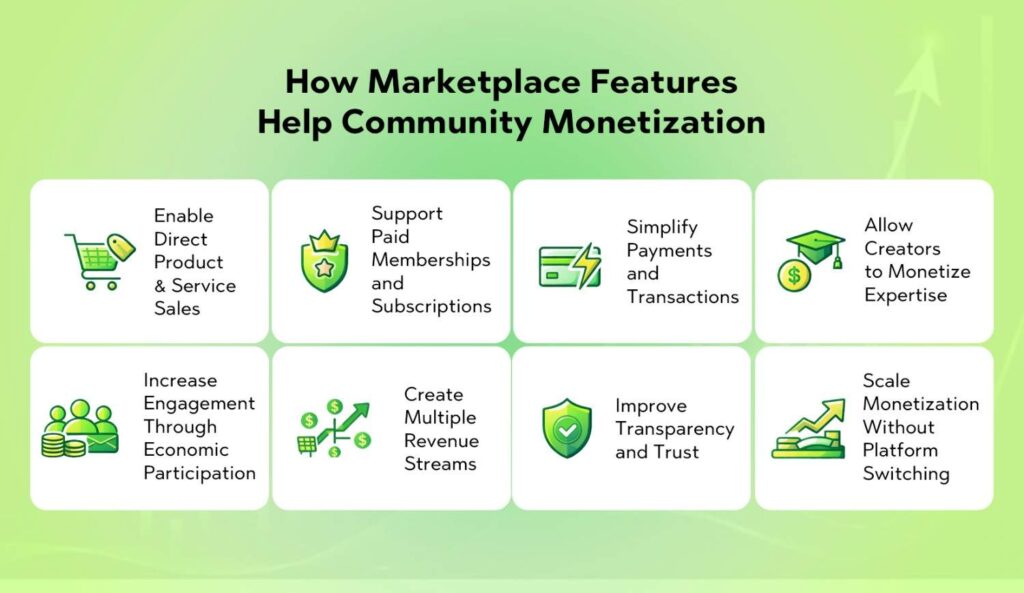
1. Enable Direct Product & Service Sales
Marketplace listings let members sell digital products (templates, presets, e-books, mini-courses, sound packs) and physical goods (merch, kits, art prints) alongside services (coaching, critiques, audits, design sprints). This removes dependency on third-party storefronts where fees, algorithms, and policies can change overnight.
Why it matters:
● Less leakage: Members aren’t pushed off-platform, which preserves session momentum and reduces drop-off.
● Higher trust: Buyers already know the seller from community interactions; the platform’s reputation carries over to purchases.
● Faster iteration: Creators test offers quickly, gather feedback in comments, and ship updates that members can immediately see.
Example play: A design community hosts “Critique Fridays.” Sellers offer 45-minute review slots directly in the marketplace. The event drives attention; the listing converts that attention into paid outcomes.
2. Support Paid Memberships and Subscriptions
Membership tiers convert passive readers into committed supporters and learners. The marketplace handles recurring billing, proration, trials, and one-click upgrades, while the community logic controls gated channels and role-based permissions.
Why it matters:
● Predictable revenue: Recurring income stabilizes operations and funds better programming.
● Value layering: Offer tiers (Starter, Pro, VIP) with escalating benefits—private channels, AMAs, templates, or office hours.
● Clear progression: Members can “level up” their involvement, mirroring gamification benefits like points, badges, and levels that reward deeper participation.
Quick framework:
● Tier 1—Supporter: community access + monthly digest.
● Tier 2—Builder: + templates library + member-only events.
● Tier 3—Leader: + mastermind group + 1:1 office hours + priority listings.
3. Simplify Payments and Transactions
Built-in checkout, invoicing, and payouts remove friction. Members prefer the path of least resistance; saved cards, local currencies, tax-inclusive pricing, and instant receipts raise conversion and reduce support tickets.
Why it matters:
● Higher trust: Transactions occur inside the environment where relationships already exist.
● Lower fees stack: Consolidating payments avoids multi-app percentages and failed webhook headaches.
● Cleaner records: Unified analytics make ROI obvious—no spreadsheet archaeology.
Pro tip: Default to inclusive pricing (tax and fees clear up front) and provide a transparent refund policy pinned in marketplace guidelines.
4. Allow Creators to Monetize Expertise
A marketplace can productize knowledge beyond static content:
● Coaching & consulting: bookable slots with automated reminders.
● Workshops & cohorts: scheduled events with capped seats and waitlists.
● Office hours & clinics: group Q&A monetized as “one-to-many” leverage.
● Templates & playbooks: repeatable systems that scale infinitely.
Why it matters:
Creators move from a time-for-money ceiling to semi-passive or one-to-many models that compound. The community itself becomes a lead qualifier, making sales warmer, shorter, and more ethical.
5. Increase Engagement Through Economic Participation
When members buy and sell, they stop being lurkers and start being stakeholders. Commerce becomes an engagement loop: discussion sparks an idea → listing launches → buyers give feedback → improvements ship → more discussion.
We can enhance this loop with gamification strategies and user engagement techniques, such as:
● Points for first purchase, first sale, reviews left, or helpful replies on listing pages.
● Badges for verified sellers, “Top Helper,” or “Launch Streak” (four consecutive monthly drops).
● Levels that unlock higher listing limits, boosted visibility, or fee discounts.
● Engagement loops: notification nudges (“3 people saved your product”), progress meters (“5 sales to reach Silver Seller”), and time-limited quests (“Review 3 purchases this week to unlock a coupon”).
These levers reinforce positive behavior and compound gamification benefits—motivation, recognition, and social proof—without cheapening the community.
6. Create Multiple Revenue Streams
Marketplace ecosystems diversify income:
● Courses & cohorts: premium learning tied to community accountability.
● Events: virtual summits, sprints, hackathons, and meetups with ticketing.
● Digital products: libraries of assets that sell 24/7.
● Services: “done-with-you” or “done-for-you” offerings for members who want speed.
● Sponsorship slots: tasteful, relevant partners showcased in a marketplace-adjacent area (not interruptive).
● Job board & gigs: paid listings that circulate talent inside the community.
Diverse streams reduce reliance on ads—often a mismatched incentive that pushes volume over value—and insulate revenue from sudden platform changes.
7. Improve Transparency and Trust
A native marketplace builds trust with:
● Reviews & ratings: surface quality; deter low-effort offers.
● Verified profiles: identity or portfolio checks for sellers.
● Clear dispute flows: defined timelines, evidence requirements, and platform mediation.
● Public policies: shipping, refund, and turnaround expectations standardized at the platform level.
Transparency doesn’t just prevent problems—it increases conversion. When members see consistent standards, they buy with confidence, and sellers commit to excellence.
8. Scale Monetization Without Platform Switching
Context switching kills momentum. With marketplace features:
● Everything is managed in one ecosystem: content, chat, listings, payments, fulfillment, analytics.
● Unified UX: shared design language and navigation reduce cognitive load.
● Retention gains: members return for conversations and stay to buy—or vice versa.
Operating inside one stack creates a compounding flywheel: the more you ship, the better your insights; the better your insights, the better your offers; the better your offers, the stronger the community.
Benefits of Marketplace-Driven Community Monetization
● Sustainable revenue growth: Recurring memberships plus evergreen digital products provide baseline stability, while launches and events create spikes.
● Stronger community loyalty: Members invest financially and emotionally, which increases belonging and lifetime value per user.
● Better creator and member retention: Sellers stay for demand; buyers stay for access, updates, and reputation effects (e.g., badges and levels).
● Data-driven monetization insights: Unified analytics reveal top categories, conversion bottlenecks, cohort retention, and CLV by tier.
● Fair value distribution: Revenue pathways for both hosts and members align incentives and reduce burnout.
Who Can Benefit Most From Marketplace Features?
● Creator-led communities: writers, filmmakers, musicians, photographers, and streamers who want to own their audience and margins.
● Learning and coaching platforms: educators who can package knowledge as courses, playbooks, office hours, and certifications.
● Professional and niche networks: designers, developers, data scientists, marketers, or collectors—any group where peer-to-peer value exists.
● Brand-owned communities: consumer brands with superfans eager for early access, limited drops, or co-created products.
● SaaS and Web3 communities: tool makers and protocol communities monetizing templates, plugins, verified services, or governance-enabled perks.
If your community can teach, fix, build, curate, or certify, a marketplace is a natural fit.
Challenges to Consider When Monetizing Communities
● Over-monetization risks: If every interaction becomes a sales pitch, trust erodes. Keep community-first spaces free and vibrant.
● Quality control of listings: Require minimum standards (clear descriptions, fulfillment times, example deliverables), and curate featured items.
● Payment compliance and fees: Understand tax/VAT, chargebacks, and payout timing. Be transparent about platform fees.
● Community trust and moderation: Enforce codes of conduct, anti-fraud measures, and conflict-of-interest policies for moderators who also sell.
Mitigate these risks with clear guidelines, graduated seller privileges (levels), and transparent enforcement.
Best Practices for Monetizing Communities With Marketplace Features
1. Start with value before monetization
Ship free, high-signal content and rituals first (weekly threads, show-and-tells). Monetization should feel like a natural extension of value, not a pivot.
2. Offer clear pricing and benefits
Use simple plans with 2–3 tiers. For each tier, state: Who is this for? What outcomes can they expect? What’s inside? Avoid feature bloat that confuses buyers.
3. Highlight top creators and sellers
Showcase verified sellers on a home carousel. Use badges like “Editor’s Pick,” “Most Helpful,” or “Fast Responder.” Recognition is a core user engagement technique.
4. Use analytics to optimize offerings
Track: free-to-paid conversion, average order value, churn by tier, time-to-first-sale, review velocity, and search term trends. Iterate your marketplace taxonomy around real demand.
5. Keep transactions community-first
Bake in engagement loops that reward feedback and helpfulness: points for reviews, levels that unlock perks, and monthly community picks chosen by vote.
6. Design trustworthy policies
Post clear refund windows, dispute processes, and fulfillment SLAs. Require sellers to acknowledge policies at listing submission.
7. Reduce friction at checkout
Support local currencies, one-click renewals, and simple receipts. Offer coupons sparingly; overuse trains people to wait for discounts.
8. Protect quality with curation
Approve new sellers via a lightweight review. Gate higher listing limits and boosted placement behind seller levels based on ratings and fulfillment history.
9. Onboard sellers with playbooks
Provide listing templates, pricing heuristics, and fulfillment checklists. Offer a seller Q&A channel for rapid feedback.
10. Integrate gamification thoughtfully
Use points, badges, and levels to reinforce pro-social behaviors: helpful reviews, on-time delivery, and resource sharing. Avoid pay-to-win mechanics that distort trust.
Want a primer on engagement mechanics? See gamification basics for an overview of points, badges, levels, and the psychology of motivation.
Future of Community Monetization With Marketplaces
● Creator economy growth: More individuals will build portfolio incomes from audiences they own—memberships plus productized services.
● Integrated commerce + community models: Chat, content, courses, and checkout will live together. The “platform” becomes the product.
● AI-driven recommendations: Personalization will match members to offers based on behavior, outcomes, and peer networks—without being creepy.
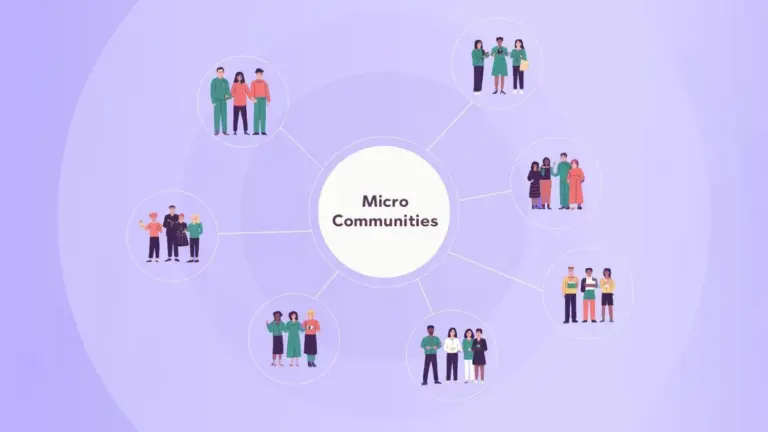
● Decentralized and niche marketplaces: Tokenized access, provenance for digital goods, and micro-communities with deep expertise.
The through-line: trust plus convenience. Communities that combine both will outcompete generic marketplaces and algorithmic feeds.
Practical Blueprint: Turn Conversations Into Commerce (Step-by-Step)
Phase 1 — Foundation (Weeks 1–2)
● Map member jobs-to-be-done: What outcomes do they hire the community for?
● Define 2–3 membership tiers and a single flagship offer (course, clinic, or template).
● Publish marketplace guidelines, refund policy, and listing standards.
Phase 2 — Pilot (Weeks 3–4)
● Recruit 5–10 trusted members as founding sellers.
● Launch with limited inventory to learn quickly.
● Add engagement loops: points for first purchase, reviews, and launch feedback.
Phase 3 — Scale (Weeks 5–8)
● Introduce seller levels (Bronze, Silver, Gold) tied to on-time delivery and ratings.
● Expand categories based on search and sales data.
● Layer in badges (Top Helper, Rising Star) and seasonal “market days.”
Phase 4 — Optimize (Ongoing)
● Run monthly audits of conversion drop-offs.
● Spotlight high-ROI use cases as case studies.
● Tune pricing and bundles by cohort behavior and LTV.
Example Monetization Map (for Inspiration)
● Free layer: weekly office hours, public challenges, curated reading list.
● Membership ($): private channels, template vault, event discounts, monthly AMAs.
● Marketplace:
○ Digital products: prompt packs, notion dashboards, Lightroom presets.
○ Services: portfolio reviews, technical audits, copy critiques.
○ Events: 2-hour clinics, multi-week cohorts, VIP masterminds.
● Gamification overlay:
○ Points: purchases, verified reviews, answering marketplace Qs.
○ Badges: Verified Seller, 100-Sale Club, On-Time Pro.
○ Levels: unlock fee discounts, higher listing caps, and featured placement.
● KPIs: free→paid conversion, churn by tier, AOV, review rate, dispute rate (<1%), seller NPS, buyer NPS.
Ethical Monetization: Keep the Soul of Your Community
Monetization should amplify your mission, not warp it. A few grounding principles:
● Value before virality: Resist the temptation to inflate promises to juice sales. Sustainable communities win on trust.
● Transparency over tricks: Price clearly. Avoid dark patterns (fake scarcity, hidden fees).
● Recognition over rivalry: Gamify prosocial behavior—helpfulness, reliability, and mentorship.
● Consentful data: Use analytics to improve relevance, not to pressure or manipulate.
● Access pathways: Offer scholarships or community-earned paths to premium tiers so contribution—not just cash—unlocks opportunity.
Final Thoughts
A marketplace isn’t just a way to “collect payments”—it’s a participation engine. When commerce happens inside the conversation, you unlock loops that deepen engagement, reward contribution, and compound revenue. Combine native marketplace tools with gamification strategies—points, badges, levels, and purposeful engagement loops—and you’ll create a community economy that serves everyone: hosts, creators, and members.
Ready to explore modules that support listings, payments, memberships, and engagement mechanics? Check out gamification basics to see how the right building blocks accelerate sustainable growth.
FAQ
Community monetization is the process of earning revenue from an engaged audience by selling access (memberships), products (digital or physical), services, or experiences. It’s sustained by real value exchange—members pay for outcomes like skills, speed, belonging, or recognition.
Marketplace features provide listings, integrated checkout, subscriptions, and delivery tools so creators can sell directly where their audience already engages. They reduce friction, increase trust, and offer analytics that help creators refine offers and pricing.
Absolutely. In small groups, trust is high, and feedback loops are fast—ideal conditions for validating offers. Start with a single paid tier and one flagship offer. Scale categories and sellers as demand becomes clear.
Digital downloads (templates, presets, e-books), courses and cohorts, tickets to events, memberships, coaching and consulting, audits, critiques, and even physical goods like merch or kits—so long as fulfillment and policies are clear.
For most communities, yes. Ads monetize attention, not outcomes, and often misalign incentives. Marketplaces monetize value delivered to members, producing higher retention, stronger loyalty, and better long-term revenue.