Circle, Mighty Networks and Thrico suit different types of online communities. Circle focuses on structured discussions, courses and events. Mighty Networks combines community participation with courses and paid memberships. Thrico brings together networking, gamification, events and commerce-related features.
For brands, the choice depends on the experience members need and the systems the business already uses. A B2B company may prioritise customer discussions, professional networking and CRM integration. A creator business may need courses, live sessions and paid memberships. A consumer brand may want customers to exchange product advice, participate in campaigns and access relevant offers or rewards.
Circle vs Mighty Networks vs Thrico comes down to the community model, the features needed to support it, and the cost of running it. This comparison examines each platform’s capabilities, pricing approach, branding options, data access and engagement tools to help you make an informed decision.
Why Community Platform Choice Matters in 2027
A community platform affects how members join, interact, find information and return. It also shapes the work your team must manage, including content, moderation, integrations, reporting and member support.
The wrong fit can create avoidable costs. A creator who primarily needs courses and paid memberships may not need extensive commerce features. A retailer seeking customer feedback and repeat engagement may need more than a course-focused community. An enterprise may require specific data access, permissions and integrations that are unavailable on an entry-level plan.
Before comparing vendors, establish three requirements:
- Audience: Customers, employees, creators, learners or professional members.
- Purpose: Discussions, networking, learning, customer feedback, event participation, referrals or purchases.
- Operations: Branding, integrations, permissions, analytics, data export and budget.
These requirements provide a consistent basis for evaluating the best community software in 2026. Rather than choosing the platform with the longest feature list, look for one that supports the intended member experience without adding unnecessary complexity.
Circle Overview: What It Does and Who It’s For
Circle is a community platform that organises member interactions through structured spaces. Businesses and creators can combine discussions with courses, events, live experiences and membership offerings.
For example, a B2B consultancy could create separate spaces for clients, publish educational resources and host discussions around its services. An educator could combine course content with group conversations, allowing learners to interact beyond scheduled sessions.
Key Features of Circle in 2027
Circle’s published offering includes:
- Community spaces: Organise conversations by topic, programme or audience.
- Courses: Deliver educational content alongside community interaction.
- Events and live experiences: Schedule sessions and activities for members.
- Memberships and payments: Support paid community offerings, depending on the plan.
- Brand customisation: Configure the community’s appearance and domain options.
- Analytics and workflows: Access reporting, automation and integrations according to plan.
The space-based structure can be useful when members need to navigate distinct topics or programmes. Administrators can organise discussions around specific interests rather than relying entirely on a continuous feed.
Circle Pricing and Limitations
Circle offers multiple subscription plans with different feature limits and billing arrangements. Check its current pricing before budgeting, particularly if you need advanced workflows, integrations or custom branding.
Before selecting a plan, verify:
- Member and administrator limits.
- Access to automation and integrations.
- Payment-related fees and membership functionality.
- Branding and custom domain options.
- Mobile app capabilities and any additional charges.
Best suited to: Brands, creators and businesses building structured communities around discussions, courses, events or memberships.
Consider before choosing: Whether Circle supports your customer data workflows, integrations and branding requirements. A mobile-accessible community is not necessarily a separately branded app, and a community platform may not replace your CRM or learning management system.
Mighty Networks Overview: What It Does and Who It’s For
Mighty Networks combines community spaces with courses, events and membership experiences. It is particularly relevant to businesses where participation is connected to learning programmes, recurring memberships or creator-led products.
An educator could use it to organise course content, host live sessions and facilitate discussions among learners. A membership business could structure its community around paid access, recurring activities and specialist groups.
Key Features of Mighty Networks in 2027
- Community spaces and feeds: Bring members together around shared interests and topics.
- Courses and learning: Combine educational material with community interaction.
- Events: Organise live sessions and other scheduled activities.
- Paid memberships: Support businesses that charge for access or programmes.
- Automations and integrations: Access additional workflows depending on the plan.
- AI-supported tools: Use AI-assisted community design and planning capabilities.
- Branded apps: Access branded mobile app services through Mighty Pro, subject to the agreement.
These capabilities can help connect educational content with member interaction. For businesses selling courses or memberships, this can provide a shared environment for delivering content and facilitating relationships.
Brands with more complex commerce, customer relationship or enterprise administration requirements should assess those workflows separately.
Mighty Networks Pricing and Limitations
Mighty Networks offers several subscription plans and a separate Mighty Pro offering. Pricing and features depend on the selected package and billing arrangement. Check the provider’s current pricing page for rates and plan details before committing.
When assessing the cost, consider:
- Which course and community features are included.
- Whether the selected plan supports the required integrations.
- Whether branded apps require a separate agreement.
- What onboarding, migration and support services cost.
- Whether the plan accommodates expected membership growth.
Best suited to: Creators, educators, coaches and membership businesses that combine courses, events and community participation.
Consider before choosing: Whether the membership-led model matches your business and whether the appropriate plan aligns with your budget.
Thrico Overview: What Makes It Different for Brands
Thrico is a community management platform that combines member interactions with networking, events, gamification and commerce-related features. Its published offering includes a web community, mobile experiences and an administrative portal, with additional branding and infrastructure options available through its custom offering.
For brands, the distinction is the range of activities the platform can support within one community. A D2C business might want customers to discuss products, participate in campaigns and access offers. A B2B company might prioritise professional networking, events and customer discussions. An employee community might focus on internal participation, communication and recognition.
The right configuration depends on the audience. Brands should evaluate the features they intend to use rather than assume that every available module is necessary.
Key Features: Gamification, Events, Networking and Commerce
Thrico’s published platform includes features across several areas.
Content and conversations
- Community feeds and media.
- Forums and chat.
- Polls, surveys and feedback.
These features can support product discussions, customer feedback and knowledge-sharing between members.
Networking and opportunities
- Member profiles and connections.
- Communities and group interactions.
- Events, mentorship, jobs and listings.
These features may be relevant to professional networks, customer communities and organisations that want members to connect beyond routine discussions.
Gamification and rewards
- Points and badges.
- Coins and rewards.
- Leaderboards and recognition.
Brands can evaluate these mechanics for programmes that recognise helpful contributions, encourage participation or reward selected activities.
Commerce and administration
- Shop and offer-related modules.
- Administrative dashboards and configurable features.
- Role-based access and management tools.
- Integrations with selected CRM, e-commerce and HR systems.
A retailer may prioritise product discussions, offers and e-commerce connections. A B2B brand may focus on events, forums and CRM integration. The appropriate feature set depends on the business objective and the integrations available for its configuration.
Data Access and White-Label Branding
Branding and data access are separate considerations. White-label features help a community reflect the organisation’s identity, while data access determines how the organisation can use, export and manage member information.
Thrico lists branded websites, custom domains and branded communication options. Its Custom tier includes separately branded iOS and Android apps and dedicated infrastructure options, subject to the agreement.
Before selecting a platform, clarify the following:
- Branding: Can you use your domain, visual identity and branded communications?
- Mobile apps: Is a dedicated app included, and who manages app-store publishing and updates?
- Data export: Can you export member profiles, content and relevant activity data?
- API access: Are the APIs available on your plan sufficient for your intended workflows?
- Data handling: What are the provider’s retention, deletion and processing policies?
- Exit arrangements: What happens to your data when the contract ends?
These questions apply to Circle and Mighty Networks as well. A branded interface does not automatically establish unrestricted data ownership, so review contractual terms and technical documentation before signing.
Brands evaluating these requirements should also consider how white-label community platforms handle brand identity, app publishing and control over the member experience. The important distinction is between changing a platform’s appearance and having the specific branding, data access and deployment rights your organisation needs.
Thrico Pricing and Who It’s Best For
Thrico publishes four plan categories on its pricing page.
Starter
- ₹8,500 per month.
- Up to 500 members.
Growth
- ₹19,000 per month.
- Up to 5,000 members.
Thrive
- ₹48,000 per month.
- Up to 25,000 members.
Custom
- Pricing provided by the vendor.
- Options for specialised requirements, including branded apps and dedicated infrastructure.
These are published monthly prices. Confirm current billing terms, administrator limits, onboarding, support, integrations and the features included in your proposed plan.
Best suited to: Brands that want to combine community discussions, networking, events, gamification and commerce-related features in one configurable environment.
Consider before choosing: Whether the broader feature set matches your operating needs, whether the required integrations are supported and whether a published plan or custom agreement provides the right combination of capabilities and cost.
Circle vs Mighty Networks vs Thrico: What Should Brands Compare?
The most useful comparison looks at the capabilities that affect your business rather than simply counting the number of features each provider advertises.
Data Ownership and Access
Data access matters when community activity needs to inform customer relationships, marketing, reporting or internal operations.
When evaluating Circle, Mighty Networks and Thrico, examine the following:
- Member data: Which profile fields and member records can be exported?
- Community content: Can discussions, media and group information be transferred if you change platforms?
- Integration access: Are the required APIs and integrations available on your plan?
- Data processing: How does the provider handle retention, deletion and processing?
- Contract termination: What access do you retain after the agreement ends?
Thrico’s positioning around branded communities may be relevant to businesses seeking control over their community experience. However, the precise rights associated with member data must be established through the provider’s contractual and technical documentation.
Apply the same evaluation criteria to all three vendors. This avoids treating branding as proof of complete data control.
Gamification and Engagement
Gamification can help organisations recognise contributions and encourage specific activities. Its usefulness depends on whether the mechanics support a meaningful community objective.
Thrico lists points, badges, coins, leaderboards and rewards. Circle and Mighty Networks have their own community engagement capabilities, but the specific mechanics and availability should be checked against their current plans.
Consider the intended behaviour before comparing features:
- Customer communities: Encourage useful feedback, product discussions or peer assistance.
- Learning communities: Recognise course participation, progress or helpful contributions.
- Professional networks: Encourage mentorship, knowledge-sharing or participation in events.
- Employee communities: Recognise collaboration and contributions to internal initiatives.
More rewards do not automatically mean better engagement. Decide what behaviour matters, how it will be measured and whether the platform can support the programme without creating unnecessary administrative work.
Community strategy also matters beyond the software itself. Factors such as relevant content, member expectations, recognition and opportunities to participate influence how people use a platform. These considerations are central to the future of community engagement trends that brands should account for when planning their programmes.
Mobile Apps and White-Label Branding
Mobile access, app customisation and a separately branded app are different offerings.
Circle: Check its current mobile app and branding options with the provider. Confirm whether the available experience meets your brand requirements.
Mighty Networks: Mighty Pro provides branded mobile app services under a separate offering. Request details about app publishing, maintenance and ongoing costs.
Thrico: Branded iOS and Android apps are listed among its Custom tier options. Confirm what is included in the agreement and which services incur additional costs.
When comparing these options, verify:
- Whether the app appears under your brand in the app stores.
- Who manages publishing, updates and maintenance.
- Whether push notifications can be configured for your use case.
- How branding and custom domain options are priced.
- What support is provided after launch.
A dedicated app may be justified when members return frequently. For a community used mainly for occasional reference or event access, a mobile-responsive website may be sufficient.
Pricing and Total Cost
Subscription prices alone do not provide a fair comparison. The total cost depends on the features, services and integrations your organisation needs.
Use this checklist for each vendor:
- Subscription fees and billing commitments.
- Member and administrator limits.
- Implementation and migration.
- Integrations and API access.
- Branded app services.
- Additional support and onboarding.
- Payment processing or transaction fees, where applicable.
- Renewal terms and future upgrade costs.
Thrico publishes INR subscription plans and a custom tier. Circle and Mighty Networks use different subscription structures, with additional options for more specialised requirements.
For a fair comparison, request quotations based on the same requirements. Comparing one provider’s entry-level subscription with another provider’s custom package will not give you a reliable picture of value.
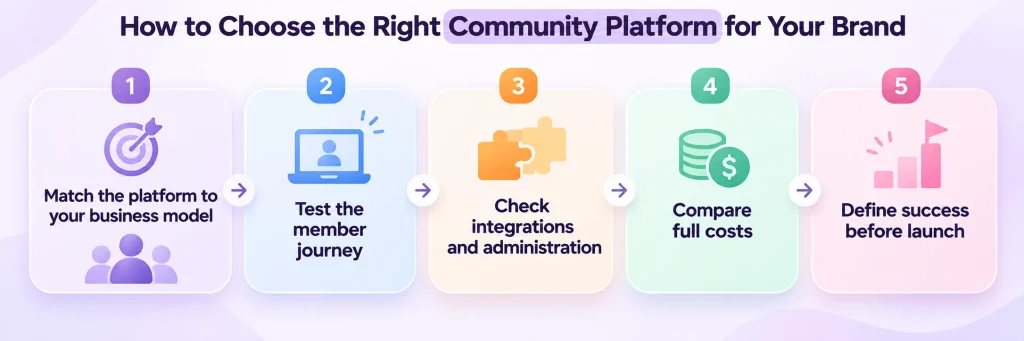
How to Choose the Right Community Platform for Your Brand
Use these steps to narrow the shortlist before requesting demonstrations.
1. Match the Platform to Your Business Model
Start with the activity that defines the community.
- Discussion-led community: Evaluate how well members can navigate spaces, find relevant conversations and participate.
- Course-led business: Examine course delivery, learning workflows, live sessions and member access.
- Customer community: Check product discussions, feedback collection, commerce connections and CRM workflows.
- Enterprise community: Prioritise permissions, data handling, integrations, reporting and administration.
- Branded customer or member experience: Compare custom domains, visual branding and dedicated app options.
These categories can overlap. Your shortlist should reflect the combination of requirements your business actually has.
2. Test the Member Journey
Ask each provider to demonstrate the same tasks using a realistic example.
Can a new member join, complete a profile, find a relevant group, participate in a discussion and register for an event without unnecessary steps? Can an administrator manage access and moderate content efficiently?
Testing the same journey across platforms makes the comparison more useful than a general product demonstration.
3. Check Integrations and Administration
List the CRM, e-commerce, HR, analytics and identity systems that must connect to the community. Ask whether the integration is native, API-based or dependent on a third-party service.
Confirm who will manage permissions, member records, moderation and reporting. A platform may offer the required features but still create too much operational work for your team.
4. Compare Full Costs
Calculate the annual cost of the configuration you need, including subscription fees, migration, integrations, support and branded app services.
Check whether your preferred plan accommodates expected growth. A low starting price may not remain the most economical option if you need several add-ons or a higher tier shortly after launch.
5. Define Success Before Launch
Choose measures that reflect your community’s purpose.
For example, a customer community could monitor repeat participation, useful feedback and unanswered questions. A learning community might track course participation and event attendance. An employee community could measure contributions to relevant discussions and internal initiatives.
Use these measures to assess whether the platform and community strategy are working together. Software can provide reporting, but the organisation still needs useful content, relevant activities and active management.
Conclusion
Circle, Mighty Networks and Thrico address overlapping but distinct community-building needs. Circle is worth considering for structured discussions, courses and events. Mighty Networks is relevant to learning-led and membership-based businesses. Thrico offers a broader combination of networking, gamification, events and commerce-related modules for brands that need these activities in one community environment.
Choose based on your audience, required workflows, integration needs and budget. Test the member experience, verify the contractual terms and compare the full cost of each suitable configuration before making a decision.
FAQs
Circle focuses on structured community spaces, discussions, courses and events. Mighty Networks combines community participation with courses, paid memberships and tools for recurring community businesses. The right choice depends on whether your community is primarily discussion-led, learning-led or membership-led.
There is no universal winner. Circle may suit structured discussion or learning communities. Mighty Networks may fit course and membership businesses. Thrico may be worth evaluating when networking, gamification, events and commerce-related features need to work together.
Do not assume that a branded community automatically gives an organisation unrestricted data rights. Review Circle’s contractual terms for data access, export, retention, deletion and processing. Confirm that its integrations support your requirements.
Thrico is worth evaluating when a B2B brand needs networking, discussions, events, gamification and business integrations. Circle may also suit B2B communities centred on structured conversations, learning or events. Compare both against your workflows, technical requirements and budget.
The best fit depends on the activities you want to encourage. Thrico lists points, badges, coins, leaderboards and rewards. Compare the available mechanics, configuration options and reporting in each provider’s current plan before deciding.
Migration depends on the data you need to transfer, the export capabilities of your current plan and the structure of your existing community. Confirm whether member records, discussions, media, groups and permissions can be transferred. Ask about migration support, costs and limitations before committing.
Thrico has monthly plans at ₹8,500, ₹19,000 and ₹48,000, plus a Custom tier. Circle and Mighty Networks use different subscription structures, and Mighty Pro is a separate offering. Compare the total cost of the features, integrations, member limits and branding your business needs rather than entry-level prices alone.